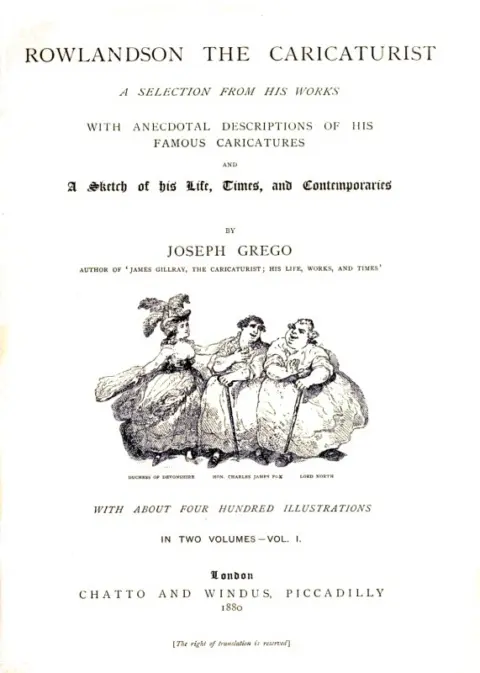
Rowlandson the Caricaturist; a Selection from His Works. Vol. 2
Joseph Grego
THE CLASSIC COLLECTION · 1886
"A History of Parliamentary Elections and Electioneering in the Old Days" by Joseph Grego is a historical account written in the late 19th century. This work explores the evolution of parliamentary elections and the various methods of electioneering in Britain from the time of the Stuarts to the reign of Queen Victoria. The text likely examines the intricate relationships between social classes, political parties, and the electoral process, centering on themes of corruption, representation, and civic engagement. The opening of the book delves into the origins of parliamentary assemblies and the complex rules governing elections, starting from early medieval practices to the formalization of the House of Commons. It highlights the role of key figures and evolving practices, touching upon concepts such as electoral qualifications, bribery, and the increasing power dynamics in electioneering. Grego establishes a historical context that underpins the development of Britain's parliamentary system, setting the stage for the ensuing chapters that promise to detail the vivid and often tumultuous political landscape of earlier centuries.
Introduction adapted from the source catalogue; source summaries may be automatically generated.
Free to read · English · 157,851 words · No account needed
MAKE TIME FOR A GOOD BOOK
On by default. Untick to stop anonymous reading totals. Each page counts after 10 seconds in view. How this works.
Anonymous counting is on unless you have switched it off.
Last comes the great man of the administration, driving his phaeton and six. He bids a mounted messenger to “ride forward, and tell my Lord Duke I would have been with him, but my horses took fright at a funeral, and won’t pull together;” the Duke of Newcastle is the person represented, and the circumstance to which he attributes the restiveness of his six-in-hand was the death, just before the dissolution of parliament, of his brother Henry Pelham, a man of superior abilities to the duke, who had filled the same offices with a better hold on his team.
“From London into Oxford Town,
See all the world is hurrying down,
Dashwood and Wenman for a crown.
Doodle, Doodle, Do.
“The Duke of Newcastle in his Fly
Cannot get up to his grace; for why?
The Funeral! Ah! men will die.
“Sir Edward in the chaise you see;
‘Get out, Sir Edward!’ ‘O, no!’ says he;
‘What,’ cries my Lord, ‘must I single be?’
“‘My jades begin to kick,’ says his Grace;
‘Sir, you had better leave the place,
And never look them in the face.’”
The elections in Oxfordshire were marked by a more animated conflict than elsewhere; the Jacobite faction was still strong there, although the comparatively recent fate of those who had declared for the Pretender served to keep these sympathies within discreet limits. The contest was strongly marked by incidents which have survived in the four famous election pictures painted by William Hogarth, the unequalled originals of which, still in fine condition, are now somewhat lost to the public in Sir John Soane’s Museum,[44] but of which the engravings are most familiar. Hogarth sold the series to his friend David Garrick for the modest price of 200 guineas; at the sale of Mrs. Garrick’s effects, in 1823, they were secured by Sir John Soane for the corresponding moderate sum of £1732 10s. The “Election Entertainment” was exhibited at Spring Gardens in 1761. These characteristic satires seem to apply to electioneering episodes in general, not only of the eighteenth century, but until within the present; a recapitulation of the principal allusions, however, will show that these pictures are composed of studies for the most part drawn from life, and founded on the actualities of the 1754 contest in Oxfordshire. The “Election Entertainment,” the first of these plates, is so well known that it was felt unnecessary to reproduce any of its incidents. This scene might he taken as a generalistic view of the electioneering hospitality and “open house,” one of the first steps towards conciliating support, but that the three “party-cries” distinctive of this particular struggle are all pictorially perpetuated. The scene embodies gluttony, turbulence, and false patriotism, but bribery and violent intimidation prevail above all. The mayor, who occupies the seat of honour, has succumbed to a surfeit of oysters, and a phlebotomist of the barber tribe is endeavouring to blood his arm and cool his head at one time. A ministerial-looking personage is treated with coarse familiarity, while a youthful aspirant for popular favour is submitting to tipsified indignities at the hands of his temporary associates. Nichols, who mentions certain assurances he received from Hogarth as to the fact that, with one exception, none of the figures were intended for portraits, affects to recognize the handsome candidate.[45] This modish gentleman has been treating the fair sex to gloves, buff or orange favours, and other gear, from the pack of a pedlar of the Hebrew persuasion, who is also dealing in notes of hand; he holds one for £20 from the candidate, signed “R. Pention” (Pension being the word). While the Court party is regaling the Buffs, or Old Interest, at the leading tavern, their opponents, the Blues, are making an out-of-door demonstration; so that a view of the humours of both sides is simultaneously afforded. The New Interest procession is composed of “bludgeon-men,” bearing an effigy of the Duke of Newcastle, with the colours of the Old Interest, and a placard round his neck, “No Jews,” in allusion to the unpopular Act introduced by the Pelhams (1752) to permit the naturalization of foreign Jews. Another cry, inscribed on a blue standard, is “Liberty and Prosperity,” while a huge blue flag bears the inscription, “Increase and multiply in spite of old ----,”[46] in reference to the recent Act for the regulation of marriages, which had encountered much opposition and given offence to the multitude. An animated exchange of missiles between the political antagonists is proceeding through the window; those within are standing a siege from showers of bricks, to which they are replying with a volley of fluids and furniture showered on the heads of the passing patriots; while a rival detachment of Old Interest hirelings, displaying their orange cockades, being armed with oak cudgels, and headed by a partisan with a drawn sword, is sallying forth to make a diversion on the besiegers. A champion Orange bludgeon-man, seated on the floor in the foreground, has evidently returned from a raid on the foe, in which he has had his head broken, but he has succeeded in carrying off one of the obnoxious blue standards. A butcher, with a “Pro Patria” favour twisted round his head, is pouring gin upon the bruiser’s cracked cranium, which he has first plastered with a “Your vote and interest” card; the doughty champion is reviving his spirits with the same stimulant; his foot is trampling upon the spoils of victory, the broken staff and the flag inscribed, “Give us our eleven days,”--another whimsical popular party cry, explained by the alteration in the style, introduced in the session 1751, to correct the calendar according to the Georgian computation, then adopted by most European nations. To equalize the number of days, so that the new year should in future begin on the 1st of January, eleven intermediate days were for that occasion passed over between the 2nd and 14th of September, 1752, so that the day succeeding the 2nd of that month would be reckoned as the 14th--an alteration which provoked discontent, and, in spite of its obvious convenience, was denounced as a Popish innovation.
Your reading position is saved on this browser. Take it to another device with a library code. Reading pages adapt to text, rather than matching a printed edition.
BEHIND THE BOOK
This eBook is for the use of anyone anywhere in the United States and most other parts of the world at no cost and with almost no restrictions whatsoever. You may copy it, give it away or re-use it under the terms of the Project Gutenberg License included with this eBook or online at www.gutenberg.org. If you are not located in the United States, you will have to check the laws of the country where you are located before using this eBook. Read the source licence.
The original source file, including credits and licence, is retained by this library. Request an original-format copy at no charge. Please include the book title and Project Gutenberg identifier #52156.
KEEP YOUR CURIOSITY GOING
Cécile Tormay

Moritz Busch
John L. Ransom
Frances Wright
Cécile Tormay

Mabel Potter Daggett