THE CLASSIC COLLECTION✦An outlaw’s diary: the CommuneCLASSIC FREE BOOKS
An outlaw’s diary: the Commune
Cécile Tormay
THE CLASSIC COLLECTION · 1894
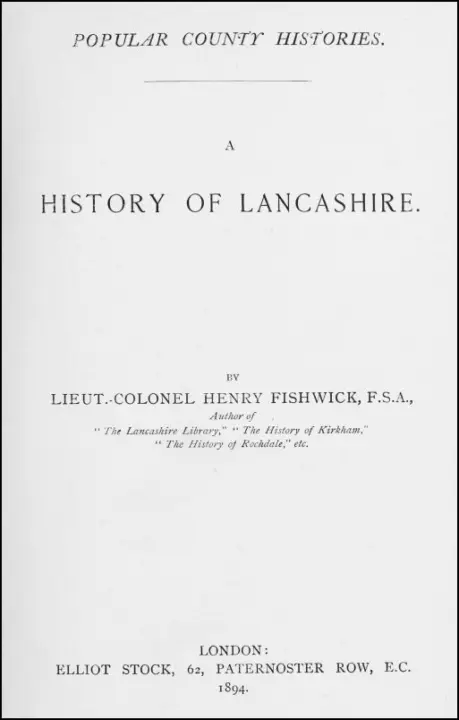
"A History of Lancashire" by Lieut.-Colonel Henry Fishwick is a historical account written in the late 19th century. This work explores the rich and diverse history of the English county of Lancashire, tracing its development from pre-Roman times through various significant historical periods, including the influence of the Romans, Saxons, and Normans. Fishwick aims to provide a comprehensive overview while selecting the most important events and figures that shaped the county. The opening of the book lays the groundwork for understanding Lancashire's geographical boundaries and significant divisions, such as its hundreds and parishes. Fishwick discusses the challenges he faced in condensing a vast amount of research material into a single volume, emphasizing the importance of authenticity and reliability in the historical facts presented. The introduction not only outlines the physical layout of the county but also sets the stage for a deeper exploration of its history, promising to delve into various eras and notable events that have defined Lancashire's identity over the centuries.
Introduction adapted from the source catalogue; source summaries may be automatically generated.
Free to read · English · 93,916 words · No account needed
MAKE TIME FOR A GOOD BOOK
On by default. Untick to stop anonymous reading totals. Each page counts after 10 seconds in view. How this works.
Anonymous counting is on unless you have switched it off.
During the Tudor time were built such houses as Speke Hall, near Liverpool; Ordsall Hall, near Manchester; Little Mitton, the home of the Sherburns; Ince Hall, Cleworth Hall, Smithell's Hall, Lostock Hall, Lydiate Hall, Rufford Hall, Belfield Hall, Rawcliffe, Rossal Grange, and a host of others far too numerous to mention. Many of these date back to very early days, and were originally built with a view to make every man's house his castle; but with the end of the sixteenth century other views began to obtain, and an Englishman, for the first time probably in the country's history, commenced to feel that his house was really his castle, and that it was defended for him by the strong arm of the law.
The houses of the middle and lower classes were nearly always built of wood and clay ("daub"); the richer people had houses which were usually divided on the ground-floor into a common hall, a small withdrawing room or parlour, and a kitchen, the upper stories being reached by wide staircases, often with ornately carved oak banisters. The higher class of houses or halls consisted of many chambers, and not infrequently there was a private chapel, and the rooms were wainscoted. Many views have been preserved of the exterior of most of our old halls (which were highly picturesque), but of the interior and general domestic arrangements we are left to glean such items as have been handed down to us through the medium of inventories and kindred records. These inventories, taken after the proving of wills, are often (where they exist at all) meagre and incomplete, yet they furnish particulars which we should look elsewhere for in vain. The inventory of the goods of Sir Thomas Butler, of Bewsey (near Prescot), knight, taken in 1579, will give some details of the contents of one of Lancashire's old houses. The following are selected items:
PLATE AND JEWELLERY.--Basin and ewer, silver engraved bowls, silver salts with covers, silver spoons, a crystal cross.
LINEN, ETC.--Table-cloths, damask work, towels, napkins, flax sheets, bed-hangings, quilted and woollen blankets, mattresses, curtains of taffeta, curtains of darynx (a kind of damask made at Tournay), green silk coverlet, etc.
FURNITURE, ETC.--Tables, chairs, stools, truckle beds, pair of playing tables, brass candlesticks, pewter in considerable quantities, and the usual kitchen and brewing apparatus.
APPAREL.--Velvet hose, satin doublets, taffeta doublets, velvet breeches, riding-cloak lined with unshorn velvet, Spanish leather jerkins, a long gown of silk grogram (a silk material), velvet cloaks, black jersey stockings, a taffeta hat, a black felt hat.
Your reading position is saved on this browser. Take it to another device with a library code. Reading pages adapt to text, rather than matching a printed edition.
BEHIND THE BOOK
This eBook is for the use of anyone anywhere in the United States and most other parts of the world at no cost and with almost no restrictions whatsoever. You may copy it, give it away or re-use it under the terms of the Project Gutenberg License included with this eBook or online at www.gutenberg.org. If you are not located in the United States, you will have to check the laws of the country where you are located before using this eBook. Read the source licence.
The original source file, including credits and licence, is retained by this library. Request an original-format copy at no charge. Please include the book title and Project Gutenberg identifier #49369.
KEEP YOUR CURIOSITY GOING
Cécile Tormay

Moritz Busch
John L. Ransom
Frances Wright
Cécile Tormay

Mabel Potter Daggett