THE CLASSIC COLLECTION✦An outlaw’s diary: the CommuneCLASSIC FREE BOOKS
An outlaw’s diary: the Commune
Cécile Tormay
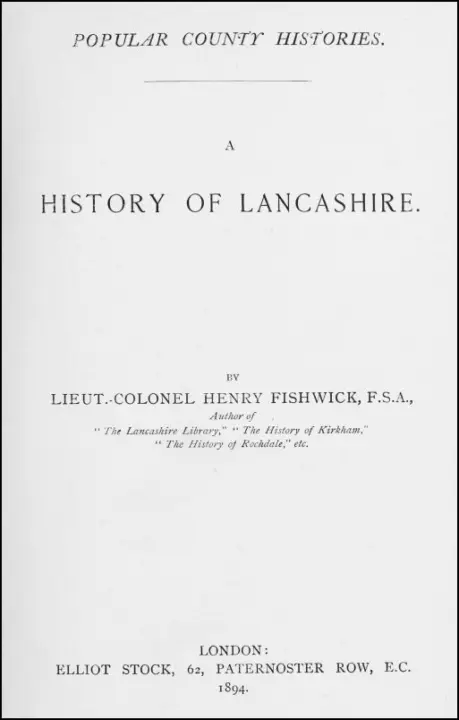
THE CLASSIC COLLECTION · 1894
"A History of Lancashire" by Lieut.-Colonel Henry Fishwick is a historical account written in the late 19th century. This work explores the rich and diverse history of the English county of Lancashire, tracing its development from pre-Roman times through various significant historical periods, including the influence of the Romans, Saxons, and Normans. Fishwick aims to provide a comprehensive overview while selecting the most important events and figures that shaped the county. The opening of the book lays the groundwork for understanding Lancashire's geographical boundaries and significant divisions, such as its hundreds and parishes. Fishwick discusses the challenges he faced in condensing a vast amount of research material into a single volume, emphasizing the importance of authenticity and reliability in the historical facts presented. The introduction not only outlines the physical layout of the county but also sets the stage for a deeper exploration of its history, promising to delve into various eras and notable events that have defined Lancashire's identity over the centuries.
Introduction adapted from the source catalogue; source summaries may be automatically generated.
Free to read · English · 93,916 words · No account needed
MAKE TIME FOR A GOOD BOOK
On by default. Untick to stop anonymous reading totals. Each page counts after 10 seconds in view. How this works.
Anonymous counting is on unless you have switched it off.
[Footnote 60: The hora was not a coin, but an equivalent for about 1s.
6d. or 1s. 8d.]
[Footnote 61: In South Lancashire it is believed that six carucates made a hide. A carucate was about 100 acres, but was a variable term.]
[Footnote 62: This will serve as a proof that foresta (= a wood or forest) was not necessarily a dense mass of trees, but rather a place where game of every kind abounded.]
[Footnote 63: Their individual holdings are 3 hides and half a carucate, 2 carucates, 1½ carucates, 1 carucate and 2 carucates = 3 hides and 7 carucates. Their united holding is put down as 22 carucates, so that a hide in this case equals 5 carucates.]
[Footnote 64: Bentham (in Yorkshire), Wennington, Tatham, and Tunstall are described as four manors, where there were three churches.]
[Footnote 65: Now Titeup.]
[Footnote 66: Authorities differ on the exact area, but probably the above is not far from the figure.]
[Footnote 67: Fishwick's "History of St. Michael's-on-Wyre," Chetham Soc., xxv. 3 (new series).]
[Footnote 68: Honour of Lancaster granted to him June 30, 1267, and letters patent issued to the tenants of the honour to do their homage and be obedient to him as their lord, February 16, 1268. In 1269 a similar letter was sent to William le Boteler, and in 1270 to Henry de Lacy, Robert de Stockfort, and the Abbot of Furness.]
[Footnote 69: Charters of duchy. See 31st Report of the Deputy-Keeper of the Public Records, p. 6.]
[Footnote 70: Toll for swine feeding in the woods.]
[Footnote 71: A fair in 1255.]
[Footnote 72: Carta de Foresta: Record Office.]
[Footnote 73: Rossendale Forest adjoins this parish.]
[Footnote 74: Plac. de Quo War., Edw. I.: Record Office.]
[Footnote 75: Duchy Chancery Rolls, chap. xxv., A 2ᵇ.]
[Footnote 76: The honour of Lancaster.]
[Footnote 77: See Fishwick's "History of Kirkham," Chetham Soc.,
xcii.]
[Footnote 78: Royal Letters, Henry III., No. 185.]
[Footnote 79: "Letters from Northern Register," p. 97.]
[Footnote 80: See "Popular History of Cumberland," p. 231.]
[Footnote 81: The original rolls are in the Record Office. They have been printed by the Chetham Society, vol. cxii.]
[Footnote 82: All the extracts refer to the Lancashire part of the honour, and to the years between 1295 and 1305.]
[Footnote 83: Authorities differ on this point, but all agree that money in the thirteenth century was worth many times its present equivalent coin. At the very least, it requires to be multiplied by ten.]
[Footnote 84: Agisted = allowed to graze in the forest.]
[Footnote 85: In 1338 the Abbot of Whalley charged certain persons armed "with swords and bows and arrows" with having taken away his goods, and, inter alia, 300 pieces of iron, and from the evidence adduced it appears that near Whitworth (in Rochdale parish), which is adjoining Rossendale, the Abbot and others were accustomed to dig up the ironstone and smelt it. (See Fishwick's "History of Rochdale," p. 84.)]
Your reading position is saved on this browser. Take it to another device with a library code. Reading pages adapt to text, rather than matching a printed edition.
BEHIND THE BOOK
This eBook is for the use of anyone anywhere in the United States and most other parts of the world at no cost and with almost no restrictions whatsoever. You may copy it, give it away or re-use it under the terms of the Project Gutenberg License included with this eBook or online at www.gutenberg.org. If you are not located in the United States, you will have to check the laws of the country where you are located before using this eBook. Read the source licence.
The original source file, including credits and licence, is retained by this library. Request an original-format copy at no charge. Please include the book title and Project Gutenberg identifier #49369.
KEEP YOUR CURIOSITY GOING
Cécile Tormay

Moritz Busch
John L. Ransom
Frances Wright
Cécile Tormay

Mabel Potter Daggett