THE CLASSIC COLLECTION✦An outlaw’s diary: the CommuneCLASSIC FREE BOOKS
An outlaw’s diary: the Commune
Cécile Tormay
THE CLASSIC COLLECTION · 1894
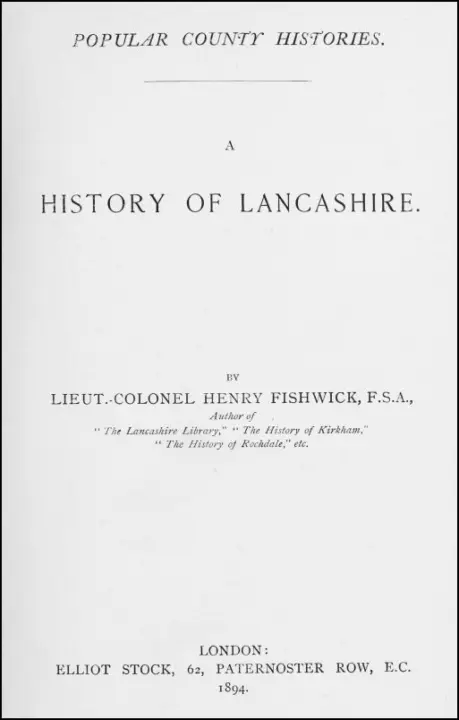
"A History of Lancashire" by Lieut.-Colonel Henry Fishwick is a historical account written in the late 19th century. This work explores the rich and diverse history of the English county of Lancashire, tracing its development from pre-Roman times through various significant historical periods, including the influence of the Romans, Saxons, and Normans. Fishwick aims to provide a comprehensive overview while selecting the most important events and figures that shaped the county. The opening of the book lays the groundwork for understanding Lancashire's geographical boundaries and significant divisions, such as its hundreds and parishes. Fishwick discusses the challenges he faced in condensing a vast amount of research material into a single volume, emphasizing the importance of authenticity and reliability in the historical facts presented. The introduction not only outlines the physical layout of the county but also sets the stage for a deeper exploration of its history, promising to delve into various eras and notable events that have defined Lancashire's identity over the centuries.
Introduction adapted from the source catalogue; source summaries may be automatically generated.
Free to read · English · 93,916 words · No account needed
MAKE TIME FOR A GOOD BOOK
On by default. Untick to stop anonymous reading totals. Each page counts after 10 seconds in view. How this works.
Anonymous counting is on unless you have switched it off.
In Salford Hundred the manor of Salford belonged to Edward, and in his time it consisted of three hides and twelve carucates of waste land, a forest over 4 miles long and the same breadth; the Confessor also owned at Radcliffe a manor containing one hide of land. To Salford Hundred belonged twenty-one berewicks, which were held as manors by as many Thanes, whose land was put down as eleven and a half hides and ten and a half carucates; the woods were said to be over 12 miles in length. The only thane named is Gamel, who held Rochdale (see p. 47). Two churches are mentioned, St. Mary's and St. Michael's, both as holding land in Mamecestre, this being the only mention of this great city of the North. The whole of the hundred paid £37 4s.
Certain land of this hundred had been given by Roger de Poictou to the following knights: Nigel, Warin, another Warin, Goisfrid and Gamel.[63] Living on these lands were three thanes, thirty villeins, nine bordarii, one priest, and ten serfs.
In the six hundreds of Derby, Newton, Warrington, Blackburn, Salford, and Leyland there were 180 manors, in which were 79 hides rateable to the danegeld. In King Edward's time the whole was worth £145 2s. 2d. At the taking of the Survey it was held by William the Conqueror, and he appears to have granted certain lands in fee to nine knights.
Amounderness had also been part of the estate of Roger de Poictou, and had been held by Earl Tosti, who at Preston had six carucates of land rateable to the geld, along with which he had the following vills in the hundred: Ashton, Lea, Salwick, Clifton, Newton-with-Seales, Freckleton, Ribby-with-Wray, Kirkham, Treales, Westby, Little Plumpton, Weeton, Preise, Warton, Lytham, Marton (in Poulton), Layton-with-Warbrick, Staining, Carleton, Bispham, Rossall, Brining, Thornton, Poulton in the Fylde, Singleton, Greenhalgh, Eccleston, Eccleston (Great and Little), Elswick, Inskip, Sowerby, Nateby, St. Michael's-le-Wyre (Michelscherche), Catterall, Claughton, Newsham, Great Plumpton, Broughton, Whittingham, Barton (in Preston), Goosnargh, Haighton, Wheatley, Chipping, Alston, Fishwick, Grimsargh, Ribchester, Billsborough, Swainsett, Forton, Chrimbles, Garstang, Rawcliffe (Upper, Middle, and Out), Hambleton, Stalmine, Preesall, Mythorp or Mythop.
There were, then, in this hundred sixty-two vills or manors, in sixteen of which the Survey reports there were "but few inhabitants, but how many there are is unknown," and the rest were waste. There were three churches then in existence; the names of these are not given, but they undoubtedly were Preston, St. Michael's, and Kirkham. Other churches there probably had been, but they had shared in the general ruin (see Chapter V.).
Your reading position is saved on this browser. Take it to another device with a library code. Reading pages adapt to text, rather than matching a printed edition.
BEHIND THE BOOK
This eBook is for the use of anyone anywhere in the United States and most other parts of the world at no cost and with almost no restrictions whatsoever. You may copy it, give it away or re-use it under the terms of the Project Gutenberg License included with this eBook or online at www.gutenberg.org. If you are not located in the United States, you will have to check the laws of the country where you are located before using this eBook. Read the source licence.
The original source file, including credits and licence, is retained by this library. Request an original-format copy at no charge. Please include the book title and Project Gutenberg identifier #49369.
KEEP YOUR CURIOSITY GOING
Cécile Tormay

Moritz Busch
John L. Ransom
Frances Wright
Cécile Tormay

Mabel Potter Daggett