THE CLASSIC COLLECTION✦An outlaw’s diary: the CommuneCLASSIC FREE BOOKS
An outlaw’s diary: the Commune
Cécile Tormay
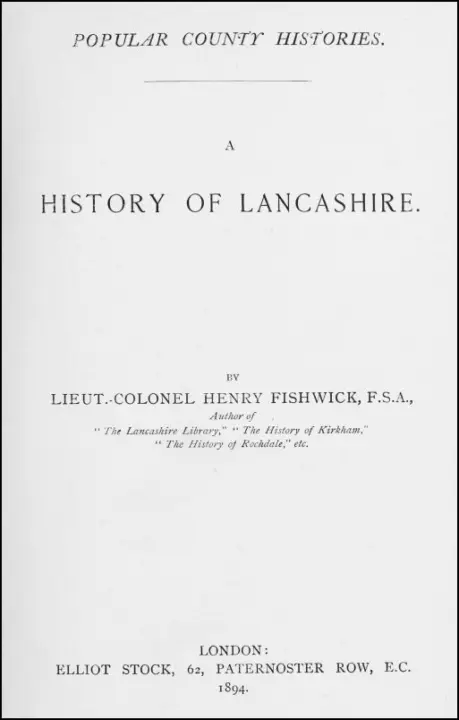
THE CLASSIC COLLECTION · 1894
"A History of Lancashire" by Lieut.-Colonel Henry Fishwick is a historical account written in the late 19th century. This work explores the rich and diverse history of the English county of Lancashire, tracing its development from pre-Roman times through various significant historical periods, including the influence of the Romans, Saxons, and Normans. Fishwick aims to provide a comprehensive overview while selecting the most important events and figures that shaped the county. The opening of the book lays the groundwork for understanding Lancashire's geographical boundaries and significant divisions, such as its hundreds and parishes. Fishwick discusses the challenges he faced in condensing a vast amount of research material into a single volume, emphasizing the importance of authenticity and reliability in the historical facts presented. The introduction not only outlines the physical layout of the county but also sets the stage for a deeper exploration of its history, promising to delve into various eras and notable events that have defined Lancashire's identity over the centuries.
Introduction adapted from the source catalogue; source summaries may be automatically generated.
Free to read · English · 93,916 words · No account needed
MAKE TIME FOR A GOOD BOOK
On by default. Untick to stop anonymous reading totals. Each page counts after 10 seconds in view. How this works.
Anonymous counting is on unless you have switched it off.
It was not so easy, however, to make a convert of her husband, but after some delay he called together his Council, who declared themselves in favour of the new religion, and many of them were baptized at York, A.D. 627. This conversion led to a war between Edwin and the King of Mercia, who still held to his faith in Woden and Thor, when the King of Northumbria was killed at the battle of Hatfield in 633.
Shortly after this, Cædwallon, King of the Welsh, became ruler over Northumbria, but only for a short time, as he was defeated and slain in battle by Oswald, who, afterwards succeeding to the thrones of Bernicia and Deira, again united Northumbria, and re-established the Christian creed. But Penda was determined to maintain the pagan religion, and, defeating Oswald at the battle of Maserfeld in 642, again held Northumbria. Subsequently another division appears to have taken place, and Lancashire became part of the kingdom of Deira, its ruler being Oswine, and continued so for some six years, when Oswi, who reigned in Bernicia (the other portion of Northumbria), caused Oswine to be slain, and again united the two kingdoms. Alcfrid, the son of Oswi, having married Cyneburga, daughter of Penda, was about this time appointed Regent over Deira, and afterwards a further fusion of the two families was brought about by the marriage of Alcfrid's sister to Peada, son of Penda.
Oswi in 655 had a pitched battle with Penda at Winwæd in Yorkshire,[39] where the latter was defeated and slain. To celebrate this victory Oswi established twelve religious houses, six of which were in Deira (see Chapter IX.). Oswi died in 670, and his son Egfrid (or Ecgfrith) succeeded to the throne of Northumbria, which was now become a Christian and powerful kingdom. His short reign was marked by several military victories, the chief being his defeat of the King of Mercia, by which he gained the province of Lindiswards, or Lincolnshire; but in A.D. 685 Egfrid went across the Forth to repress a rising of the Picts, and in a great battle at Nectansmere in Yorkshire he and many of his nobles were slain, and with them fell the supremacy of ancient Northumbria. From this date to the establishment of the Heptarchy, Northumbria, though allowed to elect tributary rulers, was, except for a very short period, under the overlords of first Mercia and then Wessex. Green, in his "History of the English People,"[40] says that Northumbria was "the literary centre of the Christian world in Western Europe. The whole learning of the age seemed to be summed up in a Northumbrian scholar, Bæda--the Venerable Bede, later times styled him." The same writer adds: "From the death of Bæda the history of Northumbria is in fact only a wild story of lawlessness and bloodshed. King after king [tributary kings] was swept away by treason and revolt, the country fell into the hands of its turbulent nobles, the very fields lay waste, and the land was swept by famine and plague." In A.D. 827 Egbert found no difficulty, after subduing the rest of England, in coming to peaceful terms with the Northumbrian nobles, and reducing the whole country from the British Channel to the Forth into one kingdom. For some time before the close of the eighth century Northumbria had been subject to frequent attacks from the Northmen, or Danes, who mostly came from Denmark and Norway, who have been frequently described as sea-pirates, distinguished for courage and ferocity and a strong hatred to the Christian religion, they themselves being worshippers of Woden and the other pagan gods. Soon after the middle of the tenth century the Danes were no longer content to make marauding expeditions, but aspired to become owners of the soil, and in 867, after a great victory near the city of York, they practically took possession of Northumbria, and a few years later the whole of England north of the Thames was in their hands. The subsequent wars between Alfred the Great and the Danes belong more to the general history of England; it will suffice here to state that in 878 was concluded the treaty of peace known as "Alfred and Guthrum's Peace," whereby the Danish settlers were recognised and the land on the east and north of Watling Street given up to them, that is, nearly all the east side of England from the Thames to the Tweed, where they were to be independent dwellers, with their own laws and institutions.[41] Thus, almost the whole of Lancashire was left to the Danish invaders; but not, however, for a long period, as Edward the Elder, the son and successor of Alfred, having wrested Mercia from the Danes, marched against Northumbria, where a contest was avoided by the submission of the inhabitants, and, according to the Saxon Chronicle,[42] having taken possession of Manchester, which he found almost in ruins, he refortified and garrisoned it in the year 923. Athelstan, the son of Edward the Elder, had frequent disturbances from the Northern Danes, who in 937, having united the Scots and the Welsh, met the King's forces at Bruanburgh (supposed to be in Northumberland), where they were defeated; only, however, for a time, as they were not finally suppressed until the year 954, when Northumbria was placed under a governor with the title of Earl.
Your reading position is saved on this browser. Take it to another device with a library code. Reading pages adapt to text, rather than matching a printed edition.
BEHIND THE BOOK
This eBook is for the use of anyone anywhere in the United States and most other parts of the world at no cost and with almost no restrictions whatsoever. You may copy it, give it away or re-use it under the terms of the Project Gutenberg License included with this eBook or online at www.gutenberg.org. If you are not located in the United States, you will have to check the laws of the country where you are located before using this eBook. Read the source licence.
The original source file, including credits and licence, is retained by this library. Request an original-format copy at no charge. Please include the book title and Project Gutenberg identifier #49369.
KEEP YOUR CURIOSITY GOING
Cécile Tormay

Moritz Busch
John L. Ransom
Frances Wright
Cécile Tormay

Mabel Potter Daggett