THE CLASSIC COLLECTION✦An outlaw’s diary: the CommuneCLASSIC FREE BOOKS
An outlaw’s diary: the Commune
Cécile Tormay
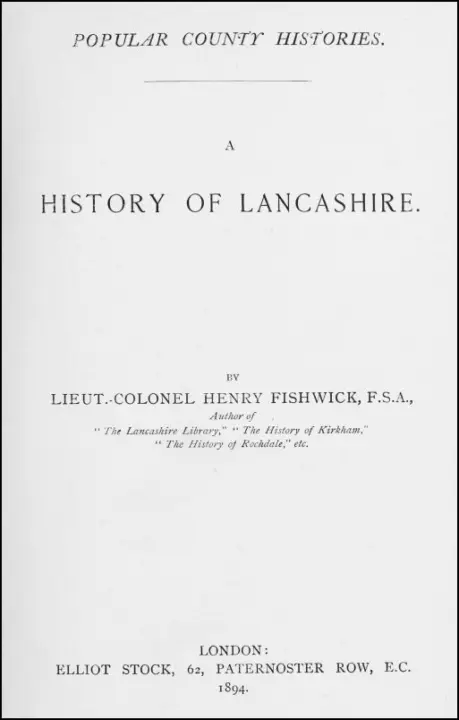
THE CLASSIC COLLECTION · 1894
"A History of Lancashire" by Lieut.-Colonel Henry Fishwick is a historical account written in the late 19th century. This work explores the rich and diverse history of the English county of Lancashire, tracing its development from pre-Roman times through various significant historical periods, including the influence of the Romans, Saxons, and Normans. Fishwick aims to provide a comprehensive overview while selecting the most important events and figures that shaped the county. The opening of the book lays the groundwork for understanding Lancashire's geographical boundaries and significant divisions, such as its hundreds and parishes. Fishwick discusses the challenges he faced in condensing a vast amount of research material into a single volume, emphasizing the importance of authenticity and reliability in the historical facts presented. The introduction not only outlines the physical layout of the county but also sets the stage for a deeper exploration of its history, promising to delve into various eras and notable events that have defined Lancashire's identity over the centuries.
Introduction adapted from the source catalogue; source summaries may be automatically generated.
Free to read · English · 93,916 words · No account needed
MAKE TIME FOR A GOOD BOOK
On by default. Untick to stop anonymous reading totals. Each page counts after 10 seconds in view. How this works.
Anonymous counting is on unless you have switched it off.
Roman coins and tiles have been found near Littleborough and at Underwood, near Rochdale; and at Tunshill in Butterworth, in the same parish, in 1793, was discovered the right arm of a silver statue of Victory, to which was attached an amulet with an inscription to the Sixth Legion.[38]
From this rapid survey of the Roman roads, stations, and settlements, with the evidence of the vestiges which time has preserved for our inspection, it must at once be seen that through the length and breadth of Lancashire (except, perhaps, Lonsdale north of the Sands) the all-conquering Roman was found, and that for nearly four centuries he held possession. That he did much to educate and civilize the conquered tribes cannot be doubted, and the Lancashire people at the close of the Roman occupation must have been a very different race to those half-naked barbarians who fought so desperately to defend their soil against the invading legions. Although the ancient Briton was not quite an untutored savage, still, the influence of the higher cultured Romans had a very material effect upon his character and surroundings, and led to the acquirement of many arts and industries, which produced corresponding results of prosperity and comfort. The culture of the land was improved, the people were shown how to make roads and build houses of stone, mines were opened, iron was smelted, and ships were built.
[Footnote 14: "Roman Lancashire," W. Thompson Watkin; Liverpool, 1883.]
[Footnote 15: There are also traces of two other supposed Roman roads.]
[Footnote 16: Lanc. and Ches. Ant. Soc., iii. 262.]
[Footnote 17: Whitaker's "History of Manchester," 1771.]
[Footnote 18: Lanc. and Ches. Ant. Soc., viii. 156.]
[Footnote 19: Whitaker as an authority is good where he is describing things which he saw himself, but otherwise many of his theories border upon romance. (Vol. i., p. 49, 1773 edition.)]
[Footnote 20: The late Mr. Thompson Watkin maintains that the N at end of the first line should be AV.]
[Footnote 21: "Palatine Note-Book," iii. 67.]
[Footnote 22: For full details of these see Watkin's "Roman
Lancashire."]
[Footnote 23: Archæological Journal, xxviii., p. 114, and xxx., p.
153.]
[Footnote 24: Watkin's "Roman Lancashire," p. 55.]
[Footnote 25: Through the influence of the Rev. J. Shortt, Vicar of Hoghton, whose description of the find is here followed.]
[Footnote 26: Watkin's "Roman Lancashire," p. 133.]
[Footnote 27: Mr. Townley. See "Vetusta Monumenta," iv. 5.]
[Footnote 28: Abram's "History of Blackburn," p. 159.]
[Footnote 29: Lanc. and Ches. Hist. Soc., xxv. 161.]
[Footnote 30: Whitaker's "History of Whalley," ii. 19.]
[Footnote 31: Baines' "History of Lancashire" (second edition), ii. 24.]
[Footnote 32: Lanc. and Ches. Hist. Soc., iii. 3.]
[Footnote 33: Hist. Soc. of Lanc. and Ches., iii. 60; also Fishwick's "History of Kirkham," Chetham Soc., xcii. 5.]
[Footnote 34: Fishwick's "History of Poulton-le-Fylde," Chetham Soc., new series, viii. 4; also civ. 2.]
[Footnote 35: Watkin's "Roman Lancashire," p. 203.]
[Footnote 36: "The Palatine Note-book," iv. 201.]
Your reading position is saved on this browser. Take it to another device with a library code. Reading pages adapt to text, rather than matching a printed edition.
BEHIND THE BOOK
This eBook is for the use of anyone anywhere in the United States and most other parts of the world at no cost and with almost no restrictions whatsoever. You may copy it, give it away or re-use it under the terms of the Project Gutenberg License included with this eBook or online at www.gutenberg.org. If you are not located in the United States, you will have to check the laws of the country where you are located before using this eBook. Read the source licence.
The original source file, including credits and licence, is retained by this library. Request an original-format copy at no charge. Please include the book title and Project Gutenberg identifier #49369.
KEEP YOUR CURIOSITY GOING
Cécile Tormay

Moritz Busch
John L. Ransom
Frances Wright
Cécile Tormay

Mabel Potter Daggett