THE CLASSIC COLLECTION✦An outlaw’s diary: the CommuneCLASSIC FREE BOOKS
An outlaw’s diary: the Commune
Cécile Tormay
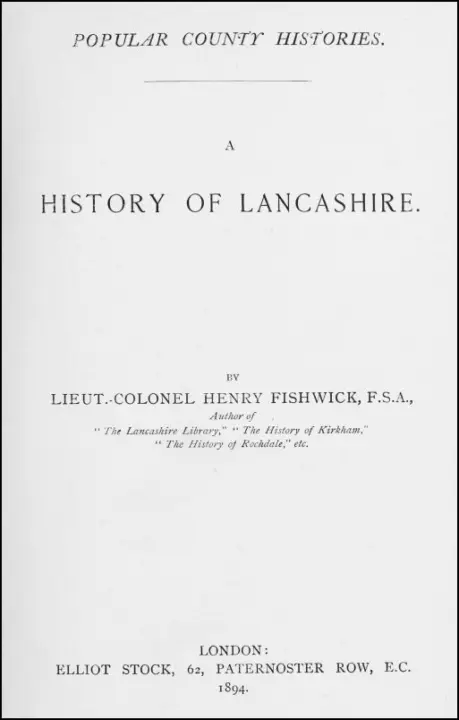
THE CLASSIC COLLECTION · 1894
"A History of Lancashire" by Lieut.-Colonel Henry Fishwick is a historical account written in the late 19th century. This work explores the rich and diverse history of the English county of Lancashire, tracing its development from pre-Roman times through various significant historical periods, including the influence of the Romans, Saxons, and Normans. Fishwick aims to provide a comprehensive overview while selecting the most important events and figures that shaped the county. The opening of the book lays the groundwork for understanding Lancashire's geographical boundaries and significant divisions, such as its hundreds and parishes. Fishwick discusses the challenges he faced in condensing a vast amount of research material into a single volume, emphasizing the importance of authenticity and reliability in the historical facts presented. The introduction not only outlines the physical layout of the county but also sets the stage for a deeper exploration of its history, promising to delve into various eras and notable events that have defined Lancashire's identity over the centuries.
Introduction adapted from the source catalogue; source summaries may be automatically generated.
Free to read · English · 93,916 words · No account needed
MAKE TIME FOR A GOOD BOOK
On by default. Untick to stop anonymous reading totals. Each page counts after 10 seconds in view. How this works.
Anonymous counting is on unless you have switched it off.
The peculiar rites appertaining to All Hallows' Eve (October 31) are well known; but in the Fylde district it was celebrated by the lighting of bonfires, and it was locally known as Teanlay, or Teanley, night. Pace-egging in the same district is called "ignagning."
In Rochdale, Good Friday, some fifty years ago, was called "Cracknel Friday," as on this day people regaled themselves with small thin cakes called cracknels. St. Gregory's Day (March 12) in the northern parts of the county is characterized as the day on which onion seed must be sown, or no crop will be yielded. Lancashire is rich in this kind of folk-lore.
Bury simnels are now known all over the country; they are a kind of cake, which derives its name from having originally been made from the finest part of flour, which in mediæval times was called "siminellus." They are used on Mid-Lent or Mothering Sunday. This day in other parts of Lancashire is called Bragot or Bragget Sunday, and on it a peculiar drink known as bragot was used; it consisted of spiced ale, which was always taken hot.
Did space permit, this chapter might well be extended, as the county is rich in old tales, ancient superstitions, "wise saws and modern instances," charms, divinations and omens, many of which, however, are not of local historical interest, as they are more or less common to other parts of the country.
[Footnote 235: See Roby's "Traditions of Lancashire"; Harland and Wilkinson, "Legends and Traditions of Lancashire," etc.]
[Footnote 236: A somewhat similar tradition obtains of Wardley Hall, where the skull of Roger Downes, who was slain in London in 1676, was preserved for centuries.]
[Footnote 237: A curious instance of the alteration in the meaning of words. Of course, by "indifferently" is meant alike to all.]
[Footnote 238: See "History of St. Michael's-on-Wyre," p. 64.]
Abbadie, Dr., 166
Abbey of Cockersand, 198, 199
„ of Whalley, 3, 201-205
Accrington, 3, 274
„ Forest, 63
„ Hall, 72
Adams, Roger, 27
Aerie of Hawks, 47, 54, 55
Æthelbert, 42, 177
Æthelburga, 42
"Agreement of the People, The," 231, 232
Agricola, 15, 22, 27
Aiden (Bishop), 181
Aiken, Dr., 259
Ainsley, 53
Ainsworth, Harrison, 119
Alcar, 53, 229
Aldcliff, 58
Aldingham, 58, 230
„ Moat Hill, 48
Alehouses, 95
Alfred and Guthrum's Peace, 44
Allectus, 17
Allen, Cardinal, 221
Allerton, 53
All Hallows' Eve, 291
Alston, 57
Altham Chapel, 202, 235
Ambrose, Rev. Isaac, 165, 234
Amounderness Hundred, 2, 52, 57, 60, 199, 249
Ancoats, 21
Anderton, Sir Francis, 165, 245
„ Colonel James, 165
Angier, John, 165, 234
„ Rev. Samuel, 121
Angles, The, 41, 42, 51
Anglo-Saxon "burh," 49
Antoninus Pius, 36
Appleby Slack, 10
Archers at Flodden, 90, 91
Archery butts, 94, 95
Arkholme, 58
Arkwright, Richard, 265-268
Arrow-heads, Flint, 7
Arrowsmith, Edmund, 225
Arval cake, 290
Asheton, Edmund, 165
Ashton, 57, 58, 153
„ Colonel, 138, 140, 143, 145, 146
„ Hall, 121
„ in Makerfield, 36
„ Ralph, Sir, 91, 92, 125, 128, 205
„ Rauf, 289
„ Robyn, 289
Ashton-under-Lyne, 163, 173, 229, 260, 283, 289
„ „ „ Church, 209
Ashurst, Captain, 138
Ashworth Chapel, 213
Asiaticus, Marcus, 31
Assarts, or "Rods," 51
Athelston, son of Edward, 45
Atherton, Sir John, 220
Aughton, 53, 54, 229
Augustine, St., 177
Authors, Seventeenth Century, 165
Ayres, Mr., 247
Bacup, 274
Bamber Green, 36
Bamford, Samuel, 262
Banastre, Christopher, 165
Banister, Christopher, 150
„ Sir Evan, 222
Bannockburn, Battle of, 68
Baptist Chapels, 240
Bardsey, 58
Bare, 58
Your reading position is saved on this browser. Take it to another device with a library code. Reading pages adapt to text, rather than matching a printed edition.
BEHIND THE BOOK
This eBook is for the use of anyone anywhere in the United States and most other parts of the world at no cost and with almost no restrictions whatsoever. You may copy it, give it away or re-use it under the terms of the Project Gutenberg License included with this eBook or online at www.gutenberg.org. If you are not located in the United States, you will have to check the laws of the country where you are located before using this eBook. Read the source licence.
The original source file, including credits and licence, is retained by this library. Request an original-format copy at no charge. Please include the book title and Project Gutenberg identifier #49369.
KEEP YOUR CURIOSITY GOING
Cécile Tormay

Moritz Busch
John L. Ransom
Frances Wright
Cécile Tormay

Mabel Potter Daggett