THE CLASSIC COLLECTION✦An outlaw’s diary: the CommuneCLASSIC FREE BOOKS
An outlaw’s diary: the Commune
Cécile Tormay
THE CLASSIC COLLECTION · 1894
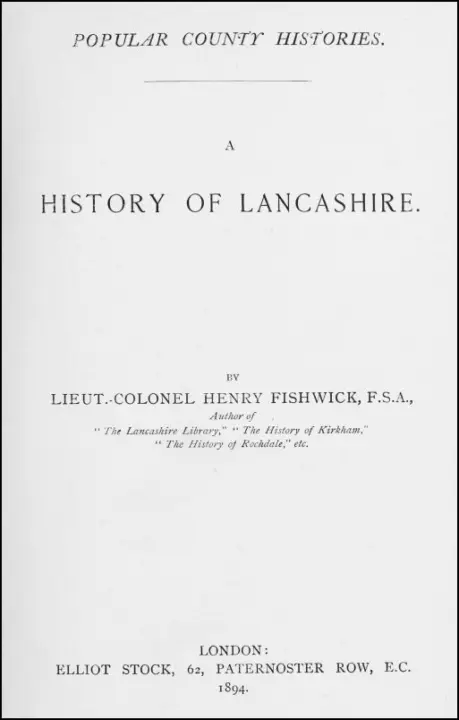
"A History of Lancashire" by Lieut.-Colonel Henry Fishwick is a historical account written in the late 19th century. This work explores the rich and diverse history of the English county of Lancashire, tracing its development from pre-Roman times through various significant historical periods, including the influence of the Romans, Saxons, and Normans. Fishwick aims to provide a comprehensive overview while selecting the most important events and figures that shaped the county. The opening of the book lays the groundwork for understanding Lancashire's geographical boundaries and significant divisions, such as its hundreds and parishes. Fishwick discusses the challenges he faced in condensing a vast amount of research material into a single volume, emphasizing the importance of authenticity and reliability in the historical facts presented. The introduction not only outlines the physical layout of the county but also sets the stage for a deeper exploration of its history, promising to delve into various eras and notable events that have defined Lancashire's identity over the centuries.
Introduction adapted from the source catalogue; source summaries may be automatically generated.
Free to read · English · 93,916 words · No account needed
MAKE TIME FOR A GOOD BOOK
On by default. Untick to stop anonymous reading totals. Each page counts after 10 seconds in view. How this works.
Anonymous counting is on unless you have switched it off.
Liverpool, very early in the century, began to exhibit that spirit of enterprise which soon placed that city in the foremost rank in the maritime world. It was only in 1815 that the first steamer appeared on the Mersey, yet in 1835 there had been constructed docks which extended for two miles along the shore, with a water area of 90 acres; these docks have now a frontage of considerably over six miles.
In 1834 the total number of bales of cotton imported into this country and landed in London was 40,400, whilst at Liverpool the number was 839,370; in 1868 at the latter were landed 3,326,543 bales, and it has been estimated that in 1834 the value of the export trade of Liverpool reached £20,000,000, the goods mostly consisting of woollens, linens, and cotton goods; the imports in the same year were put down as being worth £15,000,000. The dock dues paid in 1812 amounted to £44,403, and in 1862 to £379,528. The number of vessels which entered the port in 1802 was 4,781, with a tonnage of 510,691; in 1832 there were 12,928 vessels, with 1,540,057 tonnage; and in 1862 the vessels numbered 20,289, their tonnage being 4,630,183. The population of Liverpool in 1801 was 77,653; in 1861 it was 269,742.
Manchester and Salford, though one is now a city and the other only a borough, are in some senses almost inseparable: they both made rapid progress, following the rise of the staple trades, and both received their charters of incorporation as Parliamentary boroughs in 1832; their united population in 1801 was only 112,300, in 1831 it was 270,963, and in 1861 it had risen to 529,245. Manchester has been well described as the centre of the largest and most populous area in the world; it has on all sides large and increasing towns and villages, all of which are engaged in the staple trades of the district. The following figures will illustrate: In Manchester itself there are 2,708,000 spindles, in Oldham 11,500,000, Bolton 4,860,000, Ashton-under-Lyne 2,013,000, Rochdale 1,914,000, Blackburn 1,435,000, and there are some other towns in the neighbourhood each of which has close on a million spindles. Without detailing the marked progress in the other districts, it will perhaps equally well show the fact if we quote the population returns for the whole county.
In 1801 there were 673,486 persons, in 1851 there were 2,026,462, being an increase in fifty years of 1,352,976 persons; this is considered one of the most remarkable features in the official returns of England in 1851. In 1831 the population was 1,336,854, so that in twenty years it was nearly doubled. According to the returns of the last census (1891) Lancashire is the most densely populated county except Middlesex, and to every square mile of its surface there are 1,938 people.
Your reading position is saved on this browser. Take it to another device with a library code. Reading pages adapt to text, rather than matching a printed edition.
BEHIND THE BOOK
This eBook is for the use of anyone anywhere in the United States and most other parts of the world at no cost and with almost no restrictions whatsoever. You may copy it, give it away or re-use it under the terms of the Project Gutenberg License included with this eBook or online at www.gutenberg.org. If you are not located in the United States, you will have to check the laws of the country where you are located before using this eBook. Read the source licence.
The original source file, including credits and licence, is retained by this library. Request an original-format copy at no charge. Please include the book title and Project Gutenberg identifier #49369.
KEEP YOUR CURIOSITY GOING
Cécile Tormay

Moritz Busch
John L. Ransom
Frances Wright
Cécile Tormay

Mabel Potter Daggett