THE CLASSIC COLLECTION✦An outlaw’s diary: the CommuneCLASSIC FREE BOOKS
An outlaw’s diary: the Commune
Cécile Tormay
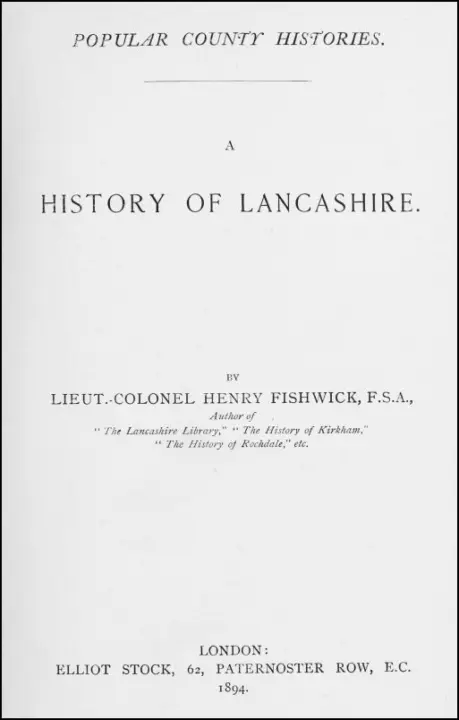
THE CLASSIC COLLECTION · 1894
"A History of Lancashire" by Lieut.-Colonel Henry Fishwick is a historical account written in the late 19th century. This work explores the rich and diverse history of the English county of Lancashire, tracing its development from pre-Roman times through various significant historical periods, including the influence of the Romans, Saxons, and Normans. Fishwick aims to provide a comprehensive overview while selecting the most important events and figures that shaped the county. The opening of the book lays the groundwork for understanding Lancashire's geographical boundaries and significant divisions, such as its hundreds and parishes. Fishwick discusses the challenges he faced in condensing a vast amount of research material into a single volume, emphasizing the importance of authenticity and reliability in the historical facts presented. The introduction not only outlines the physical layout of the county but also sets the stage for a deeper exploration of its history, promising to delve into various eras and notable events that have defined Lancashire's identity over the centuries.
Introduction adapted from the source catalogue; source summaries may be automatically generated.
Free to read · English · 93,916 words · No account needed
MAKE TIME FOR A GOOD BOOK
On by default. Untick to stop anonymous reading totals. Each page counts after 10 seconds in view. How this works.
Anonymous counting is on unless you have switched it off.
In 1819 there were in Lancashire 77 Roman Catholic chapels, and in 1823 the Dissenting chapels included: 68 Independent, 27 Baptist, 32 Unitarian, 4 Scotch Kirk, 3 Scotch Presbyterian, and 180 Wesleyan.
[Footnote 169: Bright's "Early English Church History," p. 111.]
[Footnote 170: Lancashire was subsequently included in the Diocese of Lichfield and Coventry until the establishment of the See of Chester, in 1541, the northern portion being in the Archdeaconry of Richmond, in the Diocese of York.]
[Footnote 171: Lancaster parish is partly in Lonsdale and partly in
Amounderness.]
[Footnote 172: Symeon of Durham's "Life of St. Cuthbert," Surtees
Soc., li. 141.]
[Footnote 173: See Lanc. and Ches. Ant. Soc., vol. ix.]
[Footnote 174: Aldcliffe Hall is on the south of the river. Of Newton all trace is lost. See "Materials for History of the Church of Lancaster," Chetham Soc., xxvi., new series.]
[Footnote 175: Calendar of Papal Reg., A.D. 1193-1304, and
chartulary of the priory.]
[Footnote 176: Calendar of French Rolls; 48th Report of Deputy-Keeper
of Records.]
[Footnote 177: Worthings = manure.]
[Footnote 178: "Antiquities of Furness."]
[Footnote 179: Probably granted for a term of years.]
[Footnote 180: Printed by the Chetham Society (new series, vols. xiii.,
xiv., xv.).]
[Footnote 181: A compound of "kirk," the Danish or Scandinavian for church, and the Anglo-Saxon "ham," a village or a dwelling.]
[Footnote 182: Whitaker's "History of Whalley."]
[Footnote 183: Chetham Society, Coucher Book of Whalley.]
[Footnote 184: See Whitaker's "History of Whalley," from which this
description is taken.]
[Footnote 185: Recently forms have been placed in the church.]
[Footnote 186: For detailed drawing of Stydd Church see "The History of Stydd Chapel and Preceptory," by George Latham; London, 1853.]
[Footnote 187: Warrington Church Notes.]
[Footnote 188: For details of remains of Burscough, see Lanc. and
Ches. Hist. Soc., 1889.]
[Footnote 189: Dom. Gilbert Dolan, O.S.B. (Lanc. and Ches. Hist. Soc., vols. vii., viii., p. 231).]
[Footnote 190: Partly printed by Chetham Society, cvii. and cxiii.]
[Footnote 191: Bridge = a kind of thread.]
[Footnote 192: Communion-cloths.]
[Footnote 193: A glass bottle to hold oil.]
[Footnote 194: Created in 1848, and includes all Lancashire, except parts of West Derby which are in Chester Diocese, and the Furness and Cartmel districts, which were added to Carlisle.]
[Footnote 195: Near the door of the dining-room is a small hole in the flag floor, somewhat like the impress of a human foot, which tradition says marks the place where George Marsh stamped his foot as he protested to the truth of his faith.]
[Footnote 196: State Papers, Dom. Ser., 1547-1565.]
[Footnote 197: State Papers, Dom. Ser., addenda xix., p. 525.]
[Footnote 198: Ibid., p. 161.]
[Footnote 199: Ibid., cxxxviii., p. 18.]
[Footnote 200: See "History of Poulton-le-Fylde" (Fishwick), Chetham Society, viii., new series.]
[Footnote 201: Chetham Society, xcvi., p. 1.]
[Footnote 202: Chester Presentments at York. See also "History of Kirkham" (Fishwick), Chetham Society, xcii. 45.]
[Footnote 203: State Papers, Dom. Ser., Eliz., vol. cclxxix., No. 86.]
Your reading position is saved on this browser. Take it to another device with a library code. Reading pages adapt to text, rather than matching a printed edition.
BEHIND THE BOOK
This eBook is for the use of anyone anywhere in the United States and most other parts of the world at no cost and with almost no restrictions whatsoever. You may copy it, give it away or re-use it under the terms of the Project Gutenberg License included with this eBook or online at www.gutenberg.org. If you are not located in the United States, you will have to check the laws of the country where you are located before using this eBook. Read the source licence.
The original source file, including credits and licence, is retained by this library. Request an original-format copy at no charge. Please include the book title and Project Gutenberg identifier #49369.
KEEP YOUR CURIOSITY GOING
Cécile Tormay

Moritz Busch
John L. Ransom
Frances Wright
Cécile Tormay

Mabel Potter Daggett