THE CLASSIC COLLECTION✦An outlaw’s diary: the CommuneCLASSIC FREE BOOKS
An outlaw’s diary: the Commune
Cécile Tormay
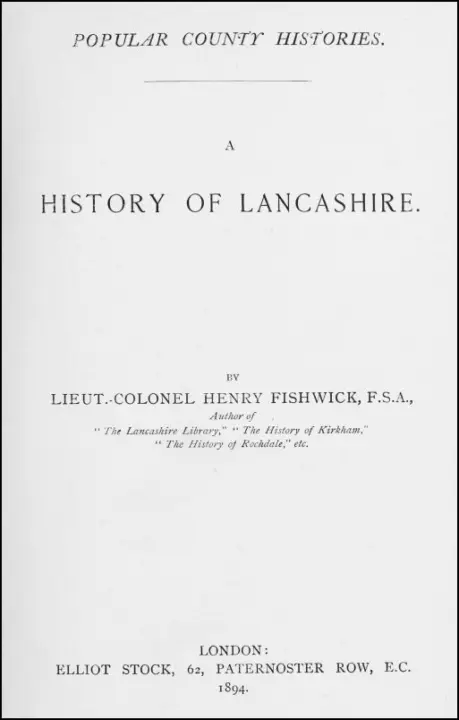
THE CLASSIC COLLECTION · 1894
"A History of Lancashire" by Lieut.-Colonel Henry Fishwick is a historical account written in the late 19th century. This work explores the rich and diverse history of the English county of Lancashire, tracing its development from pre-Roman times through various significant historical periods, including the influence of the Romans, Saxons, and Normans. Fishwick aims to provide a comprehensive overview while selecting the most important events and figures that shaped the county. The opening of the book lays the groundwork for understanding Lancashire's geographical boundaries and significant divisions, such as its hundreds and parishes. Fishwick discusses the challenges he faced in condensing a vast amount of research material into a single volume, emphasizing the importance of authenticity and reliability in the historical facts presented. The introduction not only outlines the physical layout of the county but also sets the stage for a deeper exploration of its history, promising to delve into various eras and notable events that have defined Lancashire's identity over the centuries.
Introduction adapted from the source catalogue; source summaries may be automatically generated.
Free to read · English · 93,916 words · No account needed
MAKE TIME FOR A GOOD BOOK
On by default. Untick to stop anonymous reading totals. Each page counts after 10 seconds in view. How this works.
Anonymous counting is on unless you have switched it off.
1. The parishes of Manchester, Prestwich, Oldham, Flixton, Eccles, and Ashton-under-Lyne. The members nominated consisted of eight ministers and seventeen laymen.[208]
2. The parishes of Bolton, Bury, Middleton, Rochdale, Deane, and Radcliffe. Its members, ten ministers and twenty laymen.
3. The parishes of Whalley, Chipping, and Ribchester. Its members, eight ministers and seventeen laymen.
4. The parishes of Warrington, Winwick, Leigh, Wigan, Holland, and Prescot. Its members, fourteen ministers and twenty-eight laymen.
5. The parishes of Walton, Huyton, Childwall, Sefton, Alcar, North Meols, Halsall, Ormskirk, and Aughton. Its members, fifteen ministers and twenty-three laymen.
6. The parishes of Croston, Leyland, Standish, Ecclestone, Penwortham, Hoole, and Brindle. Its members, six ministers and fourteen laymen.
7. The parishes of Preston, Kirkham, Garstang, and Poulton.[209] Its members, six ministers and thirteen laymen.
8. The parishes of Lancaster, Cockerham, Claughton, Melling, Tatham, Tunstall, Whittington, Warton, Bolton-le-Sands, Halton, and Heysham. Its members, eight ministers and eighteen laymen.
9. The parishes of Aldingham, Urswick, Ulverston, Hawkshead, Colton, Dalton, Cartmel, Kirkby, and Pennington. Its members, five ministers and eleven laymen.
The names of all these members have many times been printed. It does not necessarily follow that all the persons nominated as "fit to be of" each classis absolutely acted in that capacity; indeed, it is well known that many refused the office.
These classes at once took upon them the management and control of things ecclesiastical. The Manchester classis first met on February 16, 1646/7, when Richard Heyricke, the Warden of the collegiate church, was appointed Moderator, although he had formerly been one of the warmest supporters of the Church and King; at their second meeting, on March 16, 1646/7, they passed a resolution to the effect that all who preached within the classis who were not members of it were to be called to account, as were also all ministers or others who permitted them so to preach. A considerable part of the time of the successive meetings was taken up by the inquiry into cases of immoral conduct and social scandals affecting the members of the various congregations: candidates for the ministry were examined by the Presbyters of each classis, and, if approved, were duly ordained; and it was also part of their work to see that improper persons were not admitted to the Lord's Supper.
Your reading position is saved on this browser. Take it to another device with a library code. Reading pages adapt to text, rather than matching a printed edition.
BEHIND THE BOOK
This eBook is for the use of anyone anywhere in the United States and most other parts of the world at no cost and with almost no restrictions whatsoever. You may copy it, give it away or re-use it under the terms of the Project Gutenberg License included with this eBook or online at www.gutenberg.org. If you are not located in the United States, you will have to check the laws of the country where you are located before using this eBook. Read the source licence.
The original source file, including credits and licence, is retained by this library. Request an original-format copy at no charge. Please include the book title and Project Gutenberg identifier #49369.
KEEP YOUR CURIOSITY GOING
Cécile Tormay

Moritz Busch
John L. Ransom
Frances Wright
Cécile Tormay

Mabel Potter Daggett