THE CLASSIC COLLECTION✦An outlaw’s diary: the CommuneCLASSIC FREE BOOKS
An outlaw’s diary: the Commune
Cécile Tormay
THE CLASSIC COLLECTION · 1894
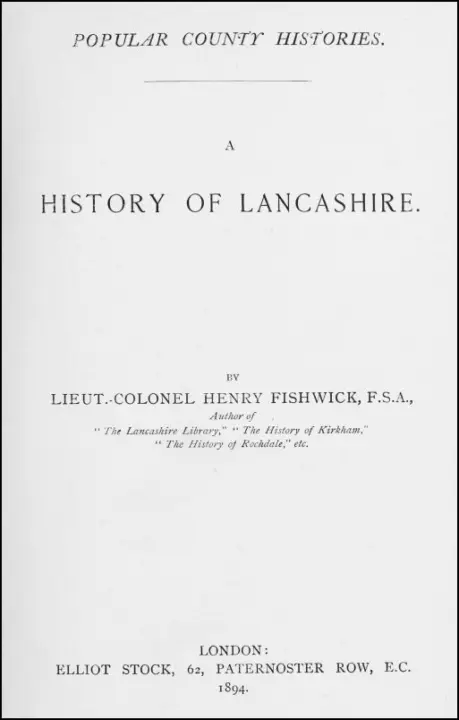
"A History of Lancashire" by Lieut.-Colonel Henry Fishwick is a historical account written in the late 19th century. This work explores the rich and diverse history of the English county of Lancashire, tracing its development from pre-Roman times through various significant historical periods, including the influence of the Romans, Saxons, and Normans. Fishwick aims to provide a comprehensive overview while selecting the most important events and figures that shaped the county. The opening of the book lays the groundwork for understanding Lancashire's geographical boundaries and significant divisions, such as its hundreds and parishes. Fishwick discusses the challenges he faced in condensing a vast amount of research material into a single volume, emphasizing the importance of authenticity and reliability in the historical facts presented. The introduction not only outlines the physical layout of the county but also sets the stage for a deeper exploration of its history, promising to delve into various eras and notable events that have defined Lancashire's identity over the centuries.
Introduction adapted from the source catalogue; source summaries may be automatically generated.
Free to read · English · 93,916 words · No account needed
MAKE TIME FOR A GOOD BOOK
On by default. Untick to stop anonymous reading totals. Each page counts after 10 seconds in view. How this works.
Anonymous counting is on unless you have switched it off.
The tale as told by Bede, of the dramatic events which led up to the conversion of Edwin, must be received with caution, mixed up as it is with such incidents as a spiritual visitor with whom the narrator held familiar converse; nevertheless, the main facts of the story are probably correct, allowing for the fact that the account was written nearly 100 years after the events took place, and by one who was prone to mix with history incidents which would only at the present time be classed with legends and superstitions. The story, briefly told (omitting the apparition), is that Edwin for a long time refused to abandon his old faith, but after an attempt had been made to assassinate him, the birth of a daughter and a victory over his enemy, the King of the West Saxons--all of which events were turned to account by the wily Bishop (who was trying to convert him)--he consented to call a council of leading men and to lay the matter before them, and if they agreed with him they would together be baptized and admitted into the Church.
At this meeting, a chief priest of one of the pagan temples, Coifi by name, declared himself against his old faith on the simple grounds that after all his long devotion to his gods he was still without that worldly success for which his soul thirsted; and, therefore, as he had nothing to lose and everything to gain, he should vote for giving the new religion a trial.
Another of the council spoke, and in simple but striking words reminded his hearers how they had often on a winter's night, gathered round the fire, when all outside was dark and dreary, the wind howling and the rain beating against the latticed windows, when a door for a moment opened admitting a poor little bird seeking shelter from the storm. But a moment only it stays, flies across the hall, and is gone. This, he continued, is a fit emblem of man's life; he appears for a little season, and having finished his appointed course is gone; but no earthly wisdom has told us from whence he came, or has illuminated his departure. And so, he concluded, if the new teacher can tell us anything with assurance of certainty as to man's origin or future destiny, his words ought to be received and accepted. Paulinus then addressed the assembly, at the conclusion of which Coifi, with all the fanatic zeal which might be expected from such a man, volunteered to enter the temples of the gods and to take therefrom what he heretofore had held to be sacred, and having been armed and mounted he rode to Goodmanham, a place of the highest pagan sanctity, and there tore down the idols of Thor and Wodin with shouts of joy and gladness. Bede adds, the people stood awe-struck, and thought that their chief priest had gone mad. But Coifi knew what he was about; he had only determined (like many a better man had done before) to keep himself on the winning side, for he saw clearly enough that paganism had received its death-blow, and however little his gods had done for him in the past, they would certainly do less in the future. Edwin, with the enthusiasm of a new convert, now set about erecting a small church, or more probably an oratory, in the city of York. This was made of wood, and within this building the Northumbrian King was baptized by Paulinus on Easter Day, A.D. 627 (April 12). This oratory was not long afterwards enclosed within a larger structure which was built of stone, and upon the site of which was afterwards erected the stately Minster of York. It is said that shortly after the baptism of Edwin a large number of his barons and subjects followed his example. Paulinus and his friends now lost no time in spreading through the length and breadth of Northumbria the tenets of the Christian religion, and under the patronage of the King and Queen no doubt many proselytes were obtained, not a few of whom were dwellers on Lancashire soil. This missionary work proceeded uninterruptedly for six years, but was then destined to receive a very severe check by the war between Edwin and Penda (see p. 42), in which the King of Northumbria was defeated and slain on October 12, A.D. 633, and subsequently the whole of his kingdom was overrun by pagan soldiers, who, according to Bede, slaughtered the Christians without regard to either age or sex. The head of Edwin was taken to York by some of his friends, and placed within the church which he had so recently built. Ethelburga, the Queen, and her two children, escorted by Paulinus, fled into Kent, and Paulinus was afterwards presented to the See of Rochester.
Your reading position is saved on this browser. Take it to another device with a library code. Reading pages adapt to text, rather than matching a printed edition.
BEHIND THE BOOK
This eBook is for the use of anyone anywhere in the United States and most other parts of the world at no cost and with almost no restrictions whatsoever. You may copy it, give it away or re-use it under the terms of the Project Gutenberg License included with this eBook or online at www.gutenberg.org. If you are not located in the United States, you will have to check the laws of the country where you are located before using this eBook. Read the source licence.
The original source file, including credits and licence, is retained by this library. Request an original-format copy at no charge. Please include the book title and Project Gutenberg identifier #49369.
KEEP YOUR CURIOSITY GOING
Cécile Tormay

Moritz Busch
John L. Ransom
Frances Wright
Cécile Tormay

Mabel Potter Daggett