THE CLASSIC COLLECTION✦An outlaw’s diary: the CommuneCLASSIC FREE BOOKS
An outlaw’s diary: the Commune
Cécile Tormay
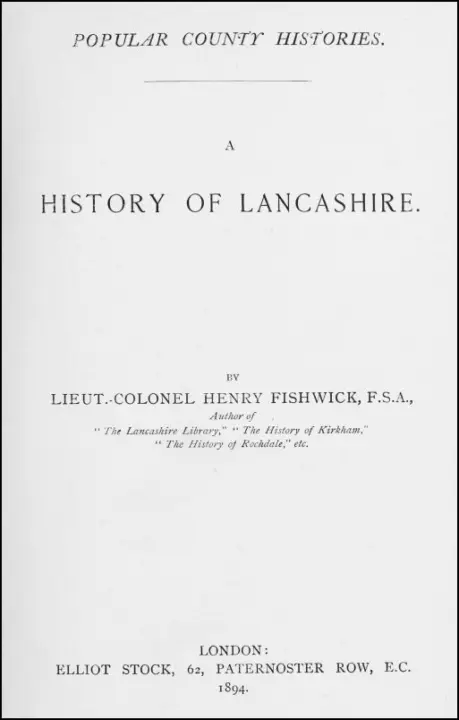
THE CLASSIC COLLECTION · 1894
"A History of Lancashire" by Lieut.-Colonel Henry Fishwick is a historical account written in the late 19th century. This work explores the rich and diverse history of the English county of Lancashire, tracing its development from pre-Roman times through various significant historical periods, including the influence of the Romans, Saxons, and Normans. Fishwick aims to provide a comprehensive overview while selecting the most important events and figures that shaped the county. The opening of the book lays the groundwork for understanding Lancashire's geographical boundaries and significant divisions, such as its hundreds and parishes. Fishwick discusses the challenges he faced in condensing a vast amount of research material into a single volume, emphasizing the importance of authenticity and reliability in the historical facts presented. The introduction not only outlines the physical layout of the county but also sets the stage for a deeper exploration of its history, promising to delve into various eras and notable events that have defined Lancashire's identity over the centuries.
Introduction adapted from the source catalogue; source summaries may be automatically generated.
Free to read · English · 93,916 words · No account needed
MAKE TIME FOR A GOOD BOOK
On by default. Untick to stop anonymous reading totals. Each page counts after 10 seconds in view. How this works.
Anonymous counting is on unless you have switched it off.
[Footnote 134: In a tract dated July 5, 1642, entitled "The Beginning of the Civil Warres in England, or Terrible News from the North," Lord Strange is reported to have approached Manchester with a considerable armed force on July 5, and drawing up at a little distance from the town, demanded that the inhabitants should deliver up their magazines. On their refusal to give them up, he marched against the town, outside of which he was met by "ten small companies set in a faire battalion," and a skirmish took place, which lasted several hours, and resulted in the withdrawal of the Royalist forces with the loss of twenty-seven men. The tract then states "that this is the beginning of the Civill Warre, being the first stroke that hath been struck, and the first bullet that hath been shot." There is much reason to doubt the correctness of this reported fight, as no mention of it is made by contemporary authorities.]
[Footnote 135: These fortifications consisted of posts and chains, and barricades of mud. They were erected under the superintendence of Lieutenant-Colonel Rosworm, a German engineer, at a cost of £30.]
[Footnote 136: A slightly different version of this is given in
"Lancashire's Valley of Achor."]
[Footnote 137: Major Edward Robinson, "A Discourse of the Warr in Lancashire," Chetham Soc., lxii.]
[Footnote 138: "Lancashire's Valley of Achor."]
[Footnote 139: "A punctuall relation of the passages in Lancashire this week" (February 14, 1642).]
[Footnote 140: This is Major Robinson's statement.]
[Footnote 141: Major Robinson says he "discharged that little pece of ordenance they carried with them divers times," and then walked into the town.]
[Footnote 142: "Lancashire's Valley of Achor."]
[Footnote 143: Edward Bridgeman, late M.P.]
[Footnote 144: This castle was afterwards ordered to be dismantled. Its position rendered it difficult to attack, as it stood on an eminence from which the ground sloped rapidly in every direction. It was entered by the large windows on the east side, and the entrance thus gained, the victory was assured.]
[Footnote 145: This castle was first taken by Colonel Ashton, in June, 1643, but Sir John Girlington, having got hold of it, reoccupied it.]
[Footnote 146: For full details of these two sieges see "Civil War
Tracts," Chetham Soc., ii.]
[Footnote 147: Seacome's "Memoirs of the House of Stanley."]
[Footnote 148: In Salford Chapel, "for poor distressed Bolton," the very large sum of £140 was collected ("Vicar's Chronicle").]
[Footnote 149: By way of Blackburn and Colne; at the latter place a slight skirmish took place on June 25. At Kirkham, between May and September, 1644, no accounts of the vestry were kept, because "Prince Rupert's army" had command of the county, and many of the parishioners had fled. In 1642 the soldiers "pulled asunder the organ pipes in the church."]
[Footnote 150: "A Discourse of the Warr in Lancashire."]
Your reading position is saved on this browser. Take it to another device with a library code. Reading pages adapt to text, rather than matching a printed edition.
BEHIND THE BOOK
This eBook is for the use of anyone anywhere in the United States and most other parts of the world at no cost and with almost no restrictions whatsoever. You may copy it, give it away or re-use it under the terms of the Project Gutenberg License included with this eBook or online at www.gutenberg.org. If you are not located in the United States, you will have to check the laws of the country where you are located before using this eBook. Read the source licence.
The original source file, including credits and licence, is retained by this library. Request an original-format copy at no charge. Please include the book title and Project Gutenberg identifier #49369.
KEEP YOUR CURIOSITY GOING
Cécile Tormay

Moritz Busch
John L. Ransom
Frances Wright
Cécile Tormay

Mabel Potter Daggett