THE CLASSIC COLLECTION✦An outlaw’s diary: the CommuneCLASSIC FREE BOOKS
An outlaw’s diary: the Commune
Cécile Tormay
THE CLASSIC COLLECTION · 1894
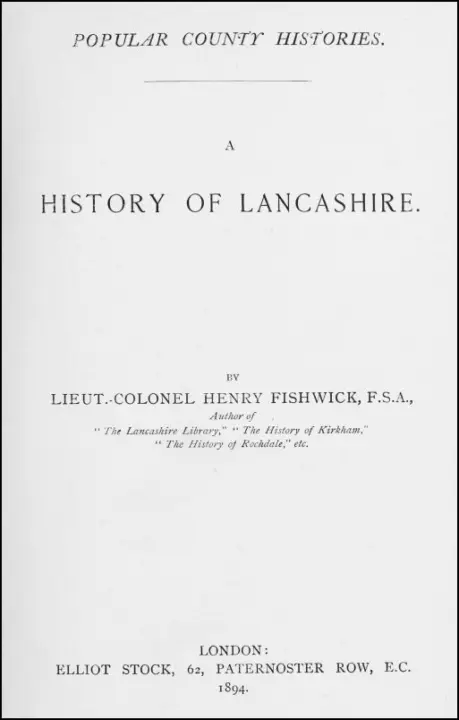
"A History of Lancashire" by Lieut.-Colonel Henry Fishwick is a historical account written in the late 19th century. This work explores the rich and diverse history of the English county of Lancashire, tracing its development from pre-Roman times through various significant historical periods, including the influence of the Romans, Saxons, and Normans. Fishwick aims to provide a comprehensive overview while selecting the most important events and figures that shaped the county. The opening of the book lays the groundwork for understanding Lancashire's geographical boundaries and significant divisions, such as its hundreds and parishes. Fishwick discusses the challenges he faced in condensing a vast amount of research material into a single volume, emphasizing the importance of authenticity and reliability in the historical facts presented. The introduction not only outlines the physical layout of the county but also sets the stage for a deeper exploration of its history, promising to delve into various eras and notable events that have defined Lancashire's identity over the centuries.
Introduction adapted from the source catalogue; source summaries may be automatically generated.
Free to read · English · 93,916 words · No account needed
MAKE TIME FOR A GOOD BOOK
On by default. Untick to stop anonymous reading totals. Each page counts after 10 seconds in view. How this works.
Anonymous counting is on unless you have switched it off.
In 1689 the war with France much interfered with this trade, and the cheese from Cheshire and Lancashire, which required twenty ships yearly to carry it to London, had all to be taken by land. The rate for the carriage in this way was from 3s. to 5s. a hundredweight in summer. Iron was obtained in the crude state from the bloomeries of Cartmel and Furness. Tobacco was largely imported into Lancaster directly from Virginia, the trade being carried on partly by exchange of goods; thus, one John Hodgson, of Lancaster, sent out £200 value of English goods, for which he obtained in Virginia 200 hogsheads of tobacco, and made by the barter a net profit of £1,500, tobacco then selling at 1s. a pound. Sugar bought at Bristol and Liverpool was refined at Lancaster, but none seems to have been imported at this time. Our diarist in 1695 was collector of the land-tax of Lancaster, which was 4s. in the pound, and amounted to £120, so that the rateable value was only about £600.
One curious funeral custom is worth recording. "I went" (writes Stout) "to Preston fair to buy cheese," the market for cheese being mostly at Garstang and Preston fairs. "At this time we sold much cheese to funerals in the country, from 30 lbs. to 100 lbs. weight, as the deceased was of ability; which was shrived into two or three" (slices or pieces) "in the lb., and one with a penny manchet given to all attendants. And it was customary at Lancaster to give one or two long biscuits, called Naples biscuits, to each attendant, by which from 20 to 100 lbs. was given." The providing of the penny manchet at the funeral often formed a paragraph in the deceased person's will, and the doles given to the poor on these occasions were often considerable.
The last Herald's visitation to the county was made in 1664-65 by Sir William Dugdale, and from it we discover that many old families of the last century have entirely died out, whilst others of more humble origin have succeeded them. The incompleteness of the pedigrees (to say nothing of their glaring inaccuracies) is striking, and one is surprised to find how many families, undoubtedly entitled to bear arms, neglected to enter their descents. The seventeenth century saw the birth of a new order of men in Lancashire, who in many cases rose to opulence and became the founders of what developed into county families; there were the clothiers--they in many instances sprang from the lowest social grade, but by industry and thrift acquired their positions. The clothier purchased the wool (or kept large quantities of sheep), and delivered it to persons who took it to their own homes, and having there made it into cloth, returned it then to their employers. This business was usually carried on in the towns of the county, which were now rapidly springing up, and the demand for the kind of labour required quickly drew workmen from the surrounding agricultural districts. Amongst the most prominent centres for this trade were Manchester, Oldham, Bolton, Rochdale, Ashton, Bury, and Blackburn. In the manorial and other records of this period we find frequent references to "loomhouses," "bleachouses," "woolmen," and "clothmakers." These pioneers of the wool trade, the clothiers, often lived in large town-houses, adjacent to and communicating with which were their warehouses for the wool and manufactured goods. The contents of one of these establishments is furnished by the inventory attached to the will of Anthony Mosley, of Manchester, clothier, proved at Chester, April 30, 1607. The will itself, after providing for the family of the testator and bestowing several hundred pounds for charitable purposes, concludes with a clause to the effect that the testator's "walke millers" (i.e., fullers) shall each have a cloak of 10 or 11 shillings a yard; that every one of his servants shall have 40s. each; that at the funeral a dinner shall be provided, and "a dealing to the poor of 2d. a piece"; and finally that the parson who shall make the funeral sermon is to be rewarded with 20s. for his pains. The dwelling-house consisted of the hall, the parlour, and the kitchen, with chambers over them; also a chamber over the warehouse, a brewhouse, a "bolting-chamber,"[161] an upper loft, and cellars. The stock of cloth in the warehouse was valued at £255, and the stock at various fulling-mills was estimated at another £740, whilst the various trade debts owing to the deceased amounted to £1,260. The household effects are not given in detail, but are given as "household stuffe and cloth," and valued at nearly £600, beside £22 of plate. In 1613 there was a heavy decline in the wool trade, to remedy which a Royal Commission was appointed, and subsequently Acts of Parliament passed to remove the impost on cloth, which had been put on by the Merchant Adventurers' Company, who for some years had an almost complete monopoly of dyeing cloth. The establishment of a free trade in dyeing once more revived the trade, and dyers were found in all our Lancashire towns where woollen cloth was manufactured, and alongside them were found fulling, or, as they were then called, walk mills. Coal, ironstone, and flags where obtainable also now began to find a ready market. Towards the close of the century the making of fustian and other so-called cotton[162] goods, which had almost been confined to Manchester, began rapidly to be taken up by the surrounding towns, one of the first of these being Bolton.
Your reading position is saved on this browser. Take it to another device with a library code. Reading pages adapt to text, rather than matching a printed edition.
BEHIND THE BOOK
This eBook is for the use of anyone anywhere in the United States and most other parts of the world at no cost and with almost no restrictions whatsoever. You may copy it, give it away or re-use it under the terms of the Project Gutenberg License included with this eBook or online at www.gutenberg.org. If you are not located in the United States, you will have to check the laws of the country where you are located before using this eBook. Read the source licence.
The original source file, including credits and licence, is retained by this library. Request an original-format copy at no charge. Please include the book title and Project Gutenberg identifier #49369.
KEEP YOUR CURIOSITY GOING
Cécile Tormay

Moritz Busch
John L. Ransom
Frances Wright
Cécile Tormay

Mabel Potter Daggett