THE CLASSIC COLLECTION✦An outlaw’s diary: the CommuneCLASSIC FREE BOOKS
An outlaw’s diary: the Commune
Cécile Tormay
THE CLASSIC COLLECTION · 1894
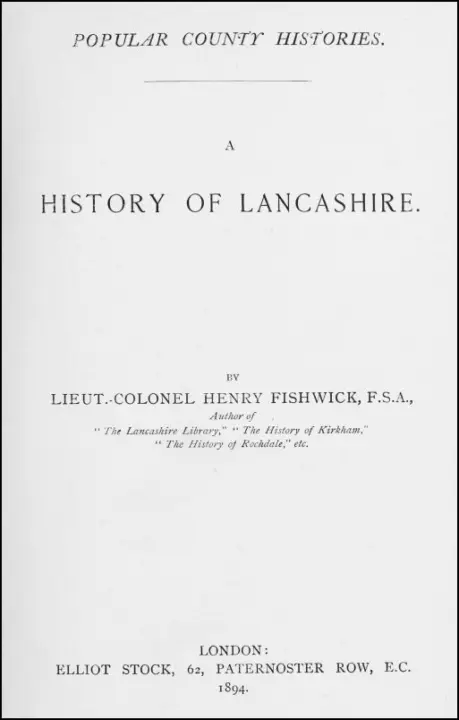
"A History of Lancashire" by Lieut.-Colonel Henry Fishwick is a historical account written in the late 19th century. This work explores the rich and diverse history of the English county of Lancashire, tracing its development from pre-Roman times through various significant historical periods, including the influence of the Romans, Saxons, and Normans. Fishwick aims to provide a comprehensive overview while selecting the most important events and figures that shaped the county. The opening of the book lays the groundwork for understanding Lancashire's geographical boundaries and significant divisions, such as its hundreds and parishes. Fishwick discusses the challenges he faced in condensing a vast amount of research material into a single volume, emphasizing the importance of authenticity and reliability in the historical facts presented. The introduction not only outlines the physical layout of the county but also sets the stage for a deeper exploration of its history, promising to delve into various eras and notable events that have defined Lancashire's identity over the centuries.
Introduction adapted from the source catalogue; source summaries may be automatically generated.
Free to read · English · 93,916 words · No account needed
MAKE TIME FOR A GOOD BOOK
On by default. Untick to stop anonymous reading totals. Each page counts after 10 seconds in view. How this works.
Anonymous counting is on unless you have switched it off.
The siege was now begun in earnest, though the object seems to have been rather to starve out the garrison than to take the place by storm; sorties were frequently made by the cavaliers, and from time to time shots were fired at the walls and towers by the enemy. One chronicle adds they were intended either to "beate down pinnacles and turretts, or else to please the women that came to see the spectacle." After the siege had continued for nearly a month, Colonels Ashton and Moore appear to have begun to despair of success by ordinary weapons of war, and thereupon addressed a letter to the ministers of Lancashire asking them to "commend their case to God," so that "the Almighty would crowne their weake endeavours with speedy success."
Towards the end of April another summons was sent to the Countess demanding immediate surrender, to which she replied in person to the messenger, "Carry this back to Rigby; tell that insolent rebell he shall neither have p'sons, goods nor house; when our strength and p'visions is spent, we shall find a fire more mercyfull than Rigby, and then if the providence of God p'vent it not, my goods and house shall burne in his sight; myselfe, children and souldiers, rather than fall into his hands, will seale our religion and loyalty in the same flame."
During the last few days the only thing that gave any anxiety to the gallant band within Lathom was a large mortar-piece from which the besiegers were continually sending fireballs and grenades into their midst. To get possession of this a sally was made, and after some smart fighting it was captured and dragged within the walls.
After this the spirits of the invaders appear to have been somewhat daunted, and at the end of nearly four months Rigby, hearing that Prince Rupert was coming to Lancashire, withdrew his troops to Eccleston Green, and ultimately marched them to Bolton. During this siege Rigby is said to have lost 500 men. Prince Rupert, on his arrival in the county, kept clear of Manchester, and marched straight towards Bolton, near to which town he was met by the Earl of Derby. Bolton was probably not well prepared to receive such a force as that led against it by the Prince and the Earl; the town was also destitute of ammunition, and had it not been for the timely appearance of Colonel Rigby with the remains of his forces, resistance would have been out of the question; but even as it was, the Boltonians gallantly and successfully drove back the enemy on the first assault, who, however, shortly rallied, and, returning to the attack, soon effected an entrance into the town, where little or no opposition was offered. This latter attack[147] was led in person by the Earl of Derby with 200 men, and after he had entered the town the other forces poured in on every side. Rigby fled, leaving some 2,000 of his men behind him, many (if not most of them) being slain on the spot, the Prince having ordered that no quarter was to be given to any person in arms. Another account accuses the Cavaliers of having "killed, stripped, and spoiled" all the people they met with, regarding "neither the dolefull cries of women nor children," and also of having brought out some "husbands on purpose to be slaine before their wives' faces." Many other outrages are said to have been perpetrated. All the records of this siege agree that the return of killed and wounded was very heavy, and it may safely be assumed that at least 1,500 were slain.[148] The colours from the Bolton soldiers were sent in triumph to Lady Derby at Lathom. Prince Rupert now marched on to Liverpool, where he found that Colonel Moore, the governor of the town, was prepared to resist him, having a strong garrison, and also being able to rely on the assistance of the sailors in port. To find provisions for this garrison Colonel Clifton is said to have taken all the sheep he could find on Layton Hawes (in Bispham). In the early part of June the siege began, but not for three weeks was the Prince able to take the town. The assaults were frequent, and resulted in serious losses to the leaguers, but at last it became evident that further resistance was useless, so the wary governor, having first shipped off his arms, ammunition, and goods, left the north entrance to the town undefended, and thus admitted the enemy, who (according to Seacome) put to the sword all they met on their way to the high cross (where the exchange now stands). A large number of prisoners were taken, and the Prince seized the castle.
Your reading position is saved on this browser. Take it to another device with a library code. Reading pages adapt to text, rather than matching a printed edition.
BEHIND THE BOOK
This eBook is for the use of anyone anywhere in the United States and most other parts of the world at no cost and with almost no restrictions whatsoever. You may copy it, give it away or re-use it under the terms of the Project Gutenberg License included with this eBook or online at www.gutenberg.org. If you are not located in the United States, you will have to check the laws of the country where you are located before using this eBook. Read the source licence.
The original source file, including credits and licence, is retained by this library. Request an original-format copy at no charge. Please include the book title and Project Gutenberg identifier #49369.
KEEP YOUR CURIOSITY GOING
Cécile Tormay

Moritz Busch
John L. Ransom
Frances Wright
Cécile Tormay

Mabel Potter Daggett