THE CLASSIC COLLECTION✦An outlaw’s diary: the CommuneCLASSIC FREE BOOKS
An outlaw’s diary: the Commune
Cécile Tormay
THE CLASSIC COLLECTION · 1894
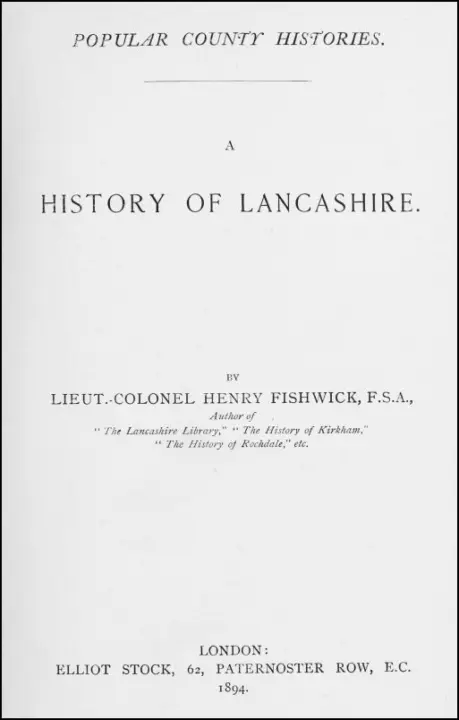
"A History of Lancashire" by Lieut.-Colonel Henry Fishwick is a historical account written in the late 19th century. This work explores the rich and diverse history of the English county of Lancashire, tracing its development from pre-Roman times through various significant historical periods, including the influence of the Romans, Saxons, and Normans. Fishwick aims to provide a comprehensive overview while selecting the most important events and figures that shaped the county. The opening of the book lays the groundwork for understanding Lancashire's geographical boundaries and significant divisions, such as its hundreds and parishes. Fishwick discusses the challenges he faced in condensing a vast amount of research material into a single volume, emphasizing the importance of authenticity and reliability in the historical facts presented. The introduction not only outlines the physical layout of the county but also sets the stage for a deeper exploration of its history, promising to delve into various eras and notable events that have defined Lancashire's identity over the centuries.
Introduction adapted from the source catalogue; source summaries may be automatically generated.
Free to read · English · 93,916 words · No account needed
MAKE TIME FOR A GOOD BOOK
On by default. Untick to stop anonymous reading totals. Each page counts after 10 seconds in view. How this works.
Anonymous counting is on unless you have switched it off.
Warrington was now garrisoned by the Earl of Derby. It was defended on one side by the river Mersey, which was crossed by a bridge of four arches; over this bridge was a narrow roadway, and on the centre pier stood a watch-house which had formerly been used by the Austin Friars as an oratory. The other sides of the town were defended by mud walls, with gates at the principal entrances; outside these walls outworks had been thrown up. Against this stronghold Sir William Brereton's forces and a large detachment from Manchester laid siege on April 1 (1643), but they only succeeded in getting possession of Sankey Bridge and "a fayre large house of one Mr. Bridgeman's."[143] They withdrew their troops after a three days' siege and some smart fighting, the reason alleged for this being that the Earl of Derby set fire to the centre of the town, and threatened to burn down the whole place rather than it should be taken.
Lancaster towards the end of April was again taken by the Parliamentary forces, and the pieces of ordnance from the Spanish ship (see p. 139) were removed to Manchester, and very shortly afterwards (May 19) Warrington, after withstanding a week's siege, was obliged to surrender, partly, it is said, because provision ran short. After these various warlike proceedings, it is not astonishing that funds began to fail, and for want of the sinews of war, many preferred to return to their usual occupations, and thus the leaders of both parties were surrounded with difficulties. Whilst the Parliament could and did order the estates of the delinquents to be confiscated, the Royalists could only levy voluntary rates, which fell heaviest on those whose estates had thus been seized. The tide of war seemed now to have turned against the Earl of Derby, who, to add to his other defeats, made an attempt, and failed, to regain the magazine in Liverpool. The Royalists were further disheartened by the removal from their midst of the Earl of Derby, who was ordered by the Queen to betake himself to the Isle of Man, which was then menaced by the enemies of the King; here he landed on June 15, 1643. Shortly after this Hornby Castle[144] was taken by the Parliamentary forces, and there now only remained Thurland Castle and Lathom House in the hands of the Royalists; and as the Earl of Derby, Lord Molyneux, and Colonel Thomas Tyldesley were all out of the county, the enemy began to realize that they were almost in possession of the whole county. Before the departure of these leaders much plundering by the soldiers was reported in the Fylde district, where Lord Molyneux and Colonel Tyldesley were for a time stationed; at Kirkham, Clifton, St. Michael's and Laton, cattle were taken and houses sacked. About this time Colonel Alexander Rigby (whose name hereafter appears more prominently) came armed with a commission from the Commons to raise forces in the hundreds of Leyland and Amounderness, and to get the soldiers so raised ready for war in the least possible time. His efforts were successful, and in nearly every parish in the district he met with some support. Encouraged by this, he, about midsummer, undertook to take Thurland Castle, which was then held by Sir John Girlington,[145] who had around him "many disperat caviliers;" his castle was well fortified and provisioned. Colonel Rigby was supplied (in addition to the men he had raised) with forces from Salford and Blackburn Hundreds. Alexander Rigby's own account of this siege is that during the greater part of the conflict, which lasted seven weeks, he was threatened by the forces of Westmorland, which were drawn up within his view; to these forces were added the Royalists from the Cartmel and Furness district. Having decided to deal with these forces before attacking the castle, he took "500 foot, 2 Drakes, and 3 small troops of horse" (part of his army which lay before Thurland), and marched thirty miles "over mountain and sea, sands and water," and when in sight of the enemy (near Dalton) they "committed themselves to God's protection and began their worke with publike prayers." From some cause, which is not recorded, he goes on to state that the enemy, before a blow was struck, began to retreat, and were soon dispersed, throwing away their arms, and leaving their guns and ammunition behind them. Colonel Rigby took some 400 prisoners, including Colonel Huddleston, of Millom. After this exploit the little band of soldiers turned back to Thurland in the best of spirits, and endowed with such enthusiasm that in a very short time Sir John Girlington surrendered, on condition that he and his wife should be allowed free passage into Yorkshire. The castle was at once demolished. A portion of the ancient walls and an entrance doorway are all that now remains of this fortified house of the Tunstall family.
Your reading position is saved on this browser. Take it to another device with a library code. Reading pages adapt to text, rather than matching a printed edition.
BEHIND THE BOOK
This eBook is for the use of anyone anywhere in the United States and most other parts of the world at no cost and with almost no restrictions whatsoever. You may copy it, give it away or re-use it under the terms of the Project Gutenberg License included with this eBook or online at www.gutenberg.org. If you are not located in the United States, you will have to check the laws of the country where you are located before using this eBook. Read the source licence.
The original source file, including credits and licence, is retained by this library. Request an original-format copy at no charge. Please include the book title and Project Gutenberg identifier #49369.
KEEP YOUR CURIOSITY GOING
Cécile Tormay

Moritz Busch
John L. Ransom
Frances Wright
Cécile Tormay

Mabel Potter Daggett