THE CLASSIC COLLECTION✦An outlaw’s diary: the CommuneCLASSIC FREE BOOKS
An outlaw’s diary: the Commune
Cécile Tormay
THE CLASSIC COLLECTION · 1873
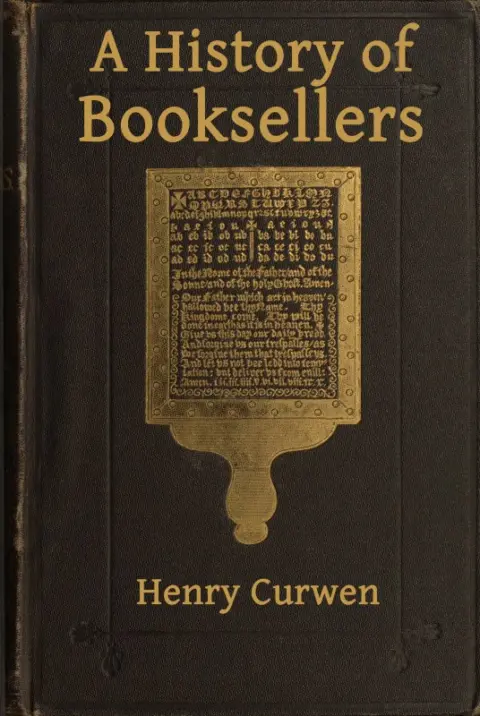
"A History of Booksellers, the Old and the New" by Henry Curwen is a historical account written in the late 19th century. This work chronicles the development of the bookselling and publishing industries, exploring the lives of significant figures and firms from ancient times to the modern era. The book aims to shine light on the literary struggles faced by various booksellers and publishers while providing insights into the broader history of literature itself. The opening of the volume sets the tone by contextualizing the early bookselling trade, tracing its roots back to ancient Rome and the work of manuscript copyists. It discusses the evolution of the industry, highlighting how books were once laboriously produced by slaves and the rise of publishing as a structured profession. Curwen emphasizes that the book aims to deliver a focused narrative despite the expansive nature of its subject, and reflects on the challenges and triumphs faced by the tradespeople involved in the history of bookselling. Overall, this introduction serves as a foundational overview, inviting readers into an exploration of the intricate relationship between literature and commerce throughout history.
Introduction adapted from the source catalogue; source summaries may be automatically generated.
Free to read · English · 132,573 words · No account needed
MAKE TIME FOR A GOOD BOOK
On by default. Untick to stop anonymous reading totals. Each page counts after 10 seconds in view. How this works.
Anonymous counting is on unless you have switched it off.
[11]
I. “On Dryden.” (E. R., 1828.)
II. “History.” (E. R., 1828.)
III. “Mirabeau.” (E. R., 1832.)
IV. “Cowley and Milton.”
V. “Mitford’s Greece.”
VI. “Athenian Orator.”
VII. “Barère’s Memoirs.”
VIII. “Mill’s Essay on Government.” (E. R., 1829.)
IX. “Bentham’s Defence of Mill.” (E. R., 1829.)
X. “Utilitarian Theory of Government.” (E. R., 1829.)
XI. “Charles Churchill.”
Many of these may be found in the volume of Miscellanies published by Longmans. It has been denied that No. XI. is by Macaulay at all.
[12] For a further account of these extraordinary sales, see Allibone’s Dictionary of English Literature, vol. ii., from which many of the above facts have been drawn.
[13] Among the sufferers by this failure was the family of Robert Watt, M.D., author of “Bibliotheca Britannica,” for which £2000 had been given in bills, all of which were dishonoured. He was a ploughboy until his seventeenth year, wrote many medical treatises, and occupied his concluding years with a work precious and indispensable to every student. The whole plan of the “Bibliotheca” is new, and few compilations of similar magnitude and variety ever presented, in a first edition, a more complete design and execution.
[14] Quarterly Review, vol. lxx.
[15] Given to Dallas.
[16] Published by James Power, music seller.
[17] Written at Geneva, and published by John Hunt, London.
[18] This sketch was written before the publication of Mr. W. Chambers’s life of his brother, but has been revised in accordance with that interesting memoir.
[19] Mr. Long has deposited in the Public Library at Brighton his private copy of the “Encyclopædia,” interleaved with the names of the contributors, and other interesting information as to the progress of the work.
[20] Mr. G. W. M. Reynolds, of the “Mysteries of London” notoriety, commenced life also as a temperance lecturer, and was at one time editor of the Teetotaller Newspaper.
[21] Lockhart, in his article in the Quarterly, says that Hook’s diary shows a clear profit of £2000 on the first series. This must be incorrect.
[22] The term Conger is ingeniously said to be derived from the eel, meaning that the association, collectively, would swallow all smaller fry.
[23] Aldine Magazine, p. 50.
[24] It was from the intricacy of thought of some few of the poems of the “Christian Year,” that Sydney Smith christened it by the name of “The Sunday Puzzle.”
[25] For the facts in the earlier portion of this memoir we are indebted to an interesting obituary notice in the Bookseller.
[26] For a very interesting bibliographical account of Mr. Tennyson’s works, showing the various changes which the poems have undergone, see “Tennysoniana,” by R. H. Shepherd (1856).
[27] For a full account of this interesting and successful bookseller see “Life of Alderman Kelly,” by the Rev. R. C. Fell (1856).
Your reading position is saved on this browser. Take it to another device with a library code. Reading pages adapt to text, rather than matching a printed edition.
BEHIND THE BOOK
This eBook is for the use of anyone anywhere in the United States and most other parts of the world at no cost and with almost no restrictions whatsoever. You may copy it, give it away or re-use it under the terms of the Project Gutenberg License included with this eBook or online at www.gutenberg.org. If you are not located in the United States, you will have to check the laws of the country where you are located before using this eBook. Read the source licence.
The original source file, including credits and licence, is retained by this library. Request an original-format copy at no charge. Please include the book title and Project Gutenberg identifier #52362.
KEEP YOUR CURIOSITY GOING
Cécile Tormay

Moritz Busch
John L. Ransom
Frances Wright
Cécile Tormay

Mabel Potter Daggett