THE CLASSIC COLLECTION✦An outlaw’s diary: the CommuneCLASSIC FREE BOOKS
An outlaw’s diary: the Commune
Cécile Tormay
THE CLASSIC COLLECTION · 1873
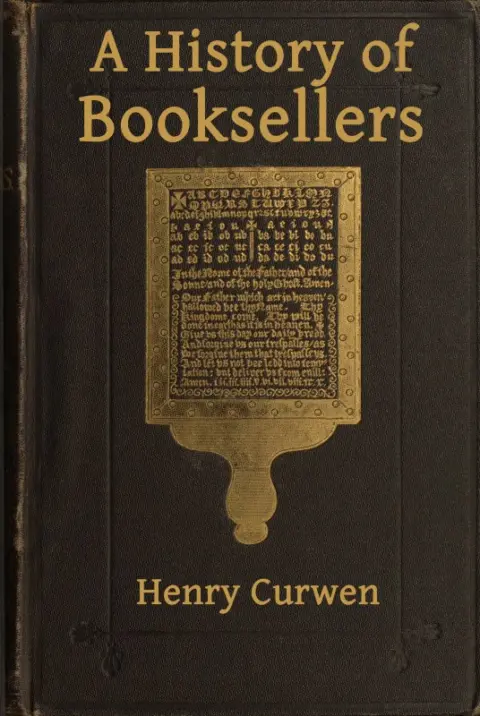
"A History of Booksellers, the Old and the New" by Henry Curwen is a historical account written in the late 19th century. This work chronicles the development of the bookselling and publishing industries, exploring the lives of significant figures and firms from ancient times to the modern era. The book aims to shine light on the literary struggles faced by various booksellers and publishers while providing insights into the broader history of literature itself. The opening of the volume sets the tone by contextualizing the early bookselling trade, tracing its roots back to ancient Rome and the work of manuscript copyists. It discusses the evolution of the industry, highlighting how books were once laboriously produced by slaves and the rise of publishing as a structured profession. Curwen emphasizes that the book aims to deliver a focused narrative despite the expansive nature of its subject, and reflects on the challenges and triumphs faced by the tradespeople involved in the history of bookselling. Overall, this introduction serves as a foundational overview, inviting readers into an exploration of the intricate relationship between literature and commerce throughout history.
Introduction adapted from the source catalogue; source summaries may be automatically generated.
Free to read · English · 132,573 words · No account needed
MAKE TIME FOR A GOOD BOOK
On by default. Untick to stop anonymous reading totals. Each page counts after 10 seconds in view. How this works.
Anonymous counting is on unless you have switched it off.
“Gave unto the man in plain apparel a tablet containing the names of those upon whom he should call; and when he called they came, and whomsoever he asked he came....
“And the first which came was after the likeness of the beautiful leopard, from the valley of the palm-trees, whose going forth was comely as the greyhound, and his eyes like the lightning of fiery flame (Professor Wilson, author of the ‘Isle of Palms.’)...
“There came also from a far country, the scorpion which delighteth to sting the faces of men, that he might sting sorely the countenance of the man which is crafty, and of the two beasts (Lockhart).
“Also the great wild boar from the forest of Lebanon, and he roused up his spirit; and I saw him whetting his dreadful tusks for the battle” (James Hogg).
Then come Dr. Macrie, Sir William Hamilton, Arthur Mower, “and the hyæna that escheweth the light, and cometh forth at eventide to raise up and gnaw the bones of the dead, and it is as a riddle unto a vain man (Riddell, the legal antiquarian).
“And the beagle and the slowhound after their kind, and all the beasts of the field, more than could be numbered, they were so many.”
In Chapter III., Constable finds that the “bear” and the “lamb” are unprofitable servants, and he, too, calls for aid, but Jeffrey--“the familiar spirit unto whom he had sold himself”--Leslie, and Playfair--contributors to the Edinburgh--refuse to come. In Chapter IV., Constable does get aid from Macney Napier, and others.
“And when I saw them all gathered together, I said unto myself, Of a truth the man which is crafty hath many in his host, yet, think I, that scarcely will these be found sufficient against them which are in the gates of the man who is clothed in plain apparel....
“Verily the man which is crafty shall be defeated, and there shall not escape one to tell of his overthrow.
“And while I was yet speaking, the hosts drew near, and the city was moved; and my spirit failed within me, and I was sore afraid, and I turned to escape away.
“And he that was like unto the messenger of a king, said unto me, Cry: and I said, What shall I cry? for the day of vengeance is come upon all those that ruled the nation with a rod of iron.
“And I fled into an inner chamber to hide myself, and I heard a great tumult, but I wist not what it was.”
It is very hard for us now to duly appreciate the crushing effect of
this Caldee manuscript.
Your reading position is saved on this browser. Take it to another device with a library code. Reading pages adapt to text, rather than matching a printed edition.
BEHIND THE BOOK
This eBook is for the use of anyone anywhere in the United States and most other parts of the world at no cost and with almost no restrictions whatsoever. You may copy it, give it away or re-use it under the terms of the Project Gutenberg License included with this eBook or online at www.gutenberg.org. If you are not located in the United States, you will have to check the laws of the country where you are located before using this eBook. Read the source licence.
The original source file, including credits and licence, is retained by this library. Request an original-format copy at no charge. Please include the book title and Project Gutenberg identifier #52362.
KEEP YOUR CURIOSITY GOING
Cécile Tormay

Moritz Busch
John L. Ransom
Frances Wright
Cécile Tormay

Mabel Potter Daggett