THE CLASSIC COLLECTION✦An outlaw’s diary: the CommuneCLASSIC FREE BOOKS
An outlaw’s diary: the Commune
Cécile Tormay
THE CLASSIC COLLECTION · 1873
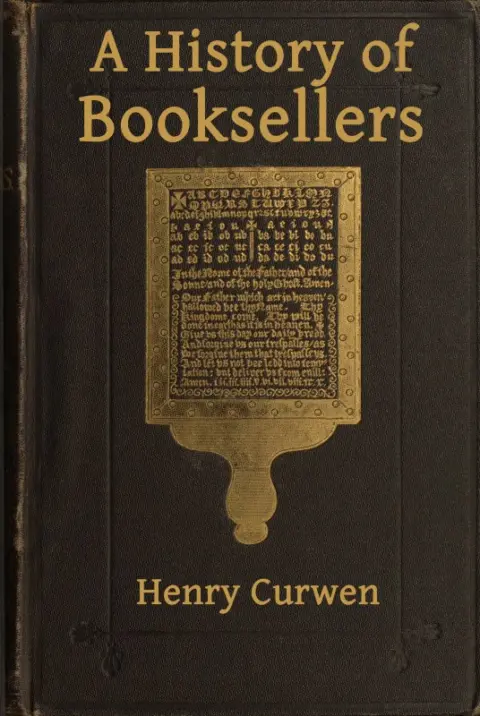
"A History of Booksellers, the Old and the New" by Henry Curwen is a historical account written in the late 19th century. This work chronicles the development of the bookselling and publishing industries, exploring the lives of significant figures and firms from ancient times to the modern era. The book aims to shine light on the literary struggles faced by various booksellers and publishers while providing insights into the broader history of literature itself. The opening of the volume sets the tone by contextualizing the early bookselling trade, tracing its roots back to ancient Rome and the work of manuscript copyists. It discusses the evolution of the industry, highlighting how books were once laboriously produced by slaves and the rise of publishing as a structured profession. Curwen emphasizes that the book aims to deliver a focused narrative despite the expansive nature of its subject, and reflects on the challenges and triumphs faced by the tradespeople involved in the history of bookselling. Overall, this introduction serves as a foundational overview, inviting readers into an exploration of the intricate relationship between literature and commerce throughout history.
Introduction adapted from the source catalogue; source summaries may be automatically generated.
Free to read · English · 132,573 words · No account needed
MAKE TIME FOR A GOOD BOOK
On by default. Untick to stop anonymous reading totals. Each page counts after 10 seconds in view. How this works.
Anonymous counting is on unless you have switched it off.
Goading had continued his general publishing business with some energy, and in 1751 he issued Blenerhasset’s “History of England”--from the landing of the Phœnicians to the death of George I.--and in his list of subscribers we find no less than eight Newcastle booksellers, one of whom was Martin Bryson, the friend and correspondent of Allan Ramsay, the Scotch poet and Edinburgh bookseller, who addressed a letter to him in rhyme--
“To Martin Bryson, on Tyne Brigg,
An upright, downright, honest Whig.”
Bryson’s name occurs on a title-page as early as 1722. His house and stock were destroyed by the great Newcastle fire of 1750, and after this occurrence he took, William Charnley, the son of a Penrith haberdasher and one of his many apprentices, into partnership.
To diverge for a moment from this pedigree of bibliopoles, we come to by far the greatest name connected in any way with the production of books at Newcastle--that, of course, of Thomas Bewick; and though his life belongs more properly to the history of engraving, for many years the books that were illustrated by his pencil gave the northern town such a world-wide reputation that we feel justified in devoting a page or two to his memory.
Thomas Bewick was born at Cherryburn, twelve miles to the west of Newcastle, in 1753, receiving a limited, but as far as it went a thorough education; his genius displayed itself in early childish days by such chalk drawings on barn-walls and stable-doors as have almost invariably discovered the bent of youthful artistic genius. At the age of fifteen he was apprenticed to Mr. Beilby, of Newcastle, an engraver in copper-plate, and though Beilby’s business lay rather in the production of brass door-plates, and the emblazoning of spoons and watches, than in Fine Art illustrations, the master soon appreciated and encouraged his pupil’s wonderful talents. During the period of his apprenticeship, young Bewick paid only ninepence a week for his lodging, and brought back a coarse brown loaf in every weekly visit to his home at Cherryburn. As soon as his term of seven years had expired, he still continued in Beilby’s service, but devoted himself henceforth to wood-engraving. Shortly afterwards he received a premium from the Society of Arts for a woodcut of the “Huntsman and the Old Hound,” and this induced him in the following year to go to London in quest of labour and fortune, but he found the metropolis so little to his liking that he writes home: “I would rather be herding sheep on Mickley Bank-top than remain in London, although for doing so I was to be made the premier of England.” With his distaste for town life and his strong love for the country--for its scenery changing with every season, for its living forms of animal and plant life, for all, in short, that incessantly appealed to a wonderful artistic instinct, Bewick was easily persuaded by his old master, Beilby, to return to Newcastle, and enter into partnership with him--his brother John becoming their joint apprentice. The publication of the illustrations to “Gay’s Fables,” and the “Select Fables,” by the brothers, spread their reputation far and wide, and placed them far above competition in the art. In 1785, Thomas Bewick began the cuts for his “History of Quadrupeds,” though the work was not completed and published until 1790. The “text,” or literary matter, was contributed by his partner, Beilby, but it was of course on account of the illustrations that three large editions were called for within three years. In this successful venture, the two partners were associated with a printer of the name of Hodgson, and unfortunately, after his death, the arrangement was made the grounds of dispute by his widow, and Bewick was compelled to remove the printing of the work to another establishment. In 1797 appeared the first volume of the “History of British Birds,” and almost immediately afterwards, Beilby retired from the partnership, leaving Bewick to produce and compile the work alone. The tail-pieces in the first edition of the Birds are considered Bewick’s chefs d’œuvres--as Professor Wilson says, “There is a moral in every tail-piece--a sermon in every vignette.... His books lie on our parlour, bed-room, dining-room, drawing-room and study tables, and are never out of place or time. Happy old man! The delight of childhood, manhood, decaying age!” After founding a famous school for wood-engravers at Newcastle--William Harvey was among his pupils--Bewick died in 1828, leaving the business to his son, Mr. R. E. Bewick.
Your reading position is saved on this browser. Take it to another device with a library code. Reading pages adapt to text, rather than matching a printed edition.
BEHIND THE BOOK
This eBook is for the use of anyone anywhere in the United States and most other parts of the world at no cost and with almost no restrictions whatsoever. You may copy it, give it away or re-use it under the terms of the Project Gutenberg License included with this eBook or online at www.gutenberg.org. If you are not located in the United States, you will have to check the laws of the country where you are located before using this eBook. Read the source licence.
The original source file, including credits and licence, is retained by this library. Request an original-format copy at no charge. Please include the book title and Project Gutenberg identifier #52362.
KEEP YOUR CURIOSITY GOING
Cécile Tormay

Moritz Busch
John L. Ransom
Frances Wright
Cécile Tormay

Mabel Potter Daggett