THE CLASSIC COLLECTION✦An outlaw’s diary: the CommuneCLASSIC FREE BOOKS
An outlaw’s diary: the Commune
Cécile Tormay
THE CLASSIC COLLECTION · 1873
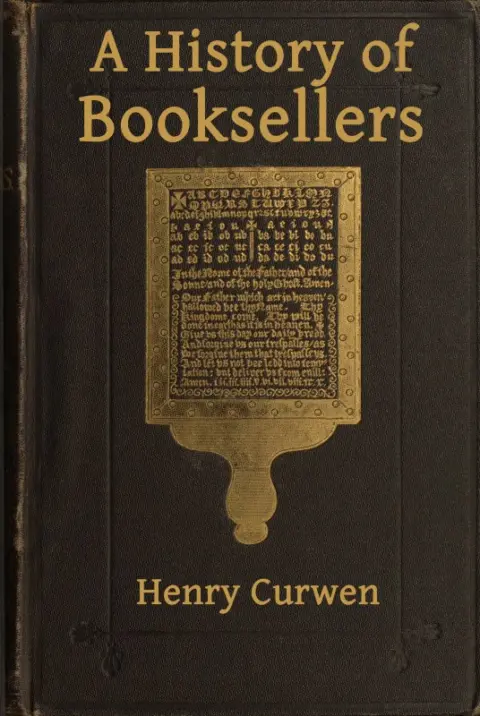
"A History of Booksellers, the Old and the New" by Henry Curwen is a historical account written in the late 19th century. This work chronicles the development of the bookselling and publishing industries, exploring the lives of significant figures and firms from ancient times to the modern era. The book aims to shine light on the literary struggles faced by various booksellers and publishers while providing insights into the broader history of literature itself. The opening of the volume sets the tone by contextualizing the early bookselling trade, tracing its roots back to ancient Rome and the work of manuscript copyists. It discusses the evolution of the industry, highlighting how books were once laboriously produced by slaves and the rise of publishing as a structured profession. Curwen emphasizes that the book aims to deliver a focused narrative despite the expansive nature of its subject, and reflects on the challenges and triumphs faced by the tradespeople involved in the history of bookselling. Overall, this introduction serves as a foundational overview, inviting readers into an exploration of the intricate relationship between literature and commerce throughout history.
Introduction adapted from the source catalogue; source summaries may be automatically generated.
Free to read · English · 132,573 words · No account needed
MAKE TIME FOR A GOOD BOOK
On by default. Untick to stop anonymous reading totals. Each page counts after 10 seconds in view. How this works.
Anonymous counting is on unless you have switched it off.
The lithographic establishment comprises a number of rooms. Sixteen machines and presses are constantly engaged, principally in the production of maps, book illustrations, coloured pictures, and the beautifully-tinted lithographic views, which Messrs. Nelson were mainly instrumental in introducing to the notice of the public. Among the artists employed here in executing preliminary work are photographers, draughtsmen, steel, copper, and wood engravers, and electrotypers. By a process patented by Messrs. Nelson, in conjunction with Mr. Ramage (to whose services they owe much of the superiority of their illustrations), a drawing or print may be converted into an engraving suitable for printing from by the simple action of light, and these engravings, either for copper-plate or letter-press printing, may be multiplied and made larger or smaller at will. The storerooms are said to contain upwards of fifty thousand wood-cuts and electrotypes.
Even the inks and varnishes are manufactured upon the premises.
Messrs. Thomas Nelson and Sons employ some four hundred and fifty
work-people in their establishment, about one-half of whom are young
women.
The whole of Scotland is of course supplied from the head-quarters in Hope Park; but they have also large branches in London and New York. The former--situated in, or rather forming, Warwick Buildings, at the corner of Paternoster Row--is, though a branch, as large a bookselling warehouse as any in London, and in its interior arrangements is unrivalled. The basement storey is devoted to the stowage of wholesale stock and the execution of export and country orders, and over the shop there are four lofty floors.
The Scotch have during the century especially cultivated the trade of printing and bookselling. In the former branch alone, ten thousand persons are employed in Scotland, five thousand of whom are engaged in the capital. In 1860 there were in Edinburgh no less than thirty firms, who combine the united business of publishing and bookselling, besides ninety who confine themselves to bookselling alone. The eight or nine leading houses, with one exception, print themselves the books they sell; a practice which is almost indigenous to Edinburgh, or, at all events, does not obtain in London. The advantage of cheap labour, which includes, of course, cheap paper, are here so great, especially in the issue of large editions, as to more than counteract the drawback in the shape of transit cost to, and agents’ commission in, London. We have already entered into the history of several of these leading Edinburgh houses, and as our space is growing scanty, we can scarcely now do more than mention the firm of Oliver and Boyd; and though, from their long standing and importance, the career of the house would afford material for an interesting chapter, we must hope to have an opportunity of recurring to the subject at a not very distant time. Formerly Oliver and Boyd enjoyed a very large share of the Scotch country business, and occupied indeed much the same position in the northern, as is held by Simpkin, Marshall, and Co., in the southern, capital. Of later years, however, their attention has been more exclusively fixed upon the publication of educational works, and among the writers whose books have been issued by them, the names of Spalding, Reid, Morell, White, and McCulloch, are known to every schoolboy. “The Edinburgh Academy Class-Books” have also attained a very wide circulation far beyond the walls of the Edinburgh Academy; and “Oliver and Boyd’s Catechisms,” published at the low price of ninepence each, are used in nearly all elementary classes where science, in any form, is taught. As a book of reference for students of every grade, of a larger growth, Oliver and Boyd’s Edinburgh Almanac is, perhaps, unrivalled for the fulness and yet conciseness of every branch of official information, at all essential to the inhabitants of Scotland.
Your reading position is saved on this browser. Take it to another device with a library code. Reading pages adapt to text, rather than matching a printed edition.
BEHIND THE BOOK
This eBook is for the use of anyone anywhere in the United States and most other parts of the world at no cost and with almost no restrictions whatsoever. You may copy it, give it away or re-use it under the terms of the Project Gutenberg License included with this eBook or online at www.gutenberg.org. If you are not located in the United States, you will have to check the laws of the country where you are located before using this eBook. Read the source licence.
The original source file, including credits and licence, is retained by this library. Request an original-format copy at no charge. Please include the book title and Project Gutenberg identifier #52362.
KEEP YOUR CURIOSITY GOING
Cécile Tormay

Moritz Busch
John L. Ransom
Frances Wright
Cécile Tormay

Mabel Potter Daggett