THE CLASSIC COLLECTION✦An outlaw’s diary: the CommuneCLASSIC FREE BOOKS
An outlaw’s diary: the Commune
Cécile Tormay
THE CLASSIC COLLECTION · 1873
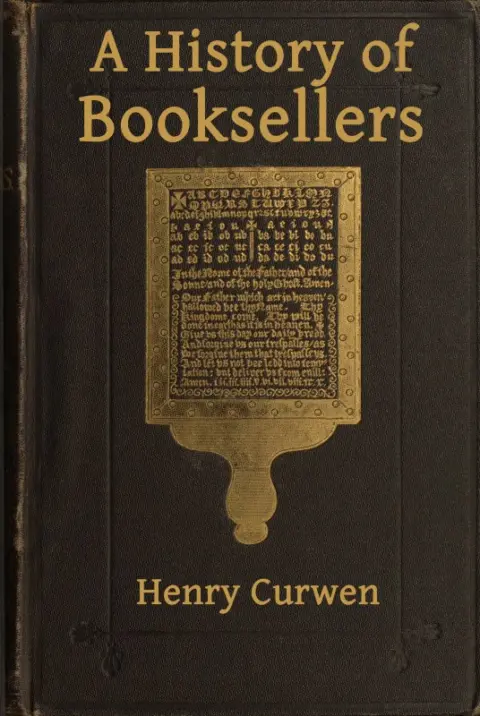
"A History of Booksellers, the Old and the New" by Henry Curwen is a historical account written in the late 19th century. This work chronicles the development of the bookselling and publishing industries, exploring the lives of significant figures and firms from ancient times to the modern era. The book aims to shine light on the literary struggles faced by various booksellers and publishers while providing insights into the broader history of literature itself. The opening of the volume sets the tone by contextualizing the early bookselling trade, tracing its roots back to ancient Rome and the work of manuscript copyists. It discusses the evolution of the industry, highlighting how books were once laboriously produced by slaves and the rise of publishing as a structured profession. Curwen emphasizes that the book aims to deliver a focused narrative despite the expansive nature of its subject, and reflects on the challenges and triumphs faced by the tradespeople involved in the history of bookselling. Overall, this introduction serves as a foundational overview, inviting readers into an exploration of the intricate relationship between literature and commerce throughout history.
Introduction adapted from the source catalogue; source summaries may be automatically generated.
Free to read · English · 132,573 words · No account needed
MAKE TIME FOR A GOOD BOOK
On by default. Untick to stop anonymous reading totals. Each page counts after 10 seconds in view. How this works.
Anonymous counting is on unless you have switched it off.
To return, however, to Moxon, we find that in 1835, conjointly with Longman, he published Wordsworth’s “Yarrow Revisited,” and shortly after this the poet transferred all his works from the Messrs. Longman, and we believe that Moxon purchased the copyrights of the past poems for the sum of one thousand pounds.
Mr. Browning’s earlier volumes, like Mr. Tennyson’s “Lyrical Poems,” had been published by Effingham Wilson, but in 1840 Moxon issued “Sordello.” This was followed by “Bells and Pomegranates,” published in numbers between 1842 and 1845, and by a “Blot in the Scutcheon,” (acted at Drury Lane in 1843), and which, though unsuccessful on the stage, was in the opinion of Charles Dickens “the finest poem of the century.” In 1848, however, Mr. Browning removed his works to the care of Messrs. Chapman and Hall.
Among the other authors whose productions were issued by Moxon somewhere at this period, and whom we cannot do more than mention, were Talfourd, Monkton Milnes (Lord Houghton), Tom Hood, Barry Cornwall (Proctor), Sheridan Knowles (who was by turn an usher, a journalist, a dramatic poet, and a dissenting minister), Quillinan (whose works Landor wittily, though unjustly, described as Quillinanities), Mr. Browning (for a brief period only), Haydn, and Dana.
Mr. Tennyson had been silent for ten years, had been maturing his talents, been mourning for the death of his friend Hallam, and probably during the whole of this time not a thousand copies of his poems had been sold. But he was already acknowledged as one of our greatest living poets by a small and ardent band of admirers, and in 1842 he was induced to break his long silence and publish an edition of his poems in two volumes, of which the second was composed entirely of new pieces, and in the first some were new, and many had been re-written. By this time his success was publicly and generally acknowledged, and fresh editions were called for in 1843, 1845, 1847, and from that date in still more rapid succession. The beauty and purity of his poems attracted royal favour, and in 1846 he received a pension from the crown, and this unfortunately gave offence to some rivals in the divine art, and Lord Lytton in the “New Timon” attacked “Schoolmiss Alfred.” To this Mr. Tennyson replied by a poem published in Punch (February, 1846), which may be summed up in the two words, “Thou bandbox.” In 1843, Wordsworth, in a letter to Reed, says, “I saw Tennyson when I was in London several times. He is decidedly the first of our living poets (sic), and I hope will live to give the world still better things. You will be pleased to hear that he expressed, in the strongest terms, his gratitude to my writings. To this I was far from indifferent, though persuaded that he is not much in sympathy with what I should myself most value in my attempts, viz., the spirituality with which I have endeavoured to invest the material universe, and the moral relations under which I have wished to exhibit its most ordinary appearances.” Again, in 1848, Mr. Emerson, in describing a visit to Wordsworth, says, “Tennyson, he thinks, a right poetic genius, though with some affectation. He had thought an elder brother of Tennyson at first the better poet, but must now reckon Alfred the true one.”
Your reading position is saved on this browser. Take it to another device with a library code. Reading pages adapt to text, rather than matching a printed edition.
BEHIND THE BOOK
This eBook is for the use of anyone anywhere in the United States and most other parts of the world at no cost and with almost no restrictions whatsoever. You may copy it, give it away or re-use it under the terms of the Project Gutenberg License included with this eBook or online at www.gutenberg.org. If you are not located in the United States, you will have to check the laws of the country where you are located before using this eBook. Read the source licence.
The original source file, including credits and licence, is retained by this library. Request an original-format copy at no charge. Please include the book title and Project Gutenberg identifier #52362.
KEEP YOUR CURIOSITY GOING
Cécile Tormay

Moritz Busch
John L. Ransom
Frances Wright
Cécile Tormay

Mabel Potter Daggett