THE CLASSIC COLLECTION✦An outlaw’s diary: the CommuneCLASSIC FREE BOOKS
An outlaw’s diary: the Commune
Cécile Tormay
THE CLASSIC COLLECTION · 1873
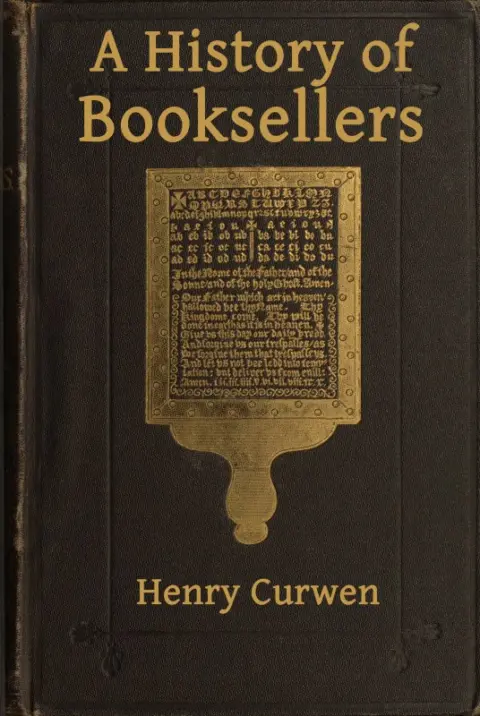
"A History of Booksellers, the Old and the New" by Henry Curwen is a historical account written in the late 19th century. This work chronicles the development of the bookselling and publishing industries, exploring the lives of significant figures and firms from ancient times to the modern era. The book aims to shine light on the literary struggles faced by various booksellers and publishers while providing insights into the broader history of literature itself. The opening of the volume sets the tone by contextualizing the early bookselling trade, tracing its roots back to ancient Rome and the work of manuscript copyists. It discusses the evolution of the industry, highlighting how books were once laboriously produced by slaves and the rise of publishing as a structured profession. Curwen emphasizes that the book aims to deliver a focused narrative despite the expansive nature of its subject, and reflects on the challenges and triumphs faced by the tradespeople involved in the history of bookselling. Overall, this introduction serves as a foundational overview, inviting readers into an exploration of the intricate relationship between literature and commerce throughout history.
Introduction adapted from the source catalogue; source summaries may be automatically generated.
Free to read · English · 132,573 words · No account needed
MAKE TIME FOR A GOOD BOOK
On by default. Untick to stop anonymous reading totals. Each page counts after 10 seconds in view. How this works.
Anonymous counting is on unless you have switched it off.
This will perhaps suffice as a specimen of the productions of Moxon’s muse, though the first lines in the volume, a “Sonnet to a Nightingale,” are inviting. They had been the cause of much pleasantry among the author’s friends, as having been penned by one who had never heard the song of the bird to which they were addressed, and the internal evidence upon this point is indubitably strong; the sonnet perhaps, to state it in proportion, is to Keats’s “Ode to the Nightingale,” as the owl’s screeching “too-whit” to “Sweet quired Philomela.”
By this time, however, Moxon, in spite of his bad poetry, had made a wide reputation as a poetical publisher, and from his establishment was issued, not only all that was most valuable of contemporary poetical literature, but with true catholic taste, the works of our older dramatic poets, edited for the most part by the Rev. Alexander Dyce. By degrees, too, Moxon was enabled to add to his catalogue the works of many of the poets who had shed a lustre upon the two first decades of this century, especially the works of Keats, Shelley, and Leigh Hunt.
In 1839 he brought out Mrs. Shelley’s edition of her husband’s poems--the first “complete edition” that had been published. In the following year a bookseller in the Strand named Hetherington was indicted for selling a work entitled “Haslam’s Letters to the Clergy of all Denominations,” and was sentenced to four months’ imprisonment, as having published in this volume sundry “libels” against the Old Testament. While the trial was pending, Hetherington commissioned a servant of his, named Holt, to purchase copies of “Shelley’s Poems” from the publisher, and from the retail dealers, and then obtained a similar indictment against Moxon. The celebrated trial the “Queen v. Moxon” was of course the result. The prosecution relied chiefly upon certain passages in “Queen Mab,” more especially in the notes, and these were read in order to prove the charge of blasphemy. Mr. Serjeant Talfourd was engaged for the defence. “I am called,” he commenced, “from the bar in which I usually practise, to defend from the odious charge of blasphemy one with whom I have been acquainted for many years--one whom I have always believed incapable of wilful offence towards God or towards man--one who was introduced to me in early days, by the dearest of my friends who has gone before--by Charles Lamb--to whom the wife of the defendant was an adopted daughter.” After a magnificent oration in which he asked, with a fitting indignation, “if the publisher of any penny blasphemy is to have the right of prescribing to us legally that such and such pages are to be torn from the treasured volumes of our choicest literature,” he left in the hands of the jury “the cause of genius--the cause of learning--the cause of history--the cause of thought,” and concluded by a tribute to Moxon’s character--“beginning his career under the auspices of Rogers, the eldest of a great age of poets, and blessed with the continued support of that excellent person, who never broke by one unworthy line the charm of moral grace which pervades his works, he has been associated with Lamb, whose kindness ennobled all sects, all parties, all classes, and whose genius shed new and pleasant lights on daily life; with Southey, the pure and childlike in heart; with Coleridge, in the light of whose Christian philosophy the indicted poems would assume their true character, as mournful, yet salutary, specimens of powers developed imperfectly in this world; and with Wordsworth, whose works, so long neglected and scorned, but so long silently nurturing tastes for the lofty and the pure, it has been Mr. Moxon’s privilege to diffuse largely throughout this and other lands, and with them the sympathies which link the human heart to nature and to God, and all classes of mankind to each other.” Lord Denman, before whom the case was tried, instructed the jury, in his summing up, to administer the law as it undoubtedly stood, though he himself was of opinion that the best and most effectual method of acting in regard to such doctrines was to refute them by argument and reasoning rather than by persecution. The jury accordingly returned a verdict of guilty, unaccompanied by any observation whatsoever. The illegal passages were eliminated for a time; and thus the matter ended. The trial took place in June, 1841, at a time when Moxon was in great sorrow for the loss of his eldest son, and much sympathy was exhibited towards him.
Your reading position is saved on this browser. Take it to another device with a library code. Reading pages adapt to text, rather than matching a printed edition.
BEHIND THE BOOK
This eBook is for the use of anyone anywhere in the United States and most other parts of the world at no cost and with almost no restrictions whatsoever. You may copy it, give it away or re-use it under the terms of the Project Gutenberg License included with this eBook or online at www.gutenberg.org. If you are not located in the United States, you will have to check the laws of the country where you are located before using this eBook. Read the source licence.
The original source file, including credits and licence, is retained by this library. Request an original-format copy at no charge. Please include the book title and Project Gutenberg identifier #52362.
KEEP YOUR CURIOSITY GOING
Cécile Tormay

Moritz Busch
John L. Ransom
Frances Wright
Cécile Tormay

Mabel Potter Daggett