THE CLASSIC COLLECTION✦An outlaw’s diary: the CommuneCLASSIC FREE BOOKS
An outlaw’s diary: the Commune
Cécile Tormay
THE CLASSIC COLLECTION · 1873
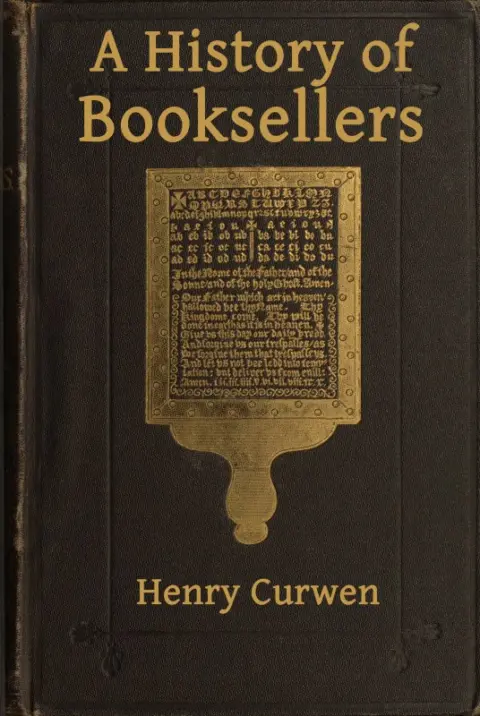
"A History of Booksellers, the Old and the New" by Henry Curwen is a historical account written in the late 19th century. This work chronicles the development of the bookselling and publishing industries, exploring the lives of significant figures and firms from ancient times to the modern era. The book aims to shine light on the literary struggles faced by various booksellers and publishers while providing insights into the broader history of literature itself. The opening of the volume sets the tone by contextualizing the early bookselling trade, tracing its roots back to ancient Rome and the work of manuscript copyists. It discusses the evolution of the industry, highlighting how books were once laboriously produced by slaves and the rise of publishing as a structured profession. Curwen emphasizes that the book aims to deliver a focused narrative despite the expansive nature of its subject, and reflects on the challenges and triumphs faced by the tradespeople involved in the history of bookselling. Overall, this introduction serves as a foundational overview, inviting readers into an exploration of the intricate relationship between literature and commerce throughout history.
Introduction adapted from the source catalogue; source summaries may be automatically generated.
Free to read · English · 132,573 words · No account needed
MAKE TIME FOR A GOOD BOOK
On by default. Untick to stop anonymous reading totals. Each page counts after 10 seconds in view. How this works.
Anonymous counting is on unless you have switched it off.
Finally, Colburn, having acquired an ample competence, retired from business, in favour of Messrs. Hurst and Blackett, still, however, retaining his name to some favourite copyrights. He had been twice married, the second time, in 1841, to the daughter of Captain Crosbie, R.N.
After a period of well-earned leisure, rendered pleasingly genial by the constant society of his literary friends, Henry Colburn died, on the 16th of August, 1855, at his house in Bryanston Square.
The whole of his property was sworn to be under £35,000, and went to his wife and her family. Two years later, the seven copyrights he had reserved were sold by auction, and realised the large sum of £14,000, to which Miss Strickland’s “Lives of the Queens of England” alone contributed £6900.
As publisher of three volume novels, Colburn was succeeded by two principal rival houses, with the foundation of each of which he was in some way concerned. As Mr. Bentley’s establishment in New Burlington Street was only a further development of Colburn’s old house, a few words may not be out of place concerning it. In 1837, Mr. Bentley proposed to start a periodical to rival the New Monthly, and at the preliminary meeting it was proposed to call it the Wit’s Miscellany, but James Smith objected to this as being too pretentious, upon which Mr. Bentley proposed the title of Bentley’s Miscellany. “Don’t you think,” interposed Smith, “that that would be going too far the other way?” However, the name was adopted (Mr. Bentley denies the accuracy of this anecdote--but se non è vero, è ben trovato). One of the chief contributors to the new Miscellany was Barham, who had been a school chum of Mr. Bentley’s at St. Paul’s, and, until 1843, the “Ingoldsby Legends” delighted the public in the pages of the Miscellany. The last poem of the “Legends” was published in Colburn’s New Monthly, but by Barham’s express wish, the song he wrote on his death-bed, “As I Lay Athynkynge,” appeared, as fitly closing his career, in Bentley. The first editor of Bentley’s Miscellany, was no less a man than Charles Dickens, who had previously contributed the “Sketches by Boz” to the Morning Chronicle, and who soon, as the author of Pickwick, became the most popular writer of the day. Mr. Bentley was one of the first publishers to secure Dickens’s services, and in his magazine “Oliver Twist” appeared. The editorship afterwards passed into the hands of Mr. Harrison Ainsworth and Mr. A. Smith. For the magazine, as for his ordinary business, Mr. Bentley secured the aid of most of the writers who had graduated first under Colburn; and to enumerate them would, with the exception of “Father Prout,” be merely a repetition of names already mentioned, and those who have won popularity since then have scarcely yet had time to lose it. An amusing story, however, worth repeating, has been recently told by the Athenæum, anent “Eustace Conway,” a novel by the late Mr. Maurice. “We believe,” says that journal, “we are not going too far in telling the following story about it. Mr. Maurice sold the novel to the late Mr. Bentley somewhere about the year 1830; but the excitement caused by the Reform Bill being unfavourable to light literature, Mr. Bentley did not issue it till 1834, when he had quite lost sight of its author, then a curate in Warwickshire. The villain of the novel was called Captain Marryat; and Mr. Maurice, who first learned of the publication of his book from a review in our columns, had soon the pleasure of receiving a challenge from the celebrated Captain Marryat. Great was the latter’s astonishment on learning that the anonymous author of ‘Eustace Conway’ had never heard of the biographer of ‘Peter Simple,’ and, being in Holy Orders, was obliged to decline to indulge in a duel.” Mr. Bentley died in September, 1871, and was succeeded in the business by his son, who for many years had been associated with him.
Your reading position is saved on this browser. Take it to another device with a library code. Reading pages adapt to text, rather than matching a printed edition.
BEHIND THE BOOK
This eBook is for the use of anyone anywhere in the United States and most other parts of the world at no cost and with almost no restrictions whatsoever. You may copy it, give it away or re-use it under the terms of the Project Gutenberg License included with this eBook or online at www.gutenberg.org. If you are not located in the United States, you will have to check the laws of the country where you are located before using this eBook. Read the source licence.
The original source file, including credits and licence, is retained by this library. Request an original-format copy at no charge. Please include the book title and Project Gutenberg identifier #52362.
KEEP YOUR CURIOSITY GOING
Cécile Tormay

Moritz Busch
John L. Ransom
Frances Wright
Cécile Tormay

Mabel Potter Daggett