THE CLASSIC COLLECTION✦An outlaw’s diary: the CommuneCLASSIC FREE BOOKS
An outlaw’s diary: the Commune
Cécile Tormay
THE CLASSIC COLLECTION · 1873
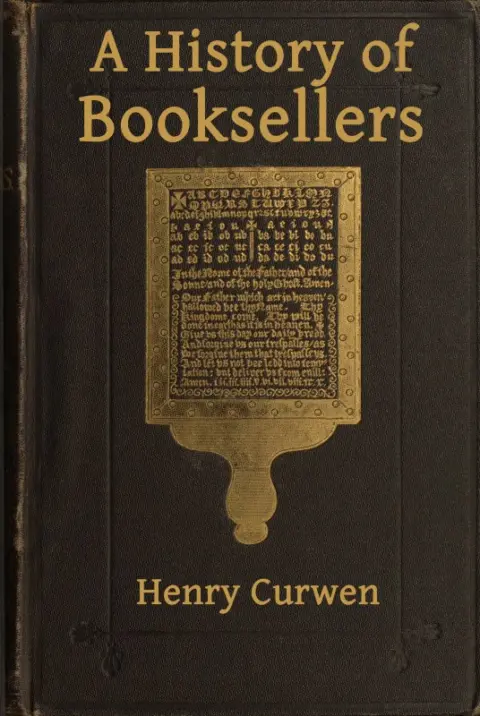
"A History of Booksellers, the Old and the New" by Henry Curwen is a historical account written in the late 19th century. This work chronicles the development of the bookselling and publishing industries, exploring the lives of significant figures and firms from ancient times to the modern era. The book aims to shine light on the literary struggles faced by various booksellers and publishers while providing insights into the broader history of literature itself. The opening of the volume sets the tone by contextualizing the early bookselling trade, tracing its roots back to ancient Rome and the work of manuscript copyists. It discusses the evolution of the industry, highlighting how books were once laboriously produced by slaves and the rise of publishing as a structured profession. Curwen emphasizes that the book aims to deliver a focused narrative despite the expansive nature of its subject, and reflects on the challenges and triumphs faced by the tradespeople involved in the history of bookselling. Overall, this introduction serves as a foundational overview, inviting readers into an exploration of the intricate relationship between literature and commerce throughout history.
Introduction adapted from the source catalogue; source summaries may be automatically generated.
Free to read · English · 132,573 words · No account needed
MAKE TIME FOR A GOOD BOOK
On by default. Untick to stop anonymous reading totals. Each page counts after 10 seconds in view. How this works.
Anonymous counting is on unless you have switched it off.
It was probably just after the publication of the first volume, in August, 1714, that Pope wrote his exquisitely humorous letter to the Earl of Burlington, describing a journey to Oxford, made in company with Lintot. “My lord, if your mare could speak, she would give an account of what extraordinary company she had on the road; which since she cannot do, I will.” Lintot had heard that Pope was “designed for Oxford, the seat of the Muses, and would, as my bookseller, by all means accompany me thither.... Mr. Lintot began in this manner: ‘Now, damn them, what if they should put it in the newspapers, how you and I went together to Oxford? What would I care? If I should go down into Sussex, they would say I was gone to the Speaker. But what of that? If my son were but big enough to go on with the business, by God! I would keep as good company as old Jacob.’... As Mr. Lintot was talking I observed he sat uneasy on his saddle, for which I expressed some solicitude. ‘’Tis nothing,’ says he; ‘I can bear it well enough, but since we have the day before us, methinks it would be very pleasant for you to rest awhile under the woods.’ When we alighted, ‘See here, what a mighty pretty Horace I have in my pocket! what if you amused yourself by turning an ode, till we mount again? Lord, if you pleased, what a clever Miscellany might you make at leisure hours.’ ‘Perhaps I may,’ said I, ‘if we ride on; the motion is an aid to my fancy, a round trot very much awakens my spirits; then jog on apace, and I’ll think as hard as I can.’
“Silence ensued for a full hour, after which Mr. Lintot tugged the reins, stopped short and broke out, ‘Well, sir, how far have you gone?’ I answered, ‘Seven miles.’ ‘Zounds, sir,’ said Lintot, ‘I thought you had done seven stanzas. Oldworth, in a ramble round Wimbleton hill, would translate a whole ode in half this time. I’ll say that for Oldworth (though I lost by his Sir Timothy’s), he translates an ode of Horace the quickest of any man in England. I remember Dr. King would write verses in a tavern three hours after he could not speak; and there’s Sir Richard, in that rambling old chariot of his, between Fleet ditch and St. Giles’s pound shall make half a job.’ ‘Pray, Mr. Lintot,’ said I, ‘now you talk of translators, what is your method of managing them?’ ‘Sir,’ replied he, ‘those are the saddest pack of rogues in the world; in a hungry fit, they’ll swear they understand all the languages in the universe. I have known one of them take down a Greek book upon my counter and cry, Ay, this is Hebrew. I must read it from the latter end. My God! I can never be sure of those fellows, for I neither understand Greek, Latin, French nor Italian myself.’ ‘Pray tell me next how you deal with the critics.’ ‘Sir’, said he, ‘nothing more easy. I can silence the most formidable of them; the rich ones for a sheet a-piece of the blotted manuscript, which costs me nothing; they’ll go about to their acquaintance and pretend they had it from the author, who submitted to their correction: this has given some of them such an air, that in time they come to be consulted with, and dictated to as the top critic of the town. As for the poor critics, I’ll give you one instance of my management, by which you may guess at the rest. A lean man, that looks like a very good scholar, came to me t’other day; he turned over your Homer, shook his head, shrugged up his shoulders, and pished at every line of it. One would wonder, says he, at the strange presumption of some men; Homer is no such easy task, that every stripling, every versifier--He was going on, when my wife called to dinner. ‘Sir,’ said I, ‘will you please to eat a piece of beef with me?’ ‘Mr. Lintot,’ said he, ‘I am sorry you should be at the expense of this great book; I am really concerned on your account.’ ‘Sir, I am much obliged to you; if you can dine upon a piece of beef, together with a slice of pudding.’ ‘Mr. Lintot, I do not say but Mr. Pope, if he would condescend to advise with men of learning--’ ‘Sir, the pudding is on the table, if you please to go in.’ My critic complies, he comes to a taste of your poetry, and tells me in the same breath that the book is commendable and the pudding excellent. These, my lord, are a few traits by which you may discern the genius of Mr. Lintot, which I have chosen for the subject of a letter. I dropt him as soon as I got to Oxford.”
Your reading position is saved on this browser. Take it to another device with a library code. Reading pages adapt to text, rather than matching a printed edition.
BEHIND THE BOOK
This eBook is for the use of anyone anywhere in the United States and most other parts of the world at no cost and with almost no restrictions whatsoever. You may copy it, give it away or re-use it under the terms of the Project Gutenberg License included with this eBook or online at www.gutenberg.org. If you are not located in the United States, you will have to check the laws of the country where you are located before using this eBook. Read the source licence.
The original source file, including credits and licence, is retained by this library. Request an original-format copy at no charge. Please include the book title and Project Gutenberg identifier #52362.
KEEP YOUR CURIOSITY GOING
Cécile Tormay

Moritz Busch
John L. Ransom
Frances Wright
Cécile Tormay

Mabel Potter Daggett