THE CLASSIC COLLECTION✦My diaries, being a personal narrative of events 1888-1914, Part 2 (1900-1914)CLASSIC FREE BOOKS
My diaries, being a personal narrative of events 1888-1914, Part 2 (1900-1914)
Wilfrid Scawen Blunt
THE CLASSIC COLLECTION · 1920
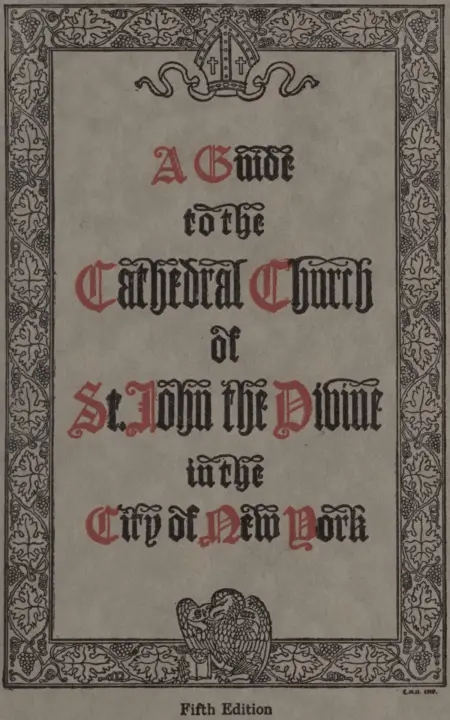
"A Guide to the Cathedral Church of Saint John the Divine in the City of New York," by Edward Hagaman Hall, is a guidebook written in the early 20th century. It explores the significance, architecture, and spiritual purpose of the Cathedral of St. John the Divine, aiming to inform visitors about its symbolism and the experiences it offers. The book emphasizes an inclusive approach to worship and the community role of the Cathedral, making it accessible to people of all backgrounds. The opening of the guide presents the Cathedral as a monumental institution that serves multiple purposes: a place for spiritual reflection, community gathering, and artistic appreciation. Hall provides insights into the Cathedral's construction history, its aesthetic features, and the emotions it evokes in visitors, such as feelings of humility and inspiration. He also describes its unique position in New York City amidst major institutions, emphasizing its aspiration to nurture the soul through its grandeur and the beautiful artistic expressions woven into its very fabric.
Introduction adapted from the source catalogue; source summaries may be automatically generated.
Free to read · English · 27,703 words · No account needed
MAKE TIME FOR A GOOD BOOK
On by default. Untick to stop anonymous reading totals. Each page counts after 10 seconds in view. How this works.
Anonymous counting is on unless you have switched it off.
“All power is given unto me in heaven and earth ‖ Go ye therefore, and teach all nations, baptizing ‖ them in the name of the Father, and of the Son, and ‖ of the Holy Ghost; teaching them to observe all ‖ things whatsoever I have commanded you; and lo ‖ I am with you always even unto the end of the world” (Mat. xxviii. 18-20).
The archivolt outside of the tympanum is composed of three ranges of Gothic niches in the voussoirs, containing 36 little figures in the round. The outer range represents 14 ancient and modern Apostles of Christianity as follows, beginning at the lowest figure on the left-hand side and reading upward to the center, and thence downward to the lowest right-hand figure: (1) Count Zinzendorf, 1700-1760, German reformer, founder of Moravian Brethren, missionary to American Indians; (2) St. Boniface, 680-755, Apostle of Germany; (3) St. Francis Xavier, 1506-1552, Apostle of the Indies, one of the founders of the Society of Jesus; (4) St. Denis, 3d century, Apostle of the Gauls, Patron Saint of France; (5) St. Olaf, 995-1030, Patron Saint and King of Norway; (6) St. Augustine, died 604, missionary to Britain, first Archbishop of Canterbury; (7) Innocent of Moscow, 1797-1879, Apostle of Alaska and Kamchatka, Archbishop of Moscow; (8) St. Patrick, circ. 372-460, Apostle and Patron Saint of Ireland; (9) John Eliot, 1604-1690, Apostle of American Indians, translator of Bible into Indian language; (10) St. Willibrod, 658-739, Apostle of the Frisians, Archbishop of Utrecht; (11) St. Cyril, 827-869, Apostle of the Slavs, inventor of the Cyrillic alphabet; (12) David Livingstone, 1813-1873, British explorer and missionary in Africa; (13) St. Columba, 521-597, Apostle of Caledonia; (14) Charles George Gordon, “Gordon Pasha,” 1833-1885, British General, promoter of Christianity in China and Egypt. The 12 figures in the middle range represent the Arts and Sciences. In the same order they are: (1) Natural Science, man with microscope; (2) Sculpture, man with mallet and chisel; (3) Medicine, man with book and skull; (4) Literature, woman reading a book; (5) Chemistry, woman holding aloft a retort; (6) Industrial Art, man with vase; (7) Painting, man with palette; (8) Astronomy, man with globe; (9) Mathematics, man wearing spectacles and gown, holding cone and truncated pyramid; (10) Physics, woman with telephone; (11) Music, man with violoncello; (12) Architecture, man[50] holding model of building. The 10 figures in the innermost range represent the Crafts and Industries, as follows: (1) Bookbinding, man making a book; (2) Agriculture, man sowing seed; (3) Metal Industry, man pouring molten metal from ladle; (4) Textile Industry, woman with distaff and shuttle; (5) Navigation, sailor holding telescope with rope at feet; (6) Building, man laying brick; (7) Engineering, man holding tape measure; (8) Fishing, sailor with seine; (9) Mining, man with pickaxe and miner’s cap; (10) Shoemaking, cobbler at his last. Below these, in niches in the splays and central pilaster of the door-way, are 7 larger figures representing Seven Famous Christian Rulers who have carried out the injunction in the tympanum, as follows, (left to right): (1) Emperor Constantine, once ruler of the Roman World and founder of Constantinople, who proclaimed religious toleration and presided over the council which adopted the Nicene Creed; (2) Charlemagne, King of the Franks, Emperor of the revived western Roman empire, who introduced Christianity into conquered countries, maintained popular assemblies, and promoted science, art and letters; (3) Alexis, one of the ablest Emperors of Byzantium and friend of the Crusaders; (4, in center) George Washington, to whose character as Christian soldier, statesman and first President of the United States, attaches local interest from the fact that he commanded the American troops in the Battle of Harlem Heights which was fought partly on the ground occupied by the Cathedral Close; (5) Gustavus Adolphus, King of Sweden, one of the greatest generals, who, with his army in Germany, saved the cause of Protestantism in the Thirty Years War; (6) St. Louis, King of France, the most distinguished monarch of his age, who was noted for his piety, justice and mercy, and who died on a Crusade; and (7) Alfred the Great, King of Wessex, who bore the brunt of the Danish invasions and was a promoter of education and Christianity. The sculptures are by John Evans & Co. of Boston. The Interior decoration of the high roof and open timbers of the truss-work in polychrome is typical of the Middle Ages and the wood panelling is a reminder of 15th century work. The latter is by Messrs. Wm. F. Ross & Co., of Cambridge, Mass. The grisaille windows are by Mr. Charles J. Connick of Boston. The main hall, which seats 800 on the floor and 400 in the gallery, has a large pipe organ built by the Ernest M. Skinner Co. of Boston. The Undercroft (basement) is equipped for use as a refectory. The building cost about $350,000. In the main vestibule, over the outer door-way, is this inscription:
Your reading position is saved on this browser. Take it to another device with a library code. Reading pages adapt to text, rather than matching a printed edition.
BEHIND THE BOOK
This eBook is for the use of anyone anywhere in the United States and most other parts of the world at no cost and with almost no restrictions whatsoever. You may copy it, give it away or re-use it under the terms of the Project Gutenberg License included with this eBook or online at www.gutenberg.org. If you are not located in the United States, you will have to check the laws of the country where you are located before using this eBook. Read the source licence.
The original source file, including credits and licence, is retained by this library. Request an original-format copy at no charge. Please include the book title and Project Gutenberg identifier #68112.
KEEP YOUR CURIOSITY GOING
Wilfrid Scawen Blunt
Wilfrid Scawen Blunt

E. W. (Edgar Watson) Howe

David Patterson (Spirit) Hatch

David Patterson (Spirit) Hatch

David Patterson (Spirit) Hatch