THE CLASSIC COLLECTION✦My diaries, being a personal narrative of events 1888-1914, Part 2 (1900-1914)CLASSIC FREE BOOKS
My diaries, being a personal narrative of events 1888-1914, Part 2 (1900-1914)
Wilfrid Scawen Blunt
THE CLASSIC COLLECTION · 1920
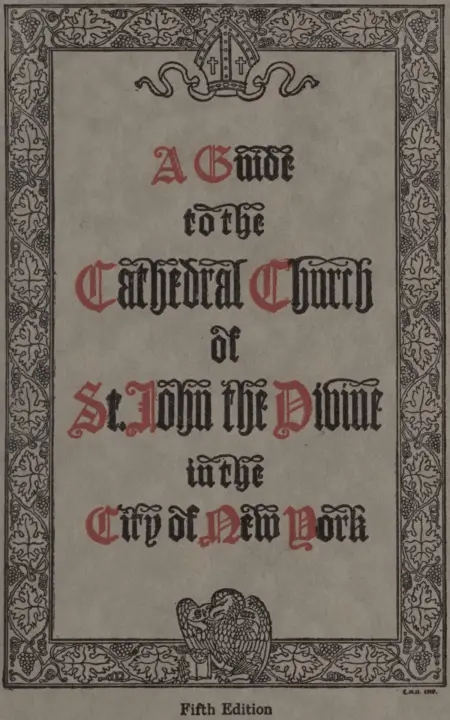
"A Guide to the Cathedral Church of Saint John the Divine in the City of New York," by Edward Hagaman Hall, is a guidebook written in the early 20th century. It explores the significance, architecture, and spiritual purpose of the Cathedral of St. John the Divine, aiming to inform visitors about its symbolism and the experiences it offers. The book emphasizes an inclusive approach to worship and the community role of the Cathedral, making it accessible to people of all backgrounds. The opening of the guide presents the Cathedral as a monumental institution that serves multiple purposes: a place for spiritual reflection, community gathering, and artistic appreciation. Hall provides insights into the Cathedral's construction history, its aesthetic features, and the emotions it evokes in visitors, such as feelings of humility and inspiration. He also describes its unique position in New York City amidst major institutions, emphasizing its aspiration to nurture the soul through its grandeur and the beautiful artistic expressions woven into its very fabric.
Introduction adapted from the source catalogue; source summaries may be automatically generated.
Free to read · English · 27,703 words · No account needed
MAKE TIME FOR A GOOD BOOK
On by default. Untick to stop anonymous reading totals. Each page counts after 10 seconds in view. How this works.
Anonymous counting is on unless you have switched it off.
Other Buildings, Etc.
The Bishop’s House
The Bishop’s House (A. on plan) is in French Gothic architecture of the chateau type, with lofty roof and high dormer windows, and is built of Germantown micaceous schist. It is designed to be connected with the Cathedral by cloisters, and is connected with the Deanery by a vaulted porch above which is to be built the Bishop’s private chapel. The extreme outside dimensions of the Bishop’s House are 77 by 126 feet, including the porch. The architects were Messrs. Cram & Ferguson.[49] The occupants of the house have been Bishop Greer from the time of its opening in 1914 until his death May 19, 1919; Bishop Burch from his installation October 28, 1919, until his death December 20, 1920; and Bishop Manning since his consecration on May 11, 1921.
The Deanery
The Deanery (B. on plan) adjoins the Bishop’s House as above mentioned. It is by the same architect, is in the same style but of a more domestic type, forms a part of the same architectural composition, and is built of the same kind of stone. It is not so lofty a structure as the Bishop’s House, but has many interesting details, particularly on the southern façade. Its extreme outside measurements are about 79 by 93 feet. The late Dean Grosvenor occupied the Deanery from the time of its erection until his death December 9, 1916, and was succeeded by Dean Robbins in June, 1917. A tablet in the porch is inscribed:
“The Deanery ‖ erected in ‖ Faithful Remembrance ‖ of ‖ Clinton Ogilvie ‖ 1838-1900 ‖ by his wife ‖ Helen Slade Ogilvie ‖ A. D. 1913.”
The Choir School
The Choir School (C. on Plan) has a special interest for everyone who goes to the Cathedral, for here are educated and trained the boys who sing in the Cathedral services. The school was founded by Bishop H. C. Potter in 1901 and was formerly located in the Old Synod House. The present building, erected in 1912 and built of the same kind of stone as the Bishop’s House and Deanery, is in the English Collegiate Gothic style of architecture; is three stories high, and has extreme outside dimensions of 83 by 150 feet. Messrs. Walter Cook and Winthrop A. Welch were the architects. The building contains offices, a general school room which is equipped with apparatus for both stereopticon and moving pictures, a choir rehearsal room with stalls, individual rooms for vocal and instrumental practice, a fine large common room with open fire-place for reading and social intercourse, dining room, kitchen, dormitories, a big gymnasium, a sick room to which a boy is transferred upon the first sign of any illness, etc. Accommodations are provided for 40 resident scholars and 20 day scholars. Their musical training is under the personal direction of the organist and Master of the Choristers, and their general education under the direction of the Head Master and staff of under-masters. A sympathetic House Mother looks out for the personal wants of the boys and directs the domestic service; and competent physicians and trained nurses are in attendance when necessary. Boys are admitted to the school at the age of 9 and remain until their voices change, which is usually between the ages of 13 and 14. They come from all parts of the United States and possessions, two boys recently having come from Alaska. An applicant is first received on probation, and if he manifests a good character and disposition, and gives promise of a good voice, he is accepted as a chorister. Until they become full choristers, vested with cassock and cotta, probationers sit in separate choir stalls in the Cathedral services and wear only their black student gowns. During their residence at the school, the boys are under strict but gentle discipline and have the finest education and musical training that can be given them. Their board, education and musical training are free, in return for which they give their services as choristers. When they leave the school, they are followed by the interest of the Cathedral organizations which endeavor to secure scholarships for their higher education. The men of the choir, of whom there are about 20, do not reside at the Choir School. The usual number of choristers, men and boys, in the Cathedral services is about 60, except during the summer vacation when the number is somewhat reduced. There is probably no finer choir school in the world, and the Cathedral music is the highest expression of this form of musical art in this country.
Your reading position is saved on this browser. Take it to another device with a library code. Reading pages adapt to text, rather than matching a printed edition.
BEHIND THE BOOK
This eBook is for the use of anyone anywhere in the United States and most other parts of the world at no cost and with almost no restrictions whatsoever. You may copy it, give it away or re-use it under the terms of the Project Gutenberg License included with this eBook or online at www.gutenberg.org. If you are not located in the United States, you will have to check the laws of the country where you are located before using this eBook. Read the source licence.
The original source file, including credits and licence, is retained by this library. Request an original-format copy at no charge. Please include the book title and Project Gutenberg identifier #68112.
KEEP YOUR CURIOSITY GOING
Wilfrid Scawen Blunt
Wilfrid Scawen Blunt

E. W. (Edgar Watson) Howe

David Patterson (Spirit) Hatch

David Patterson (Spirit) Hatch

David Patterson (Spirit) Hatch