THE CLASSIC COLLECTION✦My diaries, being a personal narrative of events 1888-1914, Part 2 (1900-1914)CLASSIC FREE BOOKS
My diaries, being a personal narrative of events 1888-1914, Part 2 (1900-1914)
Wilfrid Scawen Blunt
THE CLASSIC COLLECTION · 1920
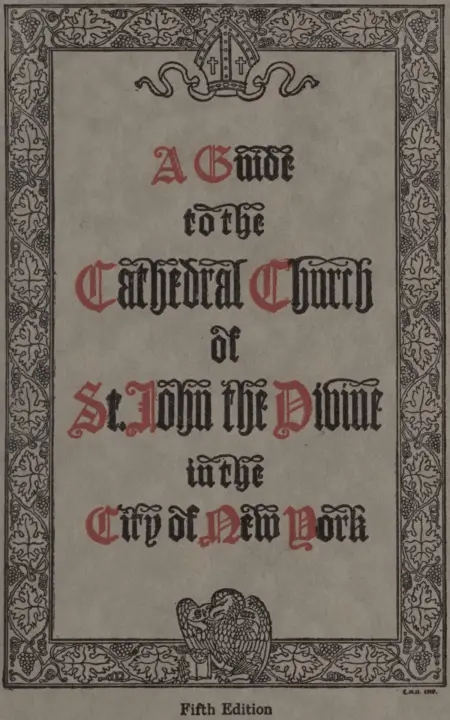
"A Guide to the Cathedral Church of Saint John the Divine in the City of New York," by Edward Hagaman Hall, is a guidebook written in the early 20th century. It explores the significance, architecture, and spiritual purpose of the Cathedral of St. John the Divine, aiming to inform visitors about its symbolism and the experiences it offers. The book emphasizes an inclusive approach to worship and the community role of the Cathedral, making it accessible to people of all backgrounds. The opening of the guide presents the Cathedral as a monumental institution that serves multiple purposes: a place for spiritual reflection, community gathering, and artistic appreciation. Hall provides insights into the Cathedral's construction history, its aesthetic features, and the emotions it evokes in visitors, such as feelings of humility and inspiration. He also describes its unique position in New York City amidst major institutions, emphasizing its aspiration to nurture the soul through its grandeur and the beautiful artistic expressions woven into its very fabric.
Introduction adapted from the source catalogue; source summaries may be automatically generated.
Free to read · English · 27,703 words · No account needed
MAKE TIME FOR A GOOD BOOK
On by default. Untick to stop anonymous reading totals. Each page counts after 10 seconds in view. How this works.
Anonymous counting is on unless you have switched it off.
On the left of the figures are St. Ansgarius with crozier (above) and Gustavus Adolphus with sword (below), while on the right are St. Olaf with crown and scepter (above) and Luther in gown with book (below). The Altar and Reredos were given by Mrs. Julia Grinnell Bowdoin. In the left (northern) wall of the Sanctuary is a niche made of stones from Worcester and Ely Cathedrals, England. On the upper surface of the stone bracket forming the shelf of the niche is carved “Ely 1320.” The stones from the Lady Chapel of Worcester Cathedral were given to the Cathedral of St. John the Divine by Canon George William Douglas of New York who procured them from Canon J. M. Wilson, Archdeacon of Worcester.[47] On the stones on either side of the recess is carved:
“These Stones from ‖ the Cathedral ‖ of Christ and ‖ St. Mary the Virgin ‖ Worcester, England, ‖ are Memorials to ‖ William Reed ‖ Huntington ‖ Sometime Rector ‖ of All Saints ‖ in Worcester ‖ Massachusetts.”
Three small Windows of two lights each in the Sanctuary contain (from left to right) representations of: (1) St. Willibrod with mitre, archiepiscopal staff, and model of cathedral; and St. Lucian with crown, scepter and sword; (2) St. Ansgarius with mitre and crozier; and King Olaf with crown and scepter; and (3) above the Reredos, St. Eric with crown and scepter; and St. Wilifred with mitre and archiepiscopal staff. The window spaces at the right of the latter are walled up because they are blanketed by the adjacent chapel. In the two bays of the north aisle are two noble stained glass windows, each having five lights and each light depicting two scenes. In the left hand or western window, the upper tier of scenes is chiefly devoted to Old Testament subjects as follows (left to right): Adam and Eve (Gen. ii. 7-25); the visit of the three angels to Abraham bearing the promise of the birth of Isaac (Gen. xviii. 2-22); St. Michael fighting the dragon with a cross-shaped spear (Rev. xii. 7); Abraham offering to sacrifice Isaac (Gen. xxii. 9-13); and Jacob’s dream of the ladder (Gen. xxviii. 12). In the lower tier are five scenes prophetic of the birth of the Forerunner of Christ and of Christ himself: The angel’s visit to Zacharias to foretell the birth of John the Baptist (Luke i. 13); the annunciation to the Virgin Mary of the coming birth of Christ (Luke i. 28); St. Gabriel with lilies as Angel of the Annunciation (Luke i. 28); the angels’ visit to the shepherds (Luke ii. 8-12); and the angel’s visit to Joseph, husband of Mary, to foretell the birth of Christ (Mat. i. 20). The right hand or eastern window depicts Acts of the Apostles. In its upper tier are: St. Peter preaching to the Disciples (Acts i. 15); St. Peter healing the lame man (Acts iii. 2-8); St. Peter with key; the stoning of St. Stephen (Acts vii. 59); and St. Philip baptizing the eunuch (Acts viii. 26-38); and in the lower tier: St. Peter raising Tabitha (Acts ix. 40); the conversion of St. Paul’s jailer at Philippi (Acts xvi. 23-31); St. Paul with sword; St. Paul laying hands on the Disciples (Acts xix. 6); and St. Paul before Felix (Acts xxiv. 24-25). All the windows are by Messrs. C. E. Kempe & Co. of London. In two high niches in the south wall are Statues of Eric, King of Sweden (left) and Canute, King of the English, Danes and Norwegians (right;) and in a niche at the west end of the north aisle is a statue of King Eskiel, all crowned. On the Ambulatory side of the entrance bay are two statues: John the Baptist (above) and St. Ansgarius with crozier and mitre, holding a small cathedral (below). The sculptures are by Mr. John Evans of Boston. In a bay of the chapel temporarily rests a symbolic group executed in Caen stone by Miss Malvina Hoffman of New York, entitled The Sacrifice. It is intended for Harvard University at Cambridge, Mass., as a memorial of Robert Bacon, sometime U. S. Ambassador to France and a Trustee of the University, and of the Harvard men who lost their lives in the World War. It represents a dead Crusader, such as those who went from Cambridge, Eng., in the 12th century, and gave their lives for an ideal, lying upon a cross with his head pillowed in a woman’s lap. According to the traditional position of the feet of the Crusader, he was one of those who never reached Jerusalem, those who did so being traditionally represented with their feet crossed. The woman may typify Alma Mater as well as those women who gave their best to a great cause and made their lonely grief their glory. The two figures symbolize mutual sacrifice. This chapel has an independent Organ played from a movable console on the floor. The chapel, which is the gift of many persons, was dedicated on April 3, 1918. On one of the walls is inscribed:
Your reading position is saved on this browser. Take it to another device with a library code. Reading pages adapt to text, rather than matching a printed edition.
BEHIND THE BOOK
This eBook is for the use of anyone anywhere in the United States and most other parts of the world at no cost and with almost no restrictions whatsoever. You may copy it, give it away or re-use it under the terms of the Project Gutenberg License included with this eBook or online at www.gutenberg.org. If you are not located in the United States, you will have to check the laws of the country where you are located before using this eBook. Read the source licence.
The original source file, including credits and licence, is retained by this library. Request an original-format copy at no charge. Please include the book title and Project Gutenberg identifier #68112.
KEEP YOUR CURIOSITY GOING
Wilfrid Scawen Blunt
Wilfrid Scawen Blunt

E. W. (Edgar Watson) Howe

David Patterson (Spirit) Hatch

David Patterson (Spirit) Hatch

David Patterson (Spirit) Hatch