THE CLASSIC COLLECTION✦My diaries, being a personal narrative of events 1888-1914, Part 2 (1900-1914)CLASSIC FREE BOOKS
My diaries, being a personal narrative of events 1888-1914, Part 2 (1900-1914)
Wilfrid Scawen Blunt
THE CLASSIC COLLECTION · 1920
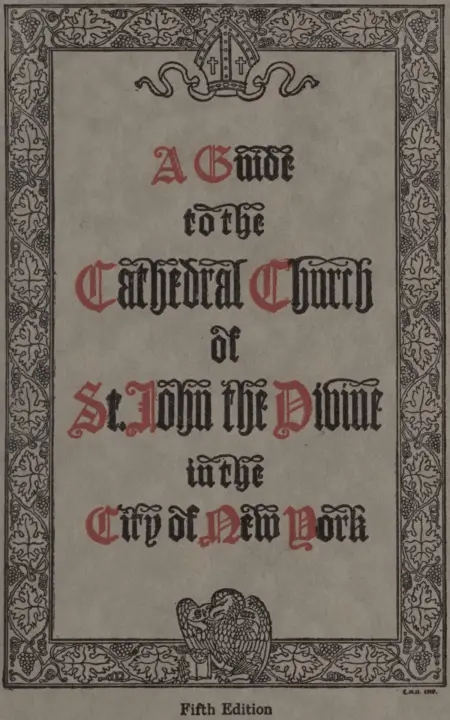
"A Guide to the Cathedral Church of Saint John the Divine in the City of New York," by Edward Hagaman Hall, is a guidebook written in the early 20th century. It explores the significance, architecture, and spiritual purpose of the Cathedral of St. John the Divine, aiming to inform visitors about its symbolism and the experiences it offers. The book emphasizes an inclusive approach to worship and the community role of the Cathedral, making it accessible to people of all backgrounds. The opening of the guide presents the Cathedral as a monumental institution that serves multiple purposes: a place for spiritual reflection, community gathering, and artistic appreciation. Hall provides insights into the Cathedral's construction history, its aesthetic features, and the emotions it evokes in visitors, such as feelings of humility and inspiration. He also describes its unique position in New York City amidst major institutions, emphasizing its aspiration to nurture the soul through its grandeur and the beautiful artistic expressions woven into its very fabric.
Introduction adapted from the source catalogue; source summaries may be automatically generated.
Free to read · English · 27,703 words · No account needed
MAKE TIME FOR A GOOD BOOK
On by default. Untick to stop anonymous reading totals. Each page counts after 10 seconds in view. How this works.
Anonymous counting is on unless you have switched it off.
The Chapel of St. Martin of Tours (15 on plan), designed by Messrs. Cram & Ferguson, is in early 13th century Gothic Architecture; about the same size as the Chapel of St. Ambrose; and cost about $150,000. Its interior walls are faced with light colored Bedford, Ind. limestone. The lower half of the walls is occupied by Gothic arcatures, in the trefoiled arches of which are fleurs de lis. Under the fleurs de lis, in mediaeval text, runs the inscription:
(Left side:) “They that ‖ be wise ‖ shall shine ‖ as the bright- ‖ ness of ‖ the firm- ‖ ament ‖ and they ‖ that turn ‖ many to ‖ righteous-‖ ness as the ‖ stars forever ‖ and ever ‖ (Right side:) The Peace ‖ of God which ‖ passeth ‖ all under- ‖ standing ‖ shall keep ‖ your hearts ‖ and minds ‖ through ‖ Christ ‖ Jesus.”
A little above the arcature is a border of roses. The upper half of the side walls presents a unique feature in a sort of triforium gallery built in the thickness of the wall. The pavement of Knoxville, Tenn. pink marble is bordered with black Belgian marble. The simple marble Altar in the form of a table resting on red marble pillars has no reredos. The Seven Windows, three in the Sanctuary and four in the clerestory, by Mr. Charles Connick of Boston, Mass., are of grisaille[37] work in geometrical designs, the Sanctuary windows being inset with pictorial medallions in painted mosaic glass in the mediaeval style. In the central window over the Altar the medallions depict scenes in the life of St. Martin as follows, beginning at the bottom and reading upward: In the left-hand light (1) St. Martin receives sword and enters army; (2) divides his cloak with the beggar; (3) has vision of Christ wearing the severed cloak which he had given to the beggar; and (4) is baptized. In the middle light, (1) He converts the robber; (2) revives the dead man; (3) is affectionately welcomed on his return to Tours; and (4) destroys the heathen temple. In the right-hand light, (1) He intercedes with Count Avitianus for the release of prisoners; (2) pleads for Priscillian’s life; (3) dies; and (4) the ship bearing his body is mysteriously propelled. In the middle light of the window at the left of the Altar are scenes in the life of St. Louis: (1) His coronation; (2) his release of prisoners at Paris; (3) his ministration to sick soldiers during the first Crusade; and (4) his departure on the second Crusade. In the middle light of the window at the right of the Altar are scenes in the life of Joan of Arc: (1) Her vision; (2) the capture of Orleans; (3) the coronation of Charles VII.; and (4) her martyrdom at the stake. In the circular lights at the top of the seven windows are the following coats-of-arms (left to right): (1) On a blue field, three golden fleurs de lis above a white wreath of oak and laurel with red fruit, representing the City of Rheims.[38] (2) On a blue field sprinkled with golden fleurs de lis, the Mother and Child, representing the Cathedral of Notre Dame in Paris. (3) Seven horizontal bars, alternately blue and gold, being the arms of Bertrand d’Eschaux, Archbishop of Tours. (4) On a blue field, a white Latin cross with trefoiled ends, being the arms of the Chapter of Poitiers. (5) On a blue cloak surrounded by red, a white sword, cross-hilt upward, emblematic of St. Martin. (6) On a blue field sprinkled with golden fleurs de lis, a red Greek cross, representing the Archdiocese of Rheims.[39] (7) On a blue field, three golden fleurs de lis under a white “label” or mark of cadency of eldest son,[40] being the royal arms of the Dukes of Orleans. A Statue of Joan of Arc, expressing her spiritual character, by Miss Anna Vaughn Hyatt, was placed in this chapel in 1922. It was given by Mr. J. Sanford Saltus through Dr. George F. Kunz, President of the Joan of Arc Statue Committee which erected the equestrian statue of the Maid by the same sculptress in Riverside Drive. Near it are two rough stones from the Chateau de Rouen in which the Maid was imprisoned at the time of her trial and from which she was led to the stake. The wrought-iron Screen of beautiful tracery at the entrance, designed in the office of Messrs. Cram & Ferguson and made by Messrs. F. Krasser & Co., of Boston, is a particularly lovely example of this form of art. While not copied from any existing mediaeval prototype, it shows the influence of the wrought-iron work of the Romanesque and early Gothic periods of France. The shell ornament in the section below the cornice is symbolical of St. Martin as a pilgrim, while the finials and cresting, blossoming with roses, signify the flowering of the Christian religion. In the frieze are four panels depicting four scenes which are described in a quaintly lettered inscription in the moulding above:
Your reading position is saved on this browser. Take it to another device with a library code. Reading pages adapt to text, rather than matching a printed edition.
BEHIND THE BOOK
This eBook is for the use of anyone anywhere in the United States and most other parts of the world at no cost and with almost no restrictions whatsoever. You may copy it, give it away or re-use it under the terms of the Project Gutenberg License included with this eBook or online at www.gutenberg.org. If you are not located in the United States, you will have to check the laws of the country where you are located before using this eBook. Read the source licence.
The original source file, including credits and licence, is retained by this library. Request an original-format copy at no charge. Please include the book title and Project Gutenberg identifier #68112.
KEEP YOUR CURIOSITY GOING
Wilfrid Scawen Blunt
Wilfrid Scawen Blunt

E. W. (Edgar Watson) Howe

David Patterson (Spirit) Hatch

David Patterson (Spirit) Hatch

David Patterson (Spirit) Hatch