THE CLASSIC COLLECTION✦My diaries, being a personal narrative of events 1888-1914, Part 2 (1900-1914)CLASSIC FREE BOOKS
My diaries, being a personal narrative of events 1888-1914, Part 2 (1900-1914)
Wilfrid Scawen Blunt
THE CLASSIC COLLECTION · 1920
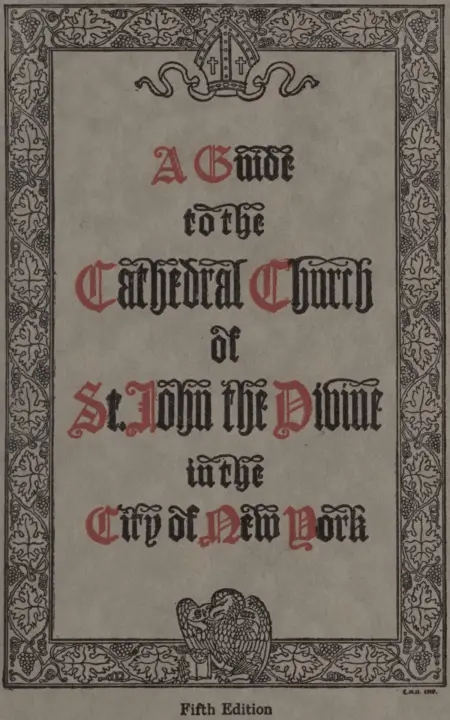
"A Guide to the Cathedral Church of Saint John the Divine in the City of New York," by Edward Hagaman Hall, is a guidebook written in the early 20th century. It explores the significance, architecture, and spiritual purpose of the Cathedral of St. John the Divine, aiming to inform visitors about its symbolism and the experiences it offers. The book emphasizes an inclusive approach to worship and the community role of the Cathedral, making it accessible to people of all backgrounds. The opening of the guide presents the Cathedral as a monumental institution that serves multiple purposes: a place for spiritual reflection, community gathering, and artistic appreciation. Hall provides insights into the Cathedral's construction history, its aesthetic features, and the emotions it evokes in visitors, such as feelings of humility and inspiration. He also describes its unique position in New York City amidst major institutions, emphasizing its aspiration to nurture the soul through its grandeur and the beautiful artistic expressions woven into its very fabric.
Introduction adapted from the source catalogue; source summaries may be automatically generated.
Free to read · English · 27,703 words · No account needed
MAKE TIME FOR A GOOD BOOK
On by default. Untick to stop anonymous reading totals. Each page counts after 10 seconds in view. How this works.
Anonymous counting is on unless you have switched it off.
The Chapel of St. James
ST. JAMES, the Apostle, after whom this chapel is named, was the son of Zebedee and was a Galilean fisherman. He is sometimes called St. James the Great to distinguish him from another Apostle called St. James the Less. He was a brother of St. John the Divine. He went almost everywhere with the Lord. After the ascension, he preached a while in Judea and then in Spain. After his mission there, he was beheaded by the Jews, and, according to tradition, his body was miraculously transported back to Spain, where his relics are said to rest at Compostella. Spanish historians chronicle 38 instances in which he is believed to have descended from heaven and in shining white armor led the Spanish armies against the Moors. Under the Spanish equivalent of his name, St. Iago or Santiago, he became the patron saint of Spain and his name was adopted as the Spanish war-cry. His shrine at Compostella was one of the most popular for pilgrimages in the Middle Ages, and it was said that two visits to Compostella equaled one to Rome. St. James is usually represented in the dress of a pilgrim with a peculiar staff. His Memorial Day is July 25.
The Chapel of St. James (13 on plan), designed by Mr. Henry Vaughan, is in pure English Gothic Architecture of the 14th century; 66 feet long and 39 wide, with a sort of transept on the north side 15 feet wide; seats 250 persons, and cost about $200,000. Its interior walls are of Bedford, Ind., limestone. On the front of the Altar of gray Knoxville, Tenn. marble, is sculptured DaVinci’s Last Supper. The central feature of the limestone Reredos is a relief representing the Transfiguration, after Raphael. In four niches, two on either side of the Transfiguration, are statues of the four Evangelists with their appropriate emblems at their feet (left to right:) St. Matthew with winged man; St. Mark with lion; St. Luke with ox; and St. John with eagle. Beneath the Transfiguration is a smaller sculpture of the Nativity, with an alleluia angel on each side. On four escutcheons, two on each side of the Nativity, are emblems of the condemnation and crucifixion (left to right:) (1) Crown of thorns and spear (John xix. 2, 5, 34); (2) pillar to which Christ was bound for scourging, cord, knotted scourge (John xix. 1) and sponge on reed (John xix. 29); (3) ladder, sponge on reed and spear; and (4) hammer, pincers, coat, and three dice (Mark xv. 24). Beautifully carved canopies surmounted by six adoring angels crown the Reredos. The stained glass East Window, by C. E. Kempe & Co. of London above the Reredos, depicts in its three lights (left to right) St. Lawrence, St. James and St. Vincent. In two walled-up panels of the window, one on each side of the glass, are statues of St. Peter with keys (left) and St. Paul with sword (right). The Saint James Window in the middle bay of the south aisle portrays in its four lights scenes in the life of the patron saint of Spain (see page 71) and other subjects, as follows, reading from left to right: Bottom, (1) Coat-of-arms of St. John and the words, “James, servant of God;” (2) St. James preaching to the natives of Spain; (3) St. James before the judge, forgiving his accuser and giving him his blessing, “Peace be with thee;” (4) Coat-of-arms of King Ramira I of Spain, and the words (to be read with those first quoted), “And of the Lord Jesus Christ.” Middle, (1) “Unto his shrine the mighty and the lowly fared on pilgrimage;” (2) “St. James, the radiant knight, upon a great white horse;” (3) “Before the banner of his name the Moorish warriors fled;” (4) “At Compostella still men serve Santiago’s shrine.” Top, (1) angel with ΙϹ-ΧϹ symbol; (2) “They bore his body to a ship that sailed for Spain;” (3) “Over his tomb they built a chapel passing fair;” (4) Angel with Ichthus symbol.[34] In the tracery at the extreme top is a representation of the Crucifixion. The window was given by Bishop Potter’s daughters and was designed and made by Mr. Henry Wynd Young, glass-painter, of New York City. In niches of the walls of the chapel are the following statues and symbols: East Wall, St. Augustine of England with crozier (left) and St. Gregory the Great (who sent him to England) with papal tiara and papal cross (right) West Wall, end of main aisle, above, Christ between his kinsmen St. James the Great (left) and St. James the Less (right); and at end of south aisle, the Venerable Bede. On four escutcheons, two on each side of the west door, are: (1) A floriated cross (emblematic of the flowering or productiveness of the Christian religion); (2) the monogram =ihc= (representing the first two and last letters, uncial form, of the Greek word for Jesus[35]); (3) the Greek cross form of the chi rho monogram (first two Greek letters of the name Christ); and (4) the Alpha and Omega, the first and last letters of the Greek alphabet, (Rev. i. 8). North Wall, statue of William of Wykeham. In the upper part of the north wall is the gallery of the organ, which is independent of the great organ of the Cathedral. Choir Stalls near the Altar are a distinctive feature of this chapel. Two clustered columns divide the south aisle into three bays in the middle one of which is Bishop Potter’s Tomb, of Siena marble. On the tomb is a recumbent figure of the Bishop in Serevezza marble, by Mr. James E. Frazer. The Bishop is represented in his episcopal robes, and the execution is so fine that even the texture of the lawn sleeves is apparent. On the front of the tomb is inscribed:
Your reading position is saved on this browser. Take it to another device with a library code. Reading pages adapt to text, rather than matching a printed edition.
BEHIND THE BOOK
This eBook is for the use of anyone anywhere in the United States and most other parts of the world at no cost and with almost no restrictions whatsoever. You may copy it, give it away or re-use it under the terms of the Project Gutenberg License included with this eBook or online at www.gutenberg.org. If you are not located in the United States, you will have to check the laws of the country where you are located before using this eBook. Read the source licence.
The original source file, including credits and licence, is retained by this library. Request an original-format copy at no charge. Please include the book title and Project Gutenberg identifier #68112.
KEEP YOUR CURIOSITY GOING
Wilfrid Scawen Blunt
Wilfrid Scawen Blunt

E. W. (Edgar Watson) Howe

David Patterson (Spirit) Hatch

David Patterson (Spirit) Hatch

David Patterson (Spirit) Hatch