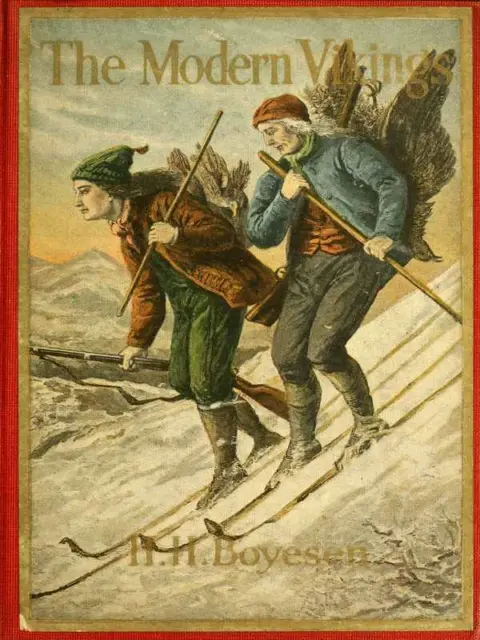
The Modern Vikings: Stories of Life and Sport in the Norseland
Hjalmar Hjorth Boyesen
THE CLASSIC COLLECTION · 1876
"A Good-For-Nothing" by Hjalmar Hjorth Boyesen is a novel written in the late 19th century. The story revolves around the character of Ralph Grimm, a young man born into a well-to-do family but lacking ambition and direction in life. As Ralph navigates his upbringing and the expectations placed upon him, the novel explores themes of identity, societal pressures, and the contrast between social status and personal worth. The narrative follows Ralph from his privileged childhood to his disillusioning experiences as a young adult. Initially desiring to be a pirate or a baker, Ralph ultimately ends up at a Military Academy where he fails to meet his father's expectations, leading him to abandon his aristocratic life for America. There, he struggles to forge an independent identity, taking on various lowly jobs and facing the challenges of self-reliance. The pivotal relationship with Bertha, a simple peasant girl who infuses his life with the self-awareness he lacks, underscores the contrast between his upbringing and the values she embodies. Ultimately, as Ralph matures and finds professional success, he must confront the changing nature of his feelings toward Bertha, leading to a poignant exploration of love, growth, and the distance between one's past and future.
Introduction adapted from the source catalogue; source summaries may be automatically generated.
Free to read · English · 10,040 words · No account needed
MAKE TIME FOR A GOOD BOOK
On by default. Untick to stop anonymous reading totals. Each page counts after 10 seconds in view. How this works.
Anonymous counting is on unless you have switched it off.
“In other words, you are disappointed at not finding me the same as I
used to be.”
“No, not exactly that; but--”
Ralph paused and looked puzzled. There was something in the earnestness of her manner which made a facetious compliment seem grossly inappropriate, and in the moment no other escape suggested itself.
“But what?” demanded Bertha, mercilessly.
“Have you ever lost an old friend?” asked he, abruptly.
“Yes; how so?”
“Then,” answered he, while his features lighted up with a happy inspiration--“then you will appreciate my situation. I fondly cherished my old picture of you in my memory. Now I have lost it, and I can not help regretting the loss. I do not mean, however, to imply that this new acquaintance--this second edition of yourself, so to speak--will prove less interesting.”
She again sent him a grave, questioning look, and began to gaze intently upon the stone in her bracelet.
“I suppose you will laugh at me,” began she, while a sudden blush flitted over her countenance. “But this is my first ball, and I feel as if I had rushed into a whirlpool, from which I have, since the first rash plunge was made, been vainly trying to escape. I feel so dreadfully forlorn. I hardly know anybody here except my cousin, who invited me, and I hardly think I know him either.”
“Well, since you are irredeemably committed,” replied Ralph, as the music, after some prefatory flourishes, broke into the delicious rhythm of a Strauss waltz, “then it is no use struggling against fate. Come, let us make the plunge together. Misery loves company.”
He offered her his arm, and she rose, somewhat hesitatingly, and
followed.
“I am afraid,” she whispered, as they fell into line with the procession that was moving down the long hall, “that you have asked me to dance merely because I said I felt forlorn. If that is the case, I should prefer to be led back to my seat.”
“What a base imputation!” cried Ralph.
There was something so charmingly naive in this self-depreciation--something so altogether novel in his experience, and, he could not help adding, just a little bit countrified. His spirits rose; he began to relish keenly his position as an experienced man of the world, and, in the agreeable glow of patronage and conscious superiority, chatted with hearty abandon with his little rustic beauty.
“If your dancing is as perfect as your German exercises were,” said she, laughing, as they swung out upon the floor, “then I promise myself a good deal of pleasure from our meeting.”
Your reading position is saved on this browser. Take it to another device with a library code. Reading pages adapt to text, rather than matching a printed edition.
Hjalmar Hjorth Boyesen
Hjalmar Hjorth Boyesen
Hjalmar Hjorth Boyesen
Hjalmar Hjorth Boyesen
BEHIND THE BOOK
This eBook is for the use of anyone anywhere in the United States and most other parts of the world at no cost and with almost no restrictions whatsoever. You may copy it, give it away or re-use it under the terms of the Project Gutenberg License included with this eBook or online at www.gutenberg.org. If you are not located in the United States, you will have to check the laws of the country where you are located before using this eBook. Read the source licence.
The original source file, including credits and licence, is retained by this library. Request an original-format copy at no charge. Please include the book title and Project Gutenberg identifier #23174.
KEEP YOUR CURIOSITY GOING
Coulson Kernahan

Maurice Baring
Frances Wright
Cécile Tormay

Frederic Jesup Stimson

W. H. P. (William Henry Pope) Jarvis