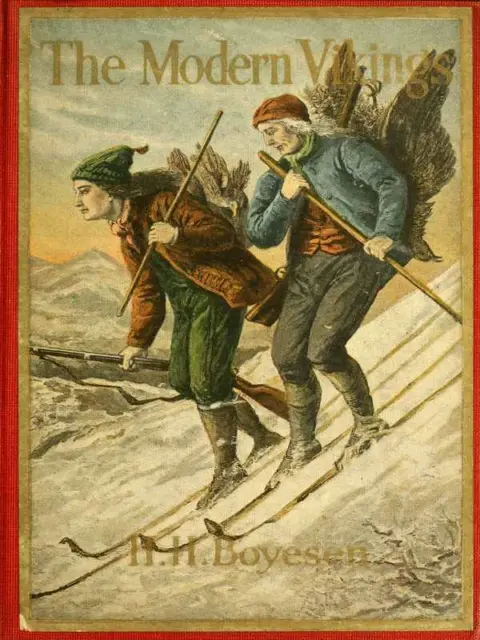
The Modern Vikings: Stories of Life and Sport in the Norseland
Hjalmar Hjorth Boyesen
THE CLASSIC COLLECTION · 1876
"A Good-For-Nothing" by Hjalmar Hjorth Boyesen is a novel written in the late 19th century. The story revolves around the character of Ralph Grimm, a young man born into a well-to-do family but lacking ambition and direction in life. As Ralph navigates his upbringing and the expectations placed upon him, the novel explores themes of identity, societal pressures, and the contrast between social status and personal worth. The narrative follows Ralph from his privileged childhood to his disillusioning experiences as a young adult. Initially desiring to be a pirate or a baker, Ralph ultimately ends up at a Military Academy where he fails to meet his father's expectations, leading him to abandon his aristocratic life for America. There, he struggles to forge an independent identity, taking on various lowly jobs and facing the challenges of self-reliance. The pivotal relationship with Bertha, a simple peasant girl who infuses his life with the self-awareness he lacks, underscores the contrast between his upbringing and the values she embodies. Ultimately, as Ralph matures and finds professional success, he must confront the changing nature of his feelings toward Bertha, leading to a poignant exploration of love, growth, and the distance between one's past and future.
Introduction adapted from the source catalogue; source summaries may be automatically generated.
Free to read · English · 10,040 words · No account needed
MAKE TIME FOR A GOOD BOOK
On by default. Untick to stop anonymous reading totals. Each page counts after 10 seconds in view. How this works.
Anonymous counting is on unless you have switched it off.
Two days later, Ralph again knocked on Bertha’s door. He looked paler than usual, almost haggard; his immaculate linen was a little crumpled, and he carried no cane; his lips were tightly compressed, and his face wore an air of desperate resolution.
“It is done,” he said, as he seated himself opposite her. “I am going.”
“Going!” cried she, startled at his unusual appearance. “How, where?”
“To America. I sail to-night. I have followed your advice, you see. I have cut off the last bridge behind me.”
“But, Ralph,” she exclaimed, in a voice of alarm. “Something dreadful must have happened. Tell me quick; I must know it.”
“No; nothing dreadful,” muttered he, smiling bitterly. “I have made a little scandal, that is all. My father told me to-day to go to the devil, if I chose, and my mother gave me five hundred dollars to help me along on the way. If you wish to know, here is the explanation.”
And he pulled from his pocket six perfumed and carefully folded notes, and threw them into her lap.
“Do you wish me to read them?” she asked, with growing surprise.
“Certainly. Why not?”
She hastily opened one note after the other, and read.
“But, Ralph,” she cried, springing up from her seat, while her eyes flamed with indignation, “what does this mean? What have you done?”
“I didn’t think it needed any explanation,” replied he, with feigned indifference. “I proposed to them all, and, you see, they all accepted me. I received all these letters to-day. I only wished to know whether the whole world regarded me as such a worthless scamp as you told me I was.”
She did not answer, but sat mutely staring at him, fiercely crumpling a rose-colored note in her hand. He began to feel uncomfortable under her gaze, and threw himself about uneasily in his chair.
“Well,” said he, at length, rising, “I suppose there is nothing more.
Good-by.”
“One moment, Mr. Grim,” demanded she, sternly. “Since I have already said so much, and you have obligingly revealed to me a new side of your character, I claim the right to correct the opinion I expressed of you at our last meeting.”
“I am all attention.”
“I did think, Mr. Grim,” began she, breathing hard, and steadying herself against the table at which she stood, “that you were a very selfish man--an embodiment of selfishness, absolute and supreme, but I did not believe that you were wicked.”
“And what convinced you that I was selfish, if I may ask?”
Your reading position is saved on this browser. Take it to another device with a library code. Reading pages adapt to text, rather than matching a printed edition.
Hjalmar Hjorth Boyesen
Hjalmar Hjorth Boyesen
Hjalmar Hjorth Boyesen
Hjalmar Hjorth Boyesen
BEHIND THE BOOK
This eBook is for the use of anyone anywhere in the United States and most other parts of the world at no cost and with almost no restrictions whatsoever. You may copy it, give it away or re-use it under the terms of the Project Gutenberg License included with this eBook or online at www.gutenberg.org. If you are not located in the United States, you will have to check the laws of the country where you are located before using this eBook. Read the source licence.
The original source file, including credits and licence, is retained by this library. Request an original-format copy at no charge. Please include the book title and Project Gutenberg identifier #23174.
KEEP YOUR CURIOSITY GOING
Coulson Kernahan

Maurice Baring
Frances Wright
Cécile Tormay

Frederic Jesup Stimson

W. H. P. (William Henry Pope) Jarvis