THE CLASSIC COLLECTION✦Dark daysCLASSIC FREE BOOKS
Dark days
Hugh Conway
THE CLASSIC COLLECTION · 1888
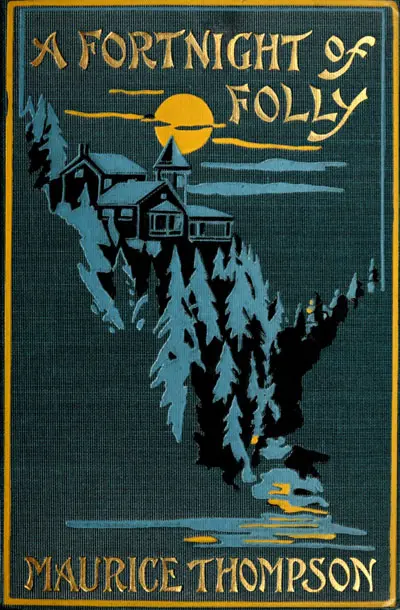
"A Fortnight of Folly" by Maurice Thompson is a novel written in the late 19th century. The story unfolds at Hotel Helicon, an extravagant mountain hotel designed to attract authors by offering free accommodations for a summer season. Central to the beginning are several intriguing characters, notably a mysterious new guest whose identity sparks curiosity among fellow literary figures, prompting speculation and social dynamics framed by a backdrop of creative expression and human interaction. The opening of the book sets the scene at Hotel Helicon, highlighting its peculiar allure and the various guests it attracts. As the narrative introduces the enigmatic stranger who occupies the coveted Room 24, a buzz of speculation and excitement builds among the guests, suggesting that he may be a notable author. Through witty dialogue and observations, the text delves into the interactions between the guests, illustrating their personalities, aspirations, and rivalries. The chapter captures the essence of a summer filled with literary ambition, humor, and unexpected relationships, primarily focusing on the light-hearted intrigue surrounding the identity of the new arrival in this idyllic but whimsically chaotic setting.
Introduction adapted from the source catalogue; source summaries may be automatically generated.
Free to read · English · 75,053 words · No account needed
MAKE TIME FOR A GOOD BOOK
On by default. Untick to stop anonymous reading totals. Each page counts after 10 seconds in view. How this works.
Anonymous counting is on unless you have switched it off.
"'Course," said he, "hit'll be poorty hard on you'ns, but I can't help it, I've got ter do my juty, let it hurt whoever it will. Not er thing kin ye tech at's in this yer tavern, 'ceptin' what's your'n, that air's jest how it air. So now mind w'at yer a doin'."
The servants were idle, the dining-room closed, the kitchen and pantries locked up. Never was there a more doleful set of people. Mrs. Nancy Jones Black thought of playing a piece of sacred music, but she found the grand piano locked, with its key deep in the sheriff's pocket.
The situation was made doubly disagreeable when at last the officer informed the guests that they would have to vacate their rooms forthwith, as he should proceed at once to close up the building.
"Heavens, man, are you going to turn us out into the woods?" demanded
Peck.
"Woods er no woods," he replied, "ye'll hev ter git out'n yer, right
off."
"But the ladies, Mr. Sheriff," suggested Punner, "no Southern gentleman can turn a lady out of doors."
The officer actually colored with the force of the insinuation. He stood silent for some time with his eyes fixed on the floor. Presently he looked up and said:
"The weeming kin stay till mornin'."
"Well they must have something to eat," said Punner. "They can't
starve."
"Thet's so," the sheriff admitted, "they kin hev a bite er so."
"And we----"
"You men folks cayn't hev a dorg gone mouthful, so shet up!"
"Well," observed Cattleton, dryly, "it appears the odds is the difference between falling into the hands of moonshiners and coming under the influence of a lawful sheriff."
"I know a little law," interposed Bartley Hubbard with a sullen emphasis, "and I know that this sheriff has no right to tumble us out of doors, and for my part----"
"Fur yer part," said the sheriff coolly, "fur yer part, Mister, ef ye fool erlong o' me I'll crack yer gourd fur ye."
"You'll do what?"
"I'll stave in yer piggin."
"I don't understand."
"W'y, blame yer ignorant hide, wha' wer' ye borned and fotch up? I'll jest knock the everlastin' head off'n ye, thet's 'zac'ly w'at I says. Mebbe ye don't understan' thet?"
"Yes," said Hubbard, visibly shrinking into himself, "I begin to suspect
your meaning."
Miss Crabb was taking notes with enthusiastic rapidity.
Dunkirk called the sheriff to him and a long conference was held between them, the result of which was presently announced.
Your reading position is saved on this browser. Take it to another device with a library code. Reading pages adapt to text, rather than matching a printed edition.
Hugh Conway
Maurice Thompson
Frank R. Stockton & Edgar Fawcett & Franklin Fyles & Anna Katharine Green & Henry Harland & Ingersoll Lockwood & Joaquin Miller & Kirk Munroe & Brainard Gardner Smith & Maurice Thompson & A. C. (Andrew Carpenter) Wheeler
Maurice Thompson
BEHIND THE BOOK
This eBook is for the use of anyone anywhere in the United States and most other parts of the world at no cost and with almost no restrictions whatsoever. You may copy it, give it away or re-use it under the terms of the Project Gutenberg License included with this eBook or online at www.gutenberg.org. If you are not located in the United States, you will have to check the laws of the country where you are located before using this eBook. Read the source licence.
The original source file, including credits and licence, is retained by this library. Request an original-format copy at no charge. Please include the book title and Project Gutenberg identifier #41660.
KEEP YOUR CURIOSITY GOING
Coulson Kernahan

Maurice Baring
Frances Wright
Cécile Tormay

Frederic Jesup Stimson

W. H. P. (William Henry Pope) Jarvis