THE CLASSIC COLLECTION✦Dark daysCLASSIC FREE BOOKS
Dark days
Hugh Conway
THE CLASSIC COLLECTION · 1888
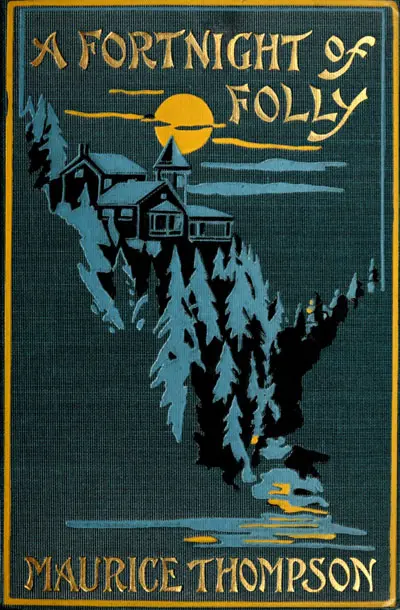
"A Fortnight of Folly" by Maurice Thompson is a novel written in the late 19th century. The story unfolds at Hotel Helicon, an extravagant mountain hotel designed to attract authors by offering free accommodations for a summer season. Central to the beginning are several intriguing characters, notably a mysterious new guest whose identity sparks curiosity among fellow literary figures, prompting speculation and social dynamics framed by a backdrop of creative expression and human interaction. The opening of the book sets the scene at Hotel Helicon, highlighting its peculiar allure and the various guests it attracts. As the narrative introduces the enigmatic stranger who occupies the coveted Room 24, a buzz of speculation and excitement builds among the guests, suggesting that he may be a notable author. Through witty dialogue and observations, the text delves into the interactions between the guests, illustrating their personalities, aspirations, and rivalries. The chapter captures the essence of a summer filled with literary ambition, humor, and unexpected relationships, primarily focusing on the light-hearted intrigue surrounding the identity of the new arrival in this idyllic but whimsically chaotic setting.
Introduction adapted from the source catalogue; source summaries may be automatically generated.
Free to read · English · 75,053 words · No account needed
MAKE TIME FOR A GOOD BOOK
On by default. Untick to stop anonymous reading totals. Each page counts after 10 seconds in view. How this works.
Anonymous counting is on unless you have switched it off.
Crane tried not to show the bitterness he felt as he saw his hope of winning the favor of Miss Moyne fading rapidly out, but now and again a cloud of irresistible melancholy fell upon him.
At such times it was his habit to lean upon the new fence that circumscribed Hotel Helicon and dreamily smoke a cigar. He felt a blind desire to assassinate somebody, if he could only know who. Of course not Peck, for Peck, too, was disconsolate, but somebody, anybody who would claim the place of a successful rival.
One morning while he stood thus regaling himself with his tobacco and his misery, Tolliver rode up, on a handsome horse this time, and, lifting his broad hat, bowed picturesquely and said:
"Good mornin,' Kyernel, how're ye this mornin'?"
"Good morning," growled Crane.
Tolliver looked off over the valley and up at the sky which was flecked with tags of fleece-cloud.
"Hit look like hit mought rain in er day er two," he remarked.
"Yes, I don't know, quite likely," said Crane, gazing evasively in
another direction.
"Ever'body's well, I s'pose, up ther' at the tavern?" inquired Tolliver.
"I believe so," was the cold answer.
Tolliver leaned over the pommel of his saddle-tree and combed his horse's mane with his sinewy fingers. Meantime the expression in his face was one of exceeding embarrassment blent with cunning.
"Kyernel, c'u'd ye do a feller a leetle yerrent what's of importance?" he asked with peculiar faltering.
"Do what?" inquired Crane lifting his eye-brows and turning the cigar in
his mouth.
"Jest a leetle frien'ly job o' kindness," said Tolliver, "jest ter please ask thet young leddy--thet Miss Crabb 'at I fotch up yer on er mule tother day, ye know; well, jest ax her for me ef I moughtn't come in an' see 'er on pertic'lar an' pressin' business, ef ye please, sir."
By this time the mountaineer's embarrassment had become painfully apparent. Any good judge of human nature could have seen at once that he was almost overcome with the burden and worry of the matter in hand. His cheeks were pale and his eyes appeared to be fading into utter vacancy of expression. Crane told him that there was no need to be particularly formal, that if he would go in and ask for Miss Crabb she would see him in the parlor.
"But, Kyernel, hit's er private, sort er confidential confab 'at I must
hev wi' 'er, an'----"
"Oh, well, that's all right, you'll not be interrupted in the parlor."
"Air ye pine blank shore of it, Kyernel?"
"Certainly."
"Dead shore?"
"Quite, I assure you."
Your reading position is saved on this browser. Take it to another device with a library code. Reading pages adapt to text, rather than matching a printed edition.
Hugh Conway
Maurice Thompson
Frank R. Stockton & Edgar Fawcett & Franklin Fyles & Anna Katharine Green & Henry Harland & Ingersoll Lockwood & Joaquin Miller & Kirk Munroe & Brainard Gardner Smith & Maurice Thompson & A. C. (Andrew Carpenter) Wheeler
Maurice Thompson
BEHIND THE BOOK
This eBook is for the use of anyone anywhere in the United States and most other parts of the world at no cost and with almost no restrictions whatsoever. You may copy it, give it away or re-use it under the terms of the Project Gutenberg License included with this eBook or online at www.gutenberg.org. If you are not located in the United States, you will have to check the laws of the country where you are located before using this eBook. Read the source licence.
The original source file, including credits and licence, is retained by this library. Request an original-format copy at no charge. Please include the book title and Project Gutenberg identifier #41660.
KEEP YOUR CURIOSITY GOING
Coulson Kernahan

Maurice Baring
Frances Wright
Cécile Tormay

Frederic Jesup Stimson

W. H. P. (William Henry Pope) Jarvis