THE CLASSIC COLLECTION✦Dark daysCLASSIC FREE BOOKS
Dark days
Hugh Conway
THE CLASSIC COLLECTION · 1888
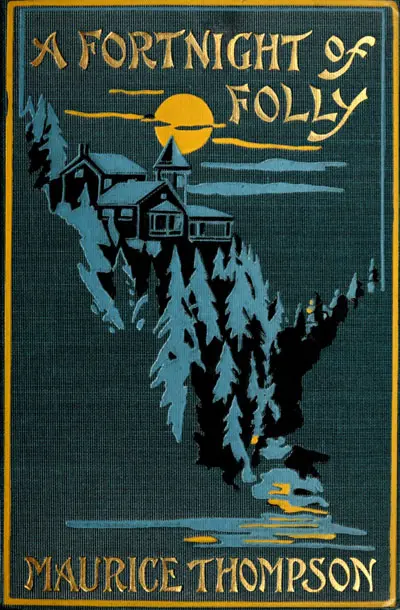
"A Fortnight of Folly" by Maurice Thompson is a novel written in the late 19th century. The story unfolds at Hotel Helicon, an extravagant mountain hotel designed to attract authors by offering free accommodations for a summer season. Central to the beginning are several intriguing characters, notably a mysterious new guest whose identity sparks curiosity among fellow literary figures, prompting speculation and social dynamics framed by a backdrop of creative expression and human interaction. The opening of the book sets the scene at Hotel Helicon, highlighting its peculiar allure and the various guests it attracts. As the narrative introduces the enigmatic stranger who occupies the coveted Room 24, a buzz of speculation and excitement builds among the guests, suggesting that he may be a notable author. Through witty dialogue and observations, the text delves into the interactions between the guests, illustrating their personalities, aspirations, and rivalries. The chapter captures the essence of a summer filled with literary ambition, humor, and unexpected relationships, primarily focusing on the light-hearted intrigue surrounding the identity of the new arrival in this idyllic but whimsically chaotic setting.
Introduction adapted from the source catalogue; source summaries may be automatically generated.
Free to read · English · 75,053 words · No account needed
MAKE TIME FOR A GOOD BOOK
On by default. Untick to stop anonymous reading totals. Each page counts after 10 seconds in view. How this works.
Anonymous counting is on unless you have switched it off.
"Well, I'll ber dorg!"
The old man stood gazing and grinning at Crane for some moments, and
then added:
"What's yer pap's name?"
"Eliphas Crane."
"'Liphas Crane yore pap!"
"Yes."
"Child, I air yer pap's uncle."
"What!"
"I air Peter Job Crane."
"You!"
"Sartin es anything."
"Are you my father's uncle Peter?"
"I air yer pap's uncle Pete."
"How strange!"
Miss Stackpole did not permit a word, a look, or a shade of this interview to escape her. She now turned to Bartley Hubbard and said:
"We Americans are the victims of heterogeneous consanguinity. Such an incident as this could not happen in England. It will be a long time before we can get rid of our ancestors."
"Yes," assented Hubbard, nonchalantly, "Yer pap's uncle certainly is a large factor in American life."
"How many men did you see when you looked out?" Peck inquired,
addressing Cattleton.
"I saw only one, but he was a monster," was the ready reply. "It's no use brooding over trying to escape by force. We're utterly helpless, and that jolt on my head has rendered me unfit for diplomatic efforts."
"What do you suppose they will do with us?"
"They won't dare let us go."
"Why?"
"They'd be afraid that we would report their illicit distillery."
"Ah, I see."
The affair began to take on a very serious and gloomy aspect, and the room was growing oppressively hot, owing to the presence of a a small but energetic furnace that glowed under a sighing boiler. Outside, with the clearing sky and refreshed air, there arose a clamor of bird-song in the dripping trees. Under the floor the spring-stream gurgled sweetly.
"Ye 'member Abbott's still house on ole Lulbegrud?" said the old man, pursuing his reminisences, after he had permitted his grand-nephew to taste the "mounting jew," "an' Dan Rankin's ole bob-tail hoss?"
"Very well, indeed," responded Crane, "and Billy Pace's blackberry fields where I picked berries in summer and chased rabbits in winter."
"Take er nother drop o' the jyful juice, boy, fur the mem'ry o' ole
Kaintuck!"
"Oh dear! but isn't it incomparably awful?" exclaimed Mrs. Nancy Jones Black, gazing in horrified fascination upon the two Kentuckians, as they bowed to each other and drank alternately from the little jug.
"Characteristic Southern scene not used by Craddock," murmured Miss Crabb, making a whole page of a single note.
"Don't this yere liquor taste o' one thing an' smell o' another an' jes' kinder git ter the lowest p'int o' yer appetite?" continued Crane's great uncle Peter.
"Delicious beyond compare," responded the young man, drinking again, "it
is nectar of the gods."
Your reading position is saved on this browser. Take it to another device with a library code. Reading pages adapt to text, rather than matching a printed edition.
Hugh Conway
Maurice Thompson
Frank R. Stockton & Edgar Fawcett & Franklin Fyles & Anna Katharine Green & Henry Harland & Ingersoll Lockwood & Joaquin Miller & Kirk Munroe & Brainard Gardner Smith & Maurice Thompson & A. C. (Andrew Carpenter) Wheeler
Maurice Thompson
BEHIND THE BOOK
This eBook is for the use of anyone anywhere in the United States and most other parts of the world at no cost and with almost no restrictions whatsoever. You may copy it, give it away or re-use it under the terms of the Project Gutenberg License included with this eBook or online at www.gutenberg.org. If you are not located in the United States, you will have to check the laws of the country where you are located before using this eBook. Read the source licence.
The original source file, including credits and licence, is retained by this library. Request an original-format copy at no charge. Please include the book title and Project Gutenberg identifier #41660.
KEEP YOUR CURIOSITY GOING
Coulson Kernahan

Maurice Baring
Frances Wright
Cécile Tormay

Frederic Jesup Stimson

W. H. P. (William Henry Pope) Jarvis