THE CLASSIC COLLECTION✦Dark daysCLASSIC FREE BOOKS
Dark days
Hugh Conway
THE CLASSIC COLLECTION · 1888
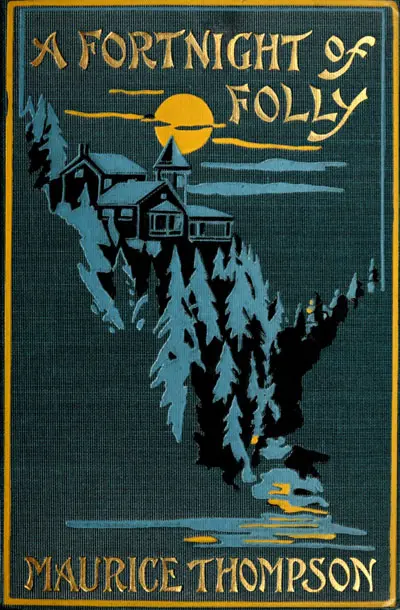
"A Fortnight of Folly" by Maurice Thompson is a novel written in the late 19th century. The story unfolds at Hotel Helicon, an extravagant mountain hotel designed to attract authors by offering free accommodations for a summer season. Central to the beginning are several intriguing characters, notably a mysterious new guest whose identity sparks curiosity among fellow literary figures, prompting speculation and social dynamics framed by a backdrop of creative expression and human interaction. The opening of the book sets the scene at Hotel Helicon, highlighting its peculiar allure and the various guests it attracts. As the narrative introduces the enigmatic stranger who occupies the coveted Room 24, a buzz of speculation and excitement builds among the guests, suggesting that he may be a notable author. Through witty dialogue and observations, the text delves into the interactions between the guests, illustrating their personalities, aspirations, and rivalries. The chapter captures the essence of a summer filled with literary ambition, humor, and unexpected relationships, primarily focusing on the light-hearted intrigue surrounding the identity of the new arrival in this idyllic but whimsically chaotic setting.
Introduction adapted from the source catalogue; source summaries may be automatically generated.
Free to read · English · 75,053 words · No account needed
MAKE TIME FOR A GOOD BOOK
On by default. Untick to stop anonymous reading totals. Each page counts after 10 seconds in view. How this works.
Anonymous counting is on unless you have switched it off.
"Yes, they do," replied Ferris, pulling his long brown mustache reflectively, "and I can't see why. He really is not popular; there is no enthusiasm for his fiction."
"It's a mere vogue, begotten by the critics," said Hartley Crane. "Criticism is at a very low ebb in America. Our critics are all either ignorant or given over to putting on English and French airs."
Ferris opened his eyes in a quiet way and glanced at Peck who, however, did not appear to notice the remark.
"There's a set of them in Boston and New York," Crane went on, "who watch the Revue de Deux Mondes and the London Atheneum, ready to take the cue from them. Even American books must stand or fall by the turn of the foreign thumb."
"That is a very ancient grumble," said Ferris, in a tone indicative of
impartial indifference.
"Take these crude, loose, awkward, almost obscene Russian novels," continued Crane, "and see what a furor the critics of New York and Boston have fermented in their behalf, all because it chanced that a coterie of Parisian literary roués fancied the filthy imaginings of Dostoieffsky and the raw vulgarity of Tolstoï. What would they say of you, Ferris, if you should write so low and dirty a story as Crime and Its Punishment by Dostoieffsky?"
"Oh, I don't know, and, begging your grace, I don't care a straw,"
Ferris replied; "the publishers would steal all my profits in any
event."
"Do you really believe that?" inquired Peck.
"Believe it? I know it," said Ferris. "When did you ever know of a publisher advertising a book as in its fiftieth thousand so long as the author had any royalty on the sales? The only book of mine that ever had a run was one I sold outright in the manuscript to George Dunkirk & Co., who publish all my works. That puerile effort is now in its ninetieth thousand, while the best of the other six has not yet shown up two thousand! Do you catch the point?"
"But what difference can printing a statement of the books sold make, anyway?" innocently inquired Miss Moyne.
Ferris laughed.
"All the difference in the world," he said; "the publisher would have to account to the author for all those thousands, don't you see."
"But they have to account, anyhow," replied Miss Moyne, with a perplexed
smile.
"Account!" exclaimed Ferris, contemptuously; "account! yes, they have to
account."
"But they account to me," Miss Moyne gently insisted.
"Who are your publishers?" he demanded.
"George Dunkirk & Co.," was the answer.
Your reading position is saved on this browser. Take it to another device with a library code. Reading pages adapt to text, rather than matching a printed edition.
Hugh Conway
Maurice Thompson
Frank R. Stockton & Edgar Fawcett & Franklin Fyles & Anna Katharine Green & Henry Harland & Ingersoll Lockwood & Joaquin Miller & Kirk Munroe & Brainard Gardner Smith & Maurice Thompson & A. C. (Andrew Carpenter) Wheeler
Maurice Thompson
BEHIND THE BOOK
This eBook is for the use of anyone anywhere in the United States and most other parts of the world at no cost and with almost no restrictions whatsoever. You may copy it, give it away or re-use it under the terms of the Project Gutenberg License included with this eBook or online at www.gutenberg.org. If you are not located in the United States, you will have to check the laws of the country where you are located before using this eBook. Read the source licence.
The original source file, including credits and licence, is retained by this library. Request an original-format copy at no charge. Please include the book title and Project Gutenberg identifier #41660.
KEEP YOUR CURIOSITY GOING
Coulson Kernahan

Maurice Baring
Frances Wright
Cécile Tormay

Frederic Jesup Stimson

W. H. P. (William Henry Pope) Jarvis