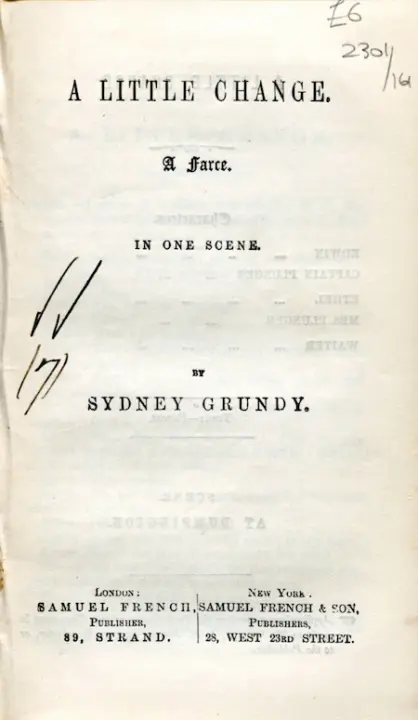
A Little Change: A Farce in One Scene
Sydney Grundy
THE CLASSIC COLLECTION · 1898
"A Fool's Paradise: An Original Play in Three Acts" by Sydney Grundy is a theatrical play written in the late 19th century. The play centers around the lives of several characters, including Philip Selwyn, a seemingly happy man who is married to Beatrice Selwyn. The initial acts establish relationships, romantic entanglements, and hint at underlying tensions, particularly regarding family secrets and the dynamics of love and duty that will unfold throughout the story. At the start of the play, the audience is introduced to Philip Selwyn and a budding romance between Tom Verinder and Mildred, Philip's sister. As Philip struggles with an undisclosed affliction, his interactions with family and friends reveal both humorous exchanges and deeper emotional currents. Tom seeks Mildred's affection, and Sir Peter Lund, a physician, is drawn into the lives of the Selwyns, suggesting a mix of comic elements with more serious undertones involving social status and familial loyalty. The opening lays the groundwork for themes of love, deception, and the consequences of one's choices, setting the stage for the complexities that will unravel in the ensuing acts.
Introduction adapted from the source catalogue; source summaries may be automatically generated.
Free to read · English · 22,057 words · No account needed
MAKE TIME FOR A GOOD BOOK
On by default. Untick to stop anonymous reading totals. Each page counts after 10 seconds in view. How this works.
Anonymous counting is on unless you have switched it off.
BEA. Confide in your chemist. Make some ridiculous excuse--say that the family cat is in convulsions--and they will sell you nothing. They know it's absurd. Say that you want to improve your complexion, and they will sell you anything; they know it's the truth.
KATE. My dear Mrs. Selwyn--for this information much thanks. (moves
towards door, R.U.E.)
BEA. Where are you going?
KATE. To the chemist's.
Enter LORD NORMANTOWER, R.U.D.
NOR. May I come in? (comes well on stage, R.C.)
KATE. (up C.) It seems to me you've come. (between NORMANTOWER and
BEATRICE)
NOR. Yes; when I want to do anything particularly, I do it first and ask permission afterwards. It prevents disappointment, and it's so very easy to apologise.
BEA. In this case no apology is needed.
NOR. (starting) Mrs. Selwyn! excuse me for not seeing you. (crosses down to BEATRICE, standing R. of sofa. KATE turns up and resumes watering plants, R.C.) How is Philip to-day?
BEA. I'm sorry to say my husband is not at all well this morning.
NOR. Old Lund seems to be making him worse instead of better.
BEA. Sir Peter has now been here a week, and Philip has grown worse
every day.
NOR. I'm sure I oughtn't to find fault with Lund; he's polished off nearly all my relations for me; but I'm not certain that I quite believe in the old boy. There's too much M.D.F.S.A. about him. I never knew a fool who hadn't half the alphabet at the end of his name. (turns away a few steps)
KATE. (demurely) At which end my Lord Edward, Arthur, Henry, Earl of Normantower? (coming down to R. of NORMANTOWER, R.C., can in hand. BEATRICE rises and goes to fire L., taking book with her)
NOR. Now, that's too bad of you, Miss Derwent. It's not my fault that I've enough names to christen the family of a curate.
KATE. Let this be a lesson to you. Don't throw stones at a friend of mine! (goes up to opening R.C.)
NOR. Mine was a very little stone; yours was half a brick. (KATE continues watering the plants)
PHIL. (off, L.) Beatrice!
BEA. My husband! I must leave Miss Derwent to console you. She won't have many more opportunities. (goes up L.)
PHIL. Beatrice!
BEA. Yes, dear! I'm coming! (exit L.D.)
NOR. Not many more opportunities? What does she mean? (standing puzzled C.--turning his head to KATE)
KATE. (in conservatory) Mrs. Selwyn means that I am leaving
Ravenhurst.
NOR. You're going away! (goes up to KATE)
KATE. This afternoon. (R.) }
} of opening, R.C.)
NOR. For good? (L.) }
Your reading position is saved on this browser. Take it to another device with a library code. Reading pages adapt to text, rather than matching a printed edition.
Sydney Grundy
Sydney Grundy
Sydney Grundy
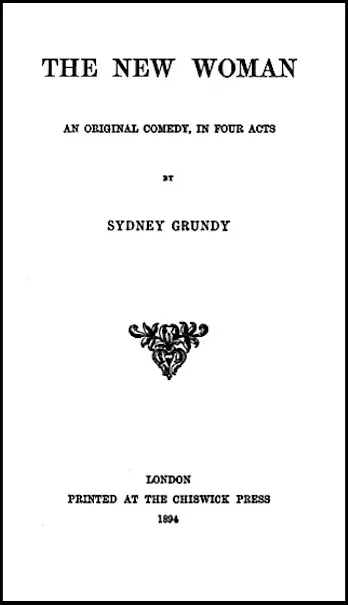
Sydney Grundy
BEHIND THE BOOK
This eBook is for the use of anyone anywhere in the United States and most other parts of the world at no cost and with almost no restrictions whatsoever. You may copy it, give it away or re-use it under the terms of the Project Gutenberg License included with this eBook or online at www.gutenberg.org. If you are not located in the United States, you will have to check the laws of the country where you are located before using this eBook. Read the source licence.
The original source file, including credits and licence, is retained by this library. Request an original-format copy at no charge. Please include the book title and Project Gutenberg identifier #41647.
KEEP YOUR CURIOSITY GOING
Maurice Baring
W. B. (William Butler) Yeats
Edward Martyn

John Brougham & Charlotte Brontë
Marguerite Merington
Leonid Andreyev