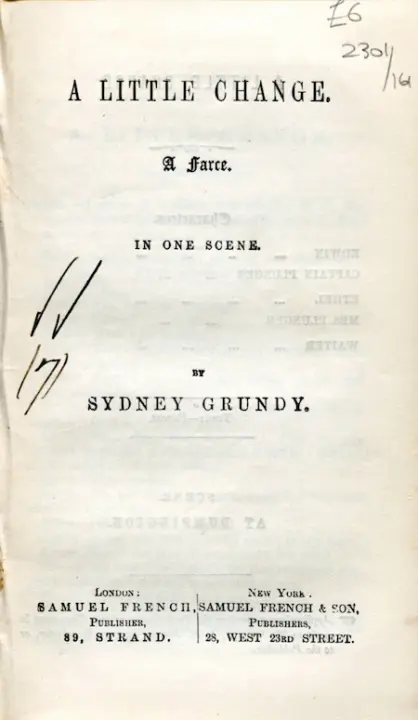
A Little Change: A Farce in One Scene
Sydney Grundy
THE CLASSIC COLLECTION · 1898
"A Fool's Paradise: An Original Play in Three Acts" by Sydney Grundy is a theatrical play written in the late 19th century. The play centers around the lives of several characters, including Philip Selwyn, a seemingly happy man who is married to Beatrice Selwyn. The initial acts establish relationships, romantic entanglements, and hint at underlying tensions, particularly regarding family secrets and the dynamics of love and duty that will unfold throughout the story. At the start of the play, the audience is introduced to Philip Selwyn and a budding romance between Tom Verinder and Mildred, Philip's sister. As Philip struggles with an undisclosed affliction, his interactions with family and friends reveal both humorous exchanges and deeper emotional currents. Tom seeks Mildred's affection, and Sir Peter Lund, a physician, is drawn into the lives of the Selwyns, suggesting a mix of comic elements with more serious undertones involving social status and familial loyalty. The opening lays the groundwork for themes of love, deception, and the consequences of one's choices, setting the stage for the complexities that will unravel in the ensuing acts.
Introduction adapted from the source catalogue; source summaries may be automatically generated.
Free to read · English · 22,057 words · No account needed
MAKE TIME FOR A GOOD BOOK
On by default. Untick to stop anonymous reading totals. Each page counts after 10 seconds in view. How this works.
Anonymous counting is on unless you have switched it off.
TOM. Because he married the girl he wanted; instead of a girl he didn't want; and his son's going to do the same. (placing his arm round her and taking her down to L.C.)
KATE. Ah, Mr. Verinder! Marriage is a serious responsibility. (goes
to C., basket in hand)
TOM. It's serious when you marry the wrong person, but I'm going to
marry the right one.
KATE. Yes, but who is the right one?
PHIL. Surely, the right one is the one we love. (sits, opening letters, in arm-chair R. of table)
TOM. (advances to C.) You think so, Mr. Selwyn? (turns to MILDRED, who sits on R. arm of sofa, searches in her work bag and finds an apple which he eats)
KATE. (sits R.C.) Because you have been fortunate in your choice, but how many have made a mistake! Even love matches are often unfortunate. Love has a habit of being so one-sided. (filling a bowl on table, with flowers)
PHIL. I haven't found it so! and mine was a love match, if ever there was one. I met my wife quite casually at Brighton--fell in love, proposed, was accepted and married, all within a month.
KATE. You married in haste.
PHIL. And by all the laws of cynical philosophy, I ought to have repented at leisure. (BEATRICE SELWYN enters, L. down staircase unobserved, and crosses slowly to back of table R.C.) But I haven't repented. To the confusion of the philosophers, I'm the happiest husband and have the best wife in the world.
TOM. (turns to KATE, his mouth full of apple) There, Miss Derwent! What do you say to that? (turns to MILDRED)
KATE. That is one side of the picture, but I've seen the other. My
mother also married for love.
PHIL. And what was the consequence?
KATE. That her daughter will never marry.
BEA. (softly) Don't say that, Miss Derwent. (all start slightly, KATE rises, and sits again almost immediately, still filling bowl with flowers) You are always severe on the gentlemen, but don't be so hard on them as that.
PHIL. Good gracious, Mousey, how you startled me! Your footsteps are so fairy-like, one never knows where you are.
BEA. Moral: never tell secrets to Miss Derwent, when you think I'm not
listening.
PHIL. My dear, it's no secret that I have the best wife in the world.
TOM. Everybody thinks that, Mrs. Selwyn. (going up C. towards her)
BEA. (goes to TOM, C.) Not everybody. To wit--Sir Peter Lund.
MIL. Oh, what does it matter what that grumpy old bear thinks? (goes to L. of sofa, and round behind it)
Your reading position is saved on this browser. Take it to another device with a library code. Reading pages adapt to text, rather than matching a printed edition.
Sydney Grundy
Sydney Grundy
Sydney Grundy
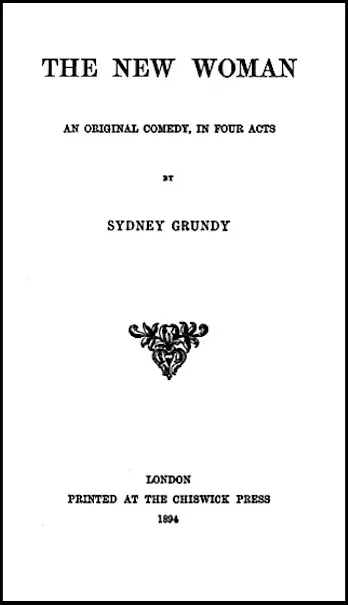
Sydney Grundy
BEHIND THE BOOK
This eBook is for the use of anyone anywhere in the United States and most other parts of the world at no cost and with almost no restrictions whatsoever. You may copy it, give it away or re-use it under the terms of the Project Gutenberg License included with this eBook or online at www.gutenberg.org. If you are not located in the United States, you will have to check the laws of the country where you are located before using this eBook. Read the source licence.
The original source file, including credits and licence, is retained by this library. Request an original-format copy at no charge. Please include the book title and Project Gutenberg identifier #41647.
KEEP YOUR CURIOSITY GOING
Maurice Baring
W. B. (William Butler) Yeats
Edward Martyn

John Brougham & Charlotte Brontë
Marguerite Merington
Leonid Andreyev