The Stark Munro Letters Being series of twelve letters written by J. Stark Munro, M.B., to his friend and former fellow-student, Herbert Swanborough, of Lowell, Massachusetts, during the years 1881-1884
Arthur Conan Doyle

THE CLASSIC COLLECTION · 1899
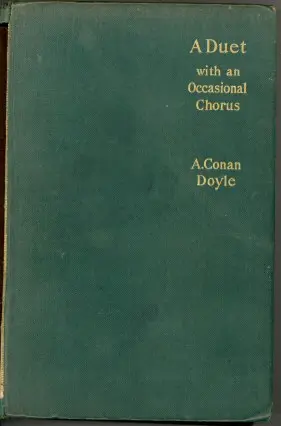
"A Duet, with an Occasional Chorus" by Arthur Conan Doyle is a novel written in the late 19th century. The story revolves around the lives of Frank Crosse and Maude Selby as they navigate the complexities of love, marriage, and personal aspirations leading up to their wedding. Through their correspondence, the book captures their deep affection and the mix of excitement and anxiety that accompanies their impending union. The opening of the novel introduces Frank and Maude through a series of letters that highlight their preparations for marriage, including discussions about the wedding date, the choice of attire, and their hopes for the future. As they share their thoughts and feelings about each other, the reader gains insight into their characters: Frank's self-doubt about providing for Maude and Maude's unwavering love and confidence in their partnership. This correspondence sets the stage for the unfolding dynamics of their relationship, infused with moments of humor, tension, and vulnerability. As the narrative progresses, the importance of their emotional connection amidst societal expectations and personal challenges becomes increasingly evident.
Introduction adapted from the source catalogue; source summaries may be automatically generated.
Free to read · English · 68,439 words · No account needed
MAKE TIME FOR A GOOD BOOK
On by default. Untick to stop anonymous reading totals. Each page counts after 10 seconds in view. How this works.
Anonymous counting is on unless you have switched it off.
‘Well, I had some idea about “Ophelia.” Do you think that it would do?’
‘Certainly. Had you worked it out at all?’
‘Well, my dear,’ said Mrs. Beecher, relapsing into her pleasant confidential manner. ‘I had some views, but, of course, I should be so glad to have your opinion about it. I only saw Hamlet once, and the lady was dressed in white, with a gauzy light nun’s-veiling over it. I thought that with white pongee silk as an under-dress, and then some sort of delicate—’
‘Crepe de Chine,’ Maude suggested.
‘But in Ophelia’s day such a thing had never been heard of,’ said Mrs. Hunt Mortimer. ‘A net of silver thread—’
‘Exactly,’ cried Mrs. Beecher, ‘with some sort of jewelling upon it. That was just what I had imagined. Of course it should be cut classically and draped—my dressmaker is such a treasure—and I should have a gold embroidery upon the white silk.’
‘Crewel work,’ said Maude.
‘Or a plain cross-stitch pattern. Then a tiara of pearls on the head.
Shakespeare—’
At the name of the poet their three consciences pricked simultaneously. They looked at each other and then at the clock with dismay.
‘We must—we really must go on with our reading,’ cried Mrs. Hunt Mortimer. ‘How did we get talking about these dresses?’
‘It was my fault,’ said Mrs. Beecher, looking contrite.
‘No, dear, it was mine,’ said Maude. ‘You remember it all came from my saying that Frank had gone to the ball as the Pied Piper.’
‘I am going to read the very first poem that I open,’ said Mrs. Hunt Mortimer remorselessly. ‘I am afraid that it is almost time that I started, but we may still be able to skim over a few pages. Now then! There! Setebos! What a funny name!’
‘What does it mean?’ asked Maude.
‘We shall find out, no doubt, as we proceed,’ said Mrs. Hunt Mortimer. ‘We shall take it line by line and draw the full meaning from it. The first line is—
‘Will sprawl now that the heat of day is best—’
‘Who will?’ asked Mrs. Beecher.
‘I don’t know. That’s what it says.’
‘The next line will explain, no doubt.’
‘Flat on his—’
‘Dear me, I had no idea that Browning was like this!’
‘Do read it, dear.’
‘I couldn’t possibly think of doing so. With your permission we will pass on to the next paragraph.’
‘But we vowed not to skip.’
Your reading position is saved on this browser. Take it to another device with a library code. Reading pages adapt to text, rather than matching a printed edition.
Arthur Conan Doyle
Arthur Conan Doyle
Arthur Conan Doyle
Arthur Conan Doyle
BEHIND THE BOOK
This eBook is for the use of anyone anywhere in the United States and most other parts of the world at no cost and with almost no restrictions whatsoever. You may copy it, give it away or re-use it under the terms of the Project Gutenberg License included with this eBook or online at www.gutenberg.org. If you are not located in the United States, you will have to check the laws of the country where you are located before using this eBook. Read the source licence.
The original source file, including credits and licence, is retained by this library. Request an original-format copy at no charge. Please include the book title and Project Gutenberg identifier #5260.
KEEP YOUR CURIOSITY GOING
Coulson Kernahan

Maurice Baring
Frances Wright
Cécile Tormay

Frederic Jesup Stimson

W. H. P. (William Henry Pope) Jarvis


