The Stark Munro Letters Being series of twelve letters written by J. Stark Munro, M.B., to his friend and former fellow-student, Herbert Swanborough, of Lowell, Massachusetts, during the years 1881-1884
Arthur Conan Doyle

THE CLASSIC COLLECTION · 1899
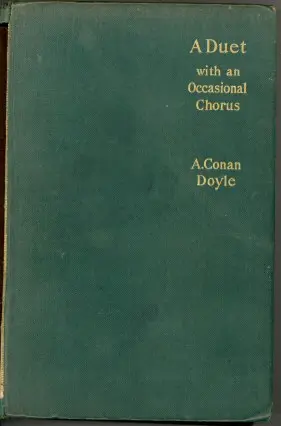
"A Duet, with an Occasional Chorus" by Arthur Conan Doyle is a novel written in the late 19th century. The story revolves around the lives of Frank Crosse and Maude Selby as they navigate the complexities of love, marriage, and personal aspirations leading up to their wedding. Through their correspondence, the book captures their deep affection and the mix of excitement and anxiety that accompanies their impending union. The opening of the novel introduces Frank and Maude through a series of letters that highlight their preparations for marriage, including discussions about the wedding date, the choice of attire, and their hopes for the future. As they share their thoughts and feelings about each other, the reader gains insight into their characters: Frank's self-doubt about providing for Maude and Maude's unwavering love and confidence in their partnership. This correspondence sets the stage for the unfolding dynamics of their relationship, infused with moments of humor, tension, and vulnerability. As the narrative progresses, the importance of their emotional connection amidst societal expectations and personal challenges becomes increasingly evident.
Introduction adapted from the source catalogue; source summaries may be automatically generated.
Free to read · English · 68,439 words · No account needed
MAKE TIME FOR A GOOD BOOK
On by default. Untick to stop anonymous reading totals. Each page counts after 10 seconds in view. How this works.
Anonymous counting is on unless you have switched it off.
‘How did he dress for it?’ asked Mrs. Beecher. ‘We are invited to the Aston’s dress ball, and I want something suitable for George.’
‘It was a most charming dress. Red and black all over, something like Mephistopheles, you know, and a peaked hat with a bell at the top. Then he had a flute, of course, and a thin wire from his waist with a stuffed rat at the end of it.’
‘A rat! How horrid!’
‘Well, that was the story, you know. The rats all followed the Pied Piper, and so this rat followed Frank. He put it in his pocket when he danced, but once he forgot, and so it got stood upon, and the sawdust came out all over the floor.’
Mrs. Hunt Mortimer was also invited to the dress ball, and her thoughts flew away from the book in front of her.
‘How did you go, Mrs. Crosse?’ she asked.
‘I went as “Night.”’
‘What! you with your brown hair!’
‘Well, father said that I was not a very dark night. I was in black, you know, just my ordinary black silk dinner-dress. Then I had a silver half-moon over my head, and black veils round my hair, and stars all over my bodice and skirt, with a long comet right across the front. Father upset a cup of milk over me at supper, and said afterwards that it was the milky way.’
‘It is simply maddening how men will make jokes about the most important subjects,’ said Mrs. Hunt Mortimer. ‘But I have no doubt, dear, that your dress was an exceedingly effective one. Now, for my own part, I had some idea of going as the “Duchess of Devonshire.”’
‘Charming!’ cried Mrs. Beecher and Maude.
‘It is not a very difficult costume, you know. I have some old Point d’Alençon lace which has been in the family for a century. I make it the starting-point of my costume. The gown need not be very elaborate—’
‘Silk?’ asked Mrs. Beecher.
‘Well, I thought that perhaps a white-flowered brocade—’
‘Oh yes, with pearl trimming.’
‘No, no, dear, with my lace for trimming.’
‘Of course. You said so.’
‘And then a muslin fichu coming over here.’
‘How perfectly sweet!’ cried Maude.
‘And the waist cut high, and ruffles at the sleeves. And, of course, a picture hat—you know what I mean—with a curling ostrich feather.’
‘Powdered hair, of course?’ said Mrs. Beecher.
‘Powdered in ringlets.’
‘It will suit you admirably—beautifully. You are tall enough to carry it off, and you have the figure also. How I wish I was equally certain about my own!’
‘What had you thought of, dear?’
Your reading position is saved on this browser. Take it to another device with a library code. Reading pages adapt to text, rather than matching a printed edition.
Arthur Conan Doyle
Arthur Conan Doyle
Arthur Conan Doyle
Arthur Conan Doyle
BEHIND THE BOOK
This eBook is for the use of anyone anywhere in the United States and most other parts of the world at no cost and with almost no restrictions whatsoever. You may copy it, give it away or re-use it under the terms of the Project Gutenberg License included with this eBook or online at www.gutenberg.org. If you are not located in the United States, you will have to check the laws of the country where you are located before using this eBook. Read the source licence.
The original source file, including credits and licence, is retained by this library. Request an original-format copy at no charge. Please include the book title and Project Gutenberg identifier #5260.
KEEP YOUR CURIOSITY GOING
Coulson Kernahan

Maurice Baring
Frances Wright
Cécile Tormay

Frederic Jesup Stimson

W. H. P. (William Henry Pope) Jarvis


