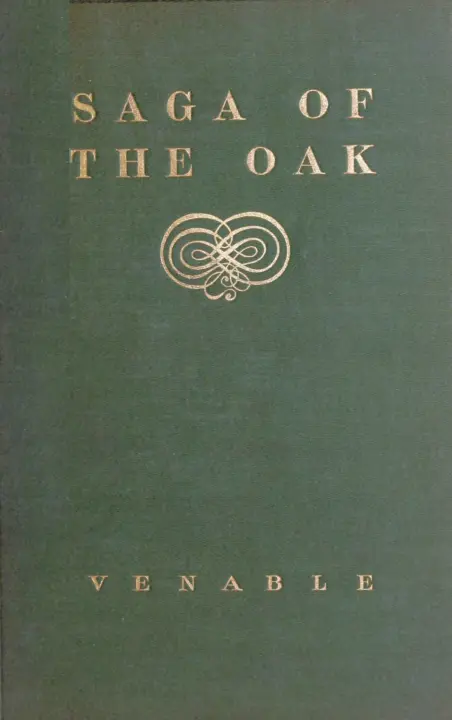
Saga of the oak, and other poems
William Henry Venable
THE CLASSIC COLLECTION · 1901
"A Dream of Empire; Or, The House of Blennerhassett" by William Henry Venable is a historical novel written in the early 20th century. The narrative centers around the Blennerhassett family and their experiences, particularly focusing on the eccentric figure of Harman Blennerhassett in the backdrop of the budding American frontier. The story unfolds in the early 1800s, incorporating themes of exploration, politics, and personal ambition set against the rich tapestry of early American life. At the start of the novel, the narrative introduces us to Peter Taylor, the overseer of Blennerhassett Island, as he supervises the labor of his slaves in a beautifully described spring landscape. Soon, an eccentric visitor named Plutarch Byle stumbles onto the scene, leading to humorous and engaging interactions as he meets Peter and then Harman Blennerhassett. This opening sets up the stage for character introductions and the interconnectedness between these individuals, hinting at the complexities of their lives and the consequences of their ambitions in a rapidly changing society. The style is rich in descriptions and offers a vivid illustration of life along the Ohio River during this transformative period in American history.
Introduction adapted from the source catalogue; source summaries may be automatically generated.
Free to read · English · 74,878 words · No account needed
MAKE TIME FOR A GOOD BOOK
On by default. Untick to stop anonymous reading totals. Each page counts after 10 seconds in view. How this works.
Anonymous counting is on unless you have switched it off.
Notwithstanding his precipitate farewell, Plutarch lingered at the door, and kept nervously wiping the blood off his thumb upon the fringe of his doublet. Mrs. Blennerhassett, with gracious solicitude, insisted upon wrapping a small linen handkerchief about the wounded member. The gawky hero looked very sheepish while she tied the soft bandage fast.
"Is this yourn?" he asked.
"It was mine," she answered, smiling amusedly, "but it now belongs to the knight who came to fight my battle when I was in great distress."
"By gum, I'm obliged to you."
Uttering these elegant parting words, Byle bolted out of the room to the long porch. He stood a moment, then turned his face toward the door, where stood the lady, smiling her embarrassed thanks and adieux. Big tears were trickling down Plutarch's cheeks. The awkward giant gulped, wheeled round, and with long strides made a bee-line for his boat, followed as he left the yard by cheers from the Wood County militia.
Fortunately, a party of youths, including Morgan Neville, William Robinson, young Brackenridge, and a dozen others, who had attached themselves to Burr and Arlington in Pittsburg, came down the Ohio, in a flatboat belonging to one of their associates, Thomas Butler. These adventurous voyagers, suspected of complicity with Burr, were arraigned before three justices of the peace, of the Dogberry caliber, and after a ludicrous examination were acquitted. The best room of their boat was fitted up with carpets, hangings, and a suite of furniture taken from the chambers of the White House, soon to be deserted. The unplaned, unpainted cabin, perfumed by the sour odor of oaken planks and the scent of pine resin, was transformed into an Eastern boudoir--couches, divans, gorgeous colors and all, for the accommodation of Mrs. Blennerhassett.
The ill-starred gentlewoman whose passion for the magnificent prompted her to adorn her floating bower thus luxuriously, and who, like Cleopatra, was attended on her barge by Ethiop slaves, had not relinquished her faith in Burr's dream of conquest and empire.
"Where are we going," asked Harman, when the boat which was to convey the family to Bayou Pierre had been pushed off from their island, and the mother and her children realized that they were afloat upon the river.
"We are going to meet your father in a splendid city far away in the
South."
"Will Colonel Burr be there?"
"Yes, but we shall not then call him Colonel; he will be Emperor."
"And what will you be, mamma?"
"A duchess, my son."
The weary mother sank back upon her oriental divan, which was piled with cushions, and closed her eyes in fragrant slumber, a luxury she had foregone for many days and nights.
Your reading position is saved on this browser. Take it to another device with a library code. Reading pages adapt to text, rather than matching a printed edition.
William Henry Venable
BEHIND THE BOOK
This eBook is for the use of anyone anywhere in the United States and most other parts of the world at no cost and with almost no restrictions whatsoever. You may copy it, give it away or re-use it under the terms of the Project Gutenberg License included with this eBook or online at www.gutenberg.org. If you are not located in the United States, you will have to check the laws of the country where you are located before using this eBook. Read the source licence.
The original source file, including credits and licence, is retained by this library. Request an original-format copy at no charge. Please include the book title and Project Gutenberg identifier #18840.
KEEP YOUR CURIOSITY GOING
Cécile Tormay

Moritz Busch
Coulson Kernahan
John L. Ransom

Maurice Baring
Frances Wright