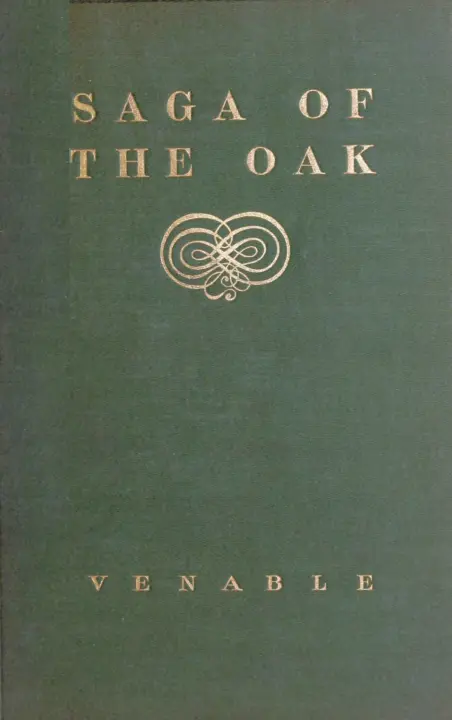
Saga of the oak, and other poems
William Henry Venable
THE CLASSIC COLLECTION · 1901
"A Dream of Empire; Or, The House of Blennerhassett" by William Henry Venable is a historical novel written in the early 20th century. The narrative centers around the Blennerhassett family and their experiences, particularly focusing on the eccentric figure of Harman Blennerhassett in the backdrop of the budding American frontier. The story unfolds in the early 1800s, incorporating themes of exploration, politics, and personal ambition set against the rich tapestry of early American life. At the start of the novel, the narrative introduces us to Peter Taylor, the overseer of Blennerhassett Island, as he supervises the labor of his slaves in a beautifully described spring landscape. Soon, an eccentric visitor named Plutarch Byle stumbles onto the scene, leading to humorous and engaging interactions as he meets Peter and then Harman Blennerhassett. This opening sets up the stage for character introductions and the interconnectedness between these individuals, hinting at the complexities of their lives and the consequences of their ambitions in a rapidly changing society. The style is rich in descriptions and offers a vivid illustration of life along the Ohio River during this transformative period in American history.
Introduction adapted from the source catalogue; source summaries may be automatically generated.
Free to read · English · 74,878 words · No account needed
MAKE TIME FOR A GOOD BOOK
On by default. Untick to stop anonymous reading totals. Each page counts after 10 seconds in view. How this works.
Anonymous counting is on unless you have switched it off.
On the morning after their provoking delay, when the travellers again appeared at the boat landing, impatient to resume their voyage, Aaron Burr was in a mood not to be trifled with. It scarcely mollified his anger to discover on the deck of the boat the slippery crew that had disappointed him.
"Here we are, sharp on time," bawled Captain Pierce audaciously. "How soon do you want to start?"
Burr, stepping aboard the vessel, confronted his plausible employee, and said in a tone of stern reprimand:
"You will be of no use to me unless you obey orders to the letter. You make a bad beginning. Why were you not here twelve hours ago?"
"I didn't agree to shove off before this morning. We were to come at
six--"
"At six last evening. You broke your word."
"What was the use of lying?" said Arlington contemptuously.
The boatman lowered upon the Virginian, and muttered to Burr: "Then I must have heard wrong. I thought you said six o'clock this morning. I'll take my oath on a pile of Bibles."
"Produce the Bibles," suggested Arlington.
Burke ignored the sneering remark, and continued his protestations to Burr. "I mean to do the fair, square thing, as these men will tell you. Ask them. They know Burke Pierce keeps his promises."
"Enough; I hope you do. Don't disappoint me again. Put the boat in
motion."
Under the captain's directions, all the hands but one bestirred themselves. The exception, a burly knot of muscles, with stubby beard and purple nose, instead of joining in the work, stood idle, chewing tobacco, ostentatiously. Without a word Burr stepped lightly in front of the impudent roustabout, and, delivering a blow, with the dexterity of an expert boxer, knocked him into the river, amid the jeers of his associates, and of the concourse assembled on the shore to see the boat off.
This prompt stroke of executive policy had a salutary effect. Recalcitrant subjects had warning that the little man wearing the queue and the small, shiny boots, could not be bluffed.
The boat, once in midstream, was easily managed by the use of long, spiked poles, and, now and then, of an oar. The captain kept his station at the stern of the uncouth craft, handling the steering-pole. The two travellers, standing upon the roof of the ark, admired their pilot's skill, and freely exchanged comments regarding him. To their murmured conversation, the steersman seemed dumb, deaf and indifferent; nevertheless, he gave the closest attention to every word, and his sense of hearing was as keen as that of a wildcat.
Your reading position is saved on this browser. Take it to another device with a library code. Reading pages adapt to text, rather than matching a printed edition.
William Henry Venable
BEHIND THE BOOK
This eBook is for the use of anyone anywhere in the United States and most other parts of the world at no cost and with almost no restrictions whatsoever. You may copy it, give it away or re-use it under the terms of the Project Gutenberg License included with this eBook or online at www.gutenberg.org. If you are not located in the United States, you will have to check the laws of the country where you are located before using this eBook. Read the source licence.
The original source file, including credits and licence, is retained by this library. Request an original-format copy at no charge. Please include the book title and Project Gutenberg identifier #18840.
KEEP YOUR CURIOSITY GOING
Cécile Tormay

Moritz Busch
Coulson Kernahan
John L. Ransom

Maurice Baring
Frances Wright