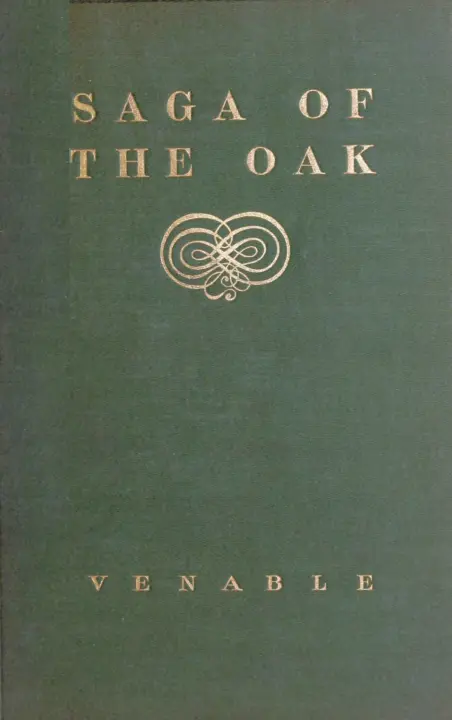
Saga of the oak, and other poems
William Henry Venable
THE CLASSIC COLLECTION · 1901
"A Dream of Empire; Or, The House of Blennerhassett" by William Henry Venable is a historical novel written in the early 20th century. The narrative centers around the Blennerhassett family and their experiences, particularly focusing on the eccentric figure of Harman Blennerhassett in the backdrop of the budding American frontier. The story unfolds in the early 1800s, incorporating themes of exploration, politics, and personal ambition set against the rich tapestry of early American life. At the start of the novel, the narrative introduces us to Peter Taylor, the overseer of Blennerhassett Island, as he supervises the labor of his slaves in a beautifully described spring landscape. Soon, an eccentric visitor named Plutarch Byle stumbles onto the scene, leading to humorous and engaging interactions as he meets Peter and then Harman Blennerhassett. This opening sets up the stage for character introductions and the interconnectedness between these individuals, hinting at the complexities of their lives and the consequences of their ambitions in a rapidly changing society. The style is rich in descriptions and offers a vivid illustration of life along the Ohio River during this transformative period in American history.
Introduction adapted from the source catalogue; source summaries may be automatically generated.
Free to read · English · 74,878 words · No account needed
MAKE TIME FOR A GOOD BOOK
On by default. Untick to stop anonymous reading totals. Each page counts after 10 seconds in view. How this works.
Anonymous counting is on unless you have switched it off.
"The boat of the Spaniard has not yet abandoned our western waters,
Mr. Arlington."
"No, not yet. Twenty years have not elapsed since the first white settlement was made on the soil of Ohio, at Marietta, a town we are now approaching."
The smokers lapsed into a silence of many minutes. Burr resumed
conversation abruptly:
"Arlington, you are not a Federalist?"
"Could you imagine that a son of my father, Major Arlington, would hold the principles of Adams and Jay?"
"You are not, you say, an admirer of Adams, the arch-Federalist. Do you worship his successor? Are you an unconditional Jeffersonian?"
"No, I am not. It seems to me that Jefferson aids the cause of centralization, with the same motive that moved Adams, but with less boldness. What do you think, Colonel Burr, of the temporizing policy of the administration in regard to Spain?"
"In regard to Spain?" echoed Burr, blowing a ring of smoke from his lips, "what do you think, yourself?"
"I think it infamous! It disgraces this nation to submit to exactions and insults from the Spaniards. Why don't the Government declare war, and conquer Mexico?"
"Would you be in favor of that?" asked Burr, lightly touching the ashes of his cigar with the tip of his little finger--so lightly that the ashes did not fall.
"Would I be in favor of it? I am in favor of it. Are not you, Colonel
Burr?"
The politician again barely grazed the cylinder of white ashes with
his little finger.
"We must not be rash."
"I feel that I am rash to talk so positively, but how can there be a difference of opinion on a subject like this? Why don't Congress declare war?"
"Is it your belief that, if war were declared, there would be difficulty in raising volunteers in Virginia?"
"Not the least. Thousands would enlist."
"Would you enlist, Mr. Arlington?"
"Yes, sir, I would."
Burr's little finger tapped the burnt out inch of his cigar, and the frail ash fell, crumbling to fine powder, which the breeze bore away. The touch recorded a point won.
"Suppose that Congress and the President, disregarding the wishes of the people, and refusing to declare war, force the country to submit tamely to the insults of Spain, do you think it possible that independent men might take upon themselves the responsibility as a private business enterprise, and march against the Dons in Mexico?"
After a thoughtful pause, the young man replied:
Your reading position is saved on this browser. Take it to another device with a library code. Reading pages adapt to text, rather than matching a printed edition.
William Henry Venable
BEHIND THE BOOK
This eBook is for the use of anyone anywhere in the United States and most other parts of the world at no cost and with almost no restrictions whatsoever. You may copy it, give it away or re-use it under the terms of the Project Gutenberg License included with this eBook or online at www.gutenberg.org. If you are not located in the United States, you will have to check the laws of the country where you are located before using this eBook. Read the source licence.
The original source file, including credits and licence, is retained by this library. Request an original-format copy at no charge. Please include the book title and Project Gutenberg identifier #18840.
KEEP YOUR CURIOSITY GOING
Cécile Tormay

Moritz Busch
Coulson Kernahan
John L. Ransom

Maurice Baring
Frances Wright