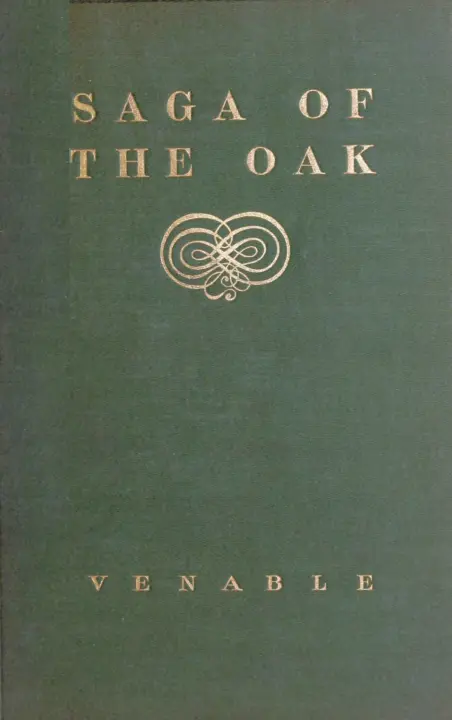
Saga of the oak, and other poems
William Henry Venable
THE CLASSIC COLLECTION · 1901
"A Dream of Empire; Or, The House of Blennerhassett" by William Henry Venable is a historical novel written in the early 20th century. The narrative centers around the Blennerhassett family and their experiences, particularly focusing on the eccentric figure of Harman Blennerhassett in the backdrop of the budding American frontier. The story unfolds in the early 1800s, incorporating themes of exploration, politics, and personal ambition set against the rich tapestry of early American life. At the start of the novel, the narrative introduces us to Peter Taylor, the overseer of Blennerhassett Island, as he supervises the labor of his slaves in a beautifully described spring landscape. Soon, an eccentric visitor named Plutarch Byle stumbles onto the scene, leading to humorous and engaging interactions as he meets Peter and then Harman Blennerhassett. This opening sets up the stage for character introductions and the interconnectedness between these individuals, hinting at the complexities of their lives and the consequences of their ambitions in a rapidly changing society. The style is rich in descriptions and offers a vivid illustration of life along the Ohio River during this transformative period in American history.
Introduction adapted from the source catalogue; source summaries may be automatically generated.
Free to read · English · 74,878 words · No account needed
MAKE TIME FOR A GOOD BOOK
On by default. Untick to stop anonymous reading totals. Each page counts after 10 seconds in view. How this works.
Anonymous counting is on unless you have switched it off.
"My dear girl, will you give no credit to human saviors? It appears you owe special gratitude to a mortal. I can't claim any merit for saving you, but I am extremely happy that we are once more together. Who is your travelling companion? We must look after her."
"Are you tired of me already," she playfully chided, "and curious to make a new friend? They are French people from Gallipolis."
"French? Is she French?" asked Danvers, gazing toward Lucrece.
"French? Is she French?" tenderly mocked Evaleen. "I told you they
were French. Now I am jealous. Do you know any French girl in
Gallipolis?"
"Nonsense, Evaleen! I am not a woman's man. Pardon, I don't mean that I don't like you, of course--"
"Like--don't you love me? I love you with all my heart, you dear fellow! But I love Lucrece also, and maybe I'll let you love her just a little."
Danvers seemed embarrassed. Evaleen went on:
"We are forgetting our friends. Come, you must thank the man who saved
us."
The pair hurried to where Arlington stood.
"Mr. Arlington, this is Captain Danvers."
"I have met Captain Danvers."
"How, what? Have you, Warren, formed the acquaintance of--?"
"I have seen Mr. Arlington once before."
"Where?"
"In Marietta."
"When?"
"A good while ago. On the day I left for St. Louis."
"You never told me." Danvers looked hard at Arlington, who felt called
upon to explain.
"Madam, I challenged Captain Danvers to fight."
Evaleen's blue eyes opened wide.
"Challenged Warren!"
"Yes."
"And you accepted the challenge?"
"Yes."
"Why, brother!"
Arlington's heart leapt within him. "Brother?" he stammered. "Captain
Danvers your brother?"
"He is my half brother."
Danvers laughed out. Putting his arm around Evaleen, he said, "Mr. Arlington, if you are still disposed to fight me, we may meet when you please. But I am of the opinion you will learn from Evaleen that you have more cause to cherish hard feelings against the man you champion than against me."
"At any rate," said Arlington, as the two shook hands, "whatever you may think concerning Colonel Burr, this is not the place nor time for quarrelling. You have the Spaniards to fight--I must fight a rash temper."
Lucrece, pale and sad-eyed, was leaning upon her father's shoulder. Evaleen hastened to her, and the doctor went up to Arlington to pour out endless thanks.
"Are you sick, Lucrece? Shall we go to the boat?"
"Sick, sick at heart."
"There is a way to cure that."
"No, my Evaleen, there is no cure. But you shall it all forgive. How could I know? You say you sometime tell me the story I read, alas, too late."
"Story? What story?"
Your reading position is saved on this browser. Take it to another device with a library code. Reading pages adapt to text, rather than matching a printed edition.
William Henry Venable
BEHIND THE BOOK
This eBook is for the use of anyone anywhere in the United States and most other parts of the world at no cost and with almost no restrictions whatsoever. You may copy it, give it away or re-use it under the terms of the Project Gutenberg License included with this eBook or online at www.gutenberg.org. If you are not located in the United States, you will have to check the laws of the country where you are located before using this eBook. Read the source licence.
The original source file, including credits and licence, is retained by this library. Request an original-format copy at no charge. Please include the book title and Project Gutenberg identifier #18840.
KEEP YOUR CURIOSITY GOING
Cécile Tormay

Moritz Busch
Coulson Kernahan
John L. Ransom

Maurice Baring
Frances Wright