THE CLASSIC COLLECTION✦The psychology of the criminalCLASSIC FREE BOOKS
The psychology of the criminal
Leo Markun
THE CLASSIC COLLECTION · 1927
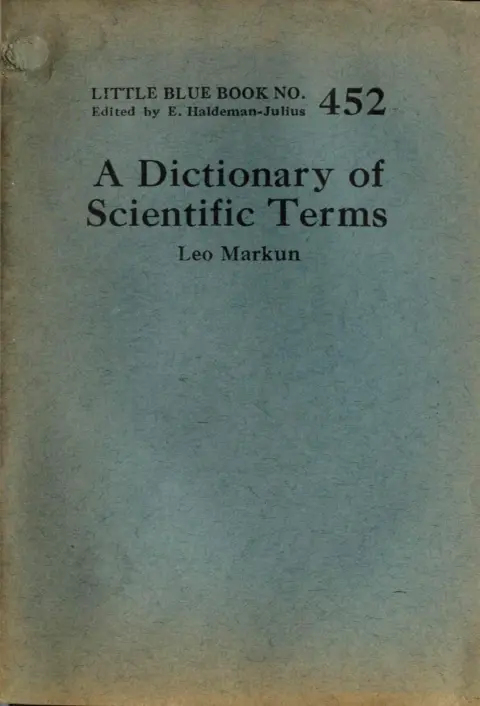
A dictionary of scientific terms by Leo Markun is a compact scientific reference compiled in the early 20th century. It is a dictionary designed for general readers and students, offering brief, accessible explanations of terminology across physics, chemistry, biology, and related disciplines; its likely topic is clarifying scientific vocabulary and method.
The preface sets a modest scope, stressing clarity for non-specialists, noting disagreements over meanings, and including boundary terms that test what counts as science (such as common sense, philosophy, theology, superstition). The main text is an alphabetical glossary from Abasia to Zymurgy, covering taxonomy, anatomy, geology and geological eras, elements and symbols, units and instruments, mathematical and physical concepts, and core ideas in evolution, genetics, psychology, and astronomy. Entries are concise and practical, often giving plural forms, variant spellings, prefixes and roots, and cross-disciplinary notes, with occasional viewpointed remarks on scientific method (hypothesis, theory, law), contested notions (instinct, ether, vitalism), and the value of metrics and standards. The result is a quick-reference guide aimed at orienting readers to essential meanings and usage across the scientific lexicon.
Introduction adapted from the source catalogue; source summaries may be automatically generated.
Free to read · English · 11,972 words · No account needed
MAKE TIME FOR A GOOD BOOK
On by default. Untick to stop anonymous reading totals. Each page counts after 10 seconds in view. How this works.
Anonymous counting is on unless you have switched it off.
Theology. The “science” of religion, especially Christian religion, and of God, according to lexicographers and other writers. Newman argues very well that if there is a miracle-working God whom we can understand by studying the Bible and the traditions of the Catholic Church, then theology is an essential branch of science. I do not see how any man who grants his premises can fail to agree with him.
Theory. A generalization which has not been absolutely proved. Sometimes one that stands between a hypothesis and a law, not so certain as the latter, more certain than the former. However, phrases continue, often when their meaning has changed, and it seems that “Theory of Evolution” may be used when the Fundamentalists have already accepted it. Also scientific principles in general. Sound theory and proper practice are not enemies.
Thermo-. In compounds, heat, temperature. As, thermodynamics: the science of the relation between heat and mechanical work.
Thorax. The part of the trunk between the neck and the tail or the
abdomen.
Tin. A metallic element. Symbol: Sn. Most objects which we say, in ordinary language, are made of tin, are made of tin plate.
Tincture. The alcoholic solution of a drug.
Titanium. A metallic element. Symbol: Ti.
Triassic. Relating to the geological division between the Permian and
the Jurassic.
Typhoon. A violent hurricane.
Ulotrichi. The wooly-haired races of mankind.
Ultra-violet rays. Invisible rays of the spectrum beyond the violet
rays.
Ungulate. One of a group (Ungulata) of mammals having horns and hoofs.
Uranium. A metallic element. Symbol: U. Uranium is radioactive.
Vacuum. A space which does not contain matter. A vacuum, in a laboratory, is a space which has been exhausted of matter to a great extent; for scientists have not been able to produce a perfect vacuum.
Value. The amount of other commodities for which a thing can be
exchanged in the open market.
Valve. The membranous part of an organ which permits the flow of a liquid in one direction only.
Vanadium. A metallic element. Symbol: V.
Vapor. A gas, especially one which exists at ordinary temperatures in
liquid or solid form.
Velocity. Rate of motion.
Vertebrate. Having a spinal column, belonging to the class of
Vertebrata.
Vitalism. The theory that there is a special force in living beings, distinct from the ordinary physical and chemical forces. Few scientists are vitalists, although many preachers are, and a number of philosophers as well.
Vitamines. Organic substances found in various foods and apparently necessary to human life. Their exact chemical constitution remains unknown.
Volt. The unit of electromotive force. The pressure which produces a current of one ampere when applied to a conductor with a resistance of one ohm.
Your reading position is saved on this browser. Take it to another device with a library code. Reading pages adapt to text, rather than matching a printed edition.
BEHIND THE BOOK
This eBook is for the use of anyone anywhere in the United States and most other parts of the world at no cost and with almost no restrictions whatsoever. You may copy it, give it away or re-use it under the terms of the Project Gutenberg License included with this eBook or online at www.gutenberg.org. If you are not located in the United States, you will have to check the laws of the country where you are located before using this eBook. Read the source licence.
The original source file, including credits and licence, is retained by this library. Request an original-format copy at no charge. Please include the book title and Project Gutenberg identifier #77721.
KEEP YOUR CURIOSITY GOING

John Muir

Asa Gray
Asa Gray

Florence Nightingale
Elizabeth Robins Pennell
Denison Olmsted