THE CLASSIC COLLECTION✦The psychology of the criminalCLASSIC FREE BOOKS
The psychology of the criminal
Leo Markun
THE CLASSIC COLLECTION · 1927
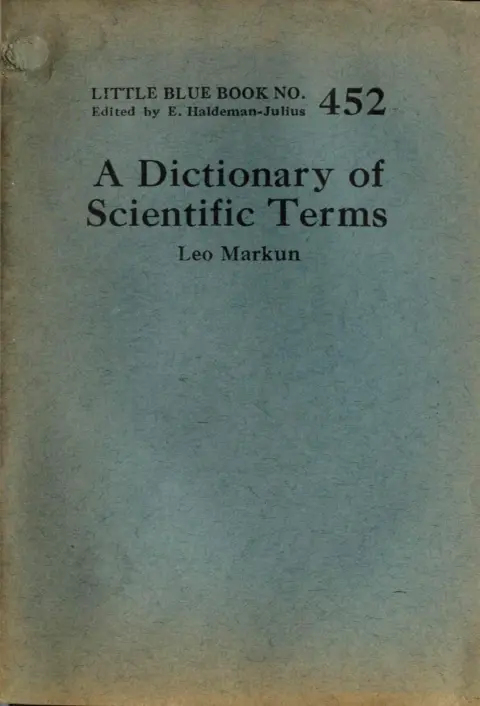
A dictionary of scientific terms by Leo Markun is a compact scientific reference compiled in the early 20th century. It is a dictionary designed for general readers and students, offering brief, accessible explanations of terminology across physics, chemistry, biology, and related disciplines; its likely topic is clarifying scientific vocabulary and method.
The preface sets a modest scope, stressing clarity for non-specialists, noting disagreements over meanings, and including boundary terms that test what counts as science (such as common sense, philosophy, theology, superstition). The main text is an alphabetical glossary from Abasia to Zymurgy, covering taxonomy, anatomy, geology and geological eras, elements and symbols, units and instruments, mathematical and physical concepts, and core ideas in evolution, genetics, psychology, and astronomy. Entries are concise and practical, often giving plural forms, variant spellings, prefixes and roots, and cross-disciplinary notes, with occasional viewpointed remarks on scientific method (hypothesis, theory, law), contested notions (instinct, ether, vitalism), and the value of metrics and standards. The result is a quick-reference guide aimed at orienting readers to essential meanings and usage across the scientific lexicon.
Introduction adapted from the source catalogue; source summaries may be automatically generated.
Free to read · English · 11,972 words · No account needed
MAKE TIME FOR A GOOD BOOK
On by default. Untick to stop anonymous reading totals. Each page counts after 10 seconds in view. How this works.
Anonymous counting is on unless you have switched it off.
Star. A heavenly body. More usually, those that appear to be fixed dots of light, including the sun but not the planets or meteors, are included in the term. One of the “fixed” stars. The stars are either named or numbered in various catalogues.
State. Condition, especially the being in solid, liquid, or gaseous form. An organized political community.
Statics. The study of bodies at rest and forces in equilibrium; a branch of mechanics. According to Einstein, no body is ever at rest.
Statistics. The systematic collection of numerical facts. The study which deals with collection of this sort and with the interpretation of statistics in the first sense.
Stigma. The part of the style or ovary-surface that receives pollen.
A small speck or mark.
Stipule. A small appendage to a leaf.
Stratum. In geology, a layer or set of layers of rock or earth. In
biology, a layer of tissue.
Strontium. A metallic element. Symbol: Sr.
Style. A narrowed extension of the ovary which supports the stigma.
Subalpine. Living or growing just below the alpine zone.
Sublimation. The direct change from the solid to the gaseous state.
Sulphur. A solid non-metallic element. Symbol: S. It occurs native
and in many compounds.
Superstition. Irrational fear of or credulity about the unknown. To the ignorant person, almost everything is unknown. Particular forms of superstition are transmitted from generation to generation and from group to group. Superstitions which masquerade as science are not unknown.
Symbol. A letter, word, or other thing which represents an object or quantity or idea. The symbol is frequently an abbreviation. In chemistry, it is the Latin name of the element which is abbreviated to form the symbol.
Synclinal. Dipping toward a common line or point.
Synthetic. Produced outside the living organism. Artificial. Making
more complex.
Tantalum. A metallic element. Symbol: Ta.
Tellurium. A rare non-metallic element. Symbol: Te.
Temperature. Degree, not total amount, of heat.
Tendon. A cord or band of tissue connecting a muscle with another
part.
Terbium. A metallic element. Symbol: Tb.
Tertiary. Relating to the third in a series, as of organic compounds. Relating to the geological period before the Quaternary.
Thallium. A metallic element. Symbol: Tl.
Thallophyte. One of a phylum (Thallophyta) of simple plants including
fungi and lichens.
Thallus. A simple plant body without root, stem, or leaves.
Your reading position is saved on this browser. Take it to another device with a library code. Reading pages adapt to text, rather than matching a printed edition.
BEHIND THE BOOK
This eBook is for the use of anyone anywhere in the United States and most other parts of the world at no cost and with almost no restrictions whatsoever. You may copy it, give it away or re-use it under the terms of the Project Gutenberg License included with this eBook or online at www.gutenberg.org. If you are not located in the United States, you will have to check the laws of the country where you are located before using this eBook. Read the source licence.
The original source file, including credits and licence, is retained by this library. Request an original-format copy at no charge. Please include the book title and Project Gutenberg identifier #77721.
KEEP YOUR CURIOSITY GOING

John Muir

Asa Gray
Asa Gray

Florence Nightingale
Elizabeth Robins Pennell
Denison Olmsted