THE CLASSIC COLLECTION✦The psychology of the criminalCLASSIC FREE BOOKS
The psychology of the criminal
Leo Markun
THE CLASSIC COLLECTION · 1927
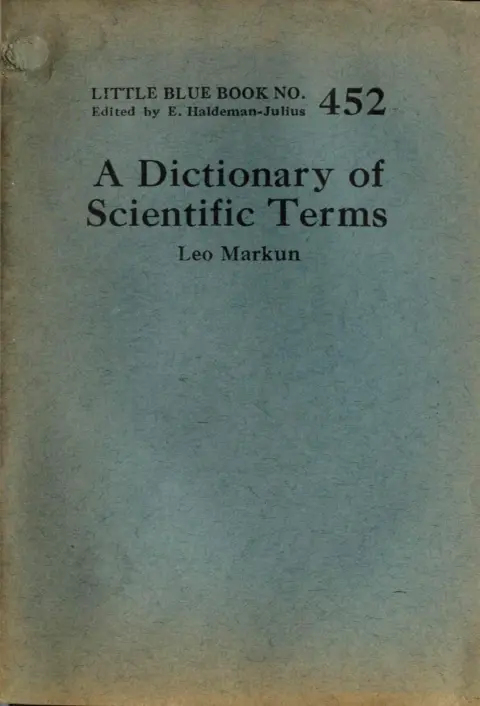
A dictionary of scientific terms by Leo Markun is a compact scientific reference compiled in the early 20th century. It is a dictionary designed for general readers and students, offering brief, accessible explanations of terminology across physics, chemistry, biology, and related disciplines; its likely topic is clarifying scientific vocabulary and method.
The preface sets a modest scope, stressing clarity for non-specialists, noting disagreements over meanings, and including boundary terms that test what counts as science (such as common sense, philosophy, theology, superstition). The main text is an alphabetical glossary from Abasia to Zymurgy, covering taxonomy, anatomy, geology and geological eras, elements and symbols, units and instruments, mathematical and physical concepts, and core ideas in evolution, genetics, psychology, and astronomy. Entries are concise and practical, often giving plural forms, variant spellings, prefixes and roots, and cross-disciplinary notes, with occasional viewpointed remarks on scientific method (hypothesis, theory, law), contested notions (instinct, ether, vitalism), and the value of metrics and standards. The result is a quick-reference guide aimed at orienting readers to essential meanings and usage across the scientific lexicon.
Introduction adapted from the source catalogue; source summaries may be automatically generated.
Free to read · English · 11,972 words · No account needed
MAKE TIME FOR A GOOD BOOK
On by default. Untick to stop anonymous reading totals. Each page counts after 10 seconds in view. How this works.
Anonymous counting is on unless you have switched it off.
Metabolism. The complete process of building up and breaking down protoplasm in a living organism. The process of digesting and storing nutritive matter and of excreting waste matter.
Metal. An element which replaces or is capable of replacing the hydrogen of an acid. One of a class of substances typically ductile, malleable, lustrous, translucent only through very thin layers, conducting heat and electricity well.
Metaphysics. The branch of philosophy dealing with knowing and being. This must disappear entirely as science advances.
Metazoa. All the complex animals. All the animals except the Protozoa.
Metric system. The decimal system of weights and measures generally used in many countries, employed for many purposes by scientists everywhere. A meter is about 1.094 yards. A kilometer is about .6214 of a mile. A cubic centimeter is about .061 of an inch. A kilogram is about 2.204 pounds. The C. G. S. (centimeter-gram-second) system is used in practically every science which deals with space, mass, and time.
Mho. A unit of electrical conductivity.
Microbe. A very small organism; in popular use, a disease-producing
bacterium, a germ.
Micro-. Small, in many compounds.
Mineral. Pertaining to substances which are not organic. An ore.
Mineralogy. The science of ores.
Miocene. Relating to the middle division of the Tertiary (geological)
period.
Mitosis. Cell division and multiplication by the usual process.
Mixture. A mass of more than one sort of material which is not chemically compounded or united.
Molecule. The smallest amount of a substance which can exist with the properties belonging to the substance.
Molybdenum. A metallic element. Symbol: Mo.
Momentum. The quantity of motion of a moving body. It is equal to the mass multiplied by the velocity.
Monadelphous. With the stamen filaments in a single bundle.
Moniliform. Jointed in such a way as to resemble a necklace.
Monecious. Hermaphrodite. Having male and female flowers on the same
plant.
Monopoly. Sufficient control to influence price.
Monotreme. One of the lowest order (Monotremata) of mammals.
Monsoon. A periodic wind. Specifically, such a wind in the Indian
Ocean.
Moraine. The mass of earth and other matter deposited by a glacier.
Morphology. The study of form (of organisms or of words).
Motor. Pertaining to a nerve and an impulse causing motion. Relating to action and the consciousness of action. Pertaining to a muscle causing action. A machine which causes motion, especially such an electric machine or one which is comparatively small.
Muscle. A fibrous band or bundle which contracts to produce movement
in an animal body.
Muscology. The study of mosses.
Mutation. A sudden variation which may produce a new species.
Mycology. The study of fungi.
Myriapoda. A class of arthropods including the centipedes.
Narcotic. A substance which induces sleepiness.
Your reading position is saved on this browser. Take it to another device with a library code. Reading pages adapt to text, rather than matching a printed edition.
BEHIND THE BOOK
This eBook is for the use of anyone anywhere in the United States and most other parts of the world at no cost and with almost no restrictions whatsoever. You may copy it, give it away or re-use it under the terms of the Project Gutenberg License included with this eBook or online at www.gutenberg.org. If you are not located in the United States, you will have to check the laws of the country where you are located before using this eBook. Read the source licence.
The original source file, including credits and licence, is retained by this library. Request an original-format copy at no charge. Please include the book title and Project Gutenberg identifier #77721.
KEEP YOUR CURIOSITY GOING

John Muir

Asa Gray
Asa Gray

Florence Nightingale
Elizabeth Robins Pennell
Denison Olmsted