THE CLASSIC COLLECTION✦The psychology of the criminalCLASSIC FREE BOOKS
The psychology of the criminal
Leo Markun
THE CLASSIC COLLECTION · 1927
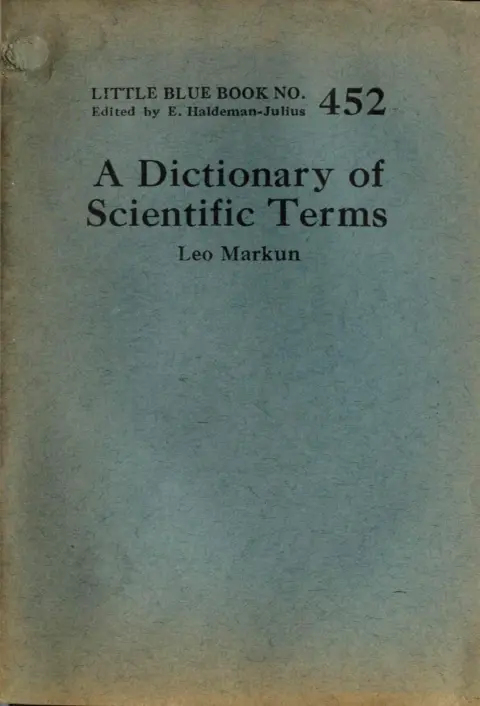
A dictionary of scientific terms by Leo Markun is a compact scientific reference compiled in the early 20th century. It is a dictionary designed for general readers and students, offering brief, accessible explanations of terminology across physics, chemistry, biology, and related disciplines; its likely topic is clarifying scientific vocabulary and method.
The preface sets a modest scope, stressing clarity for non-specialists, noting disagreements over meanings, and including boundary terms that test what counts as science (such as common sense, philosophy, theology, superstition). The main text is an alphabetical glossary from Abasia to Zymurgy, covering taxonomy, anatomy, geology and geological eras, elements and symbols, units and instruments, mathematical and physical concepts, and core ideas in evolution, genetics, psychology, and astronomy. Entries are concise and practical, often giving plural forms, variant spellings, prefixes and roots, and cross-disciplinary notes, with occasional viewpointed remarks on scientific method (hypothesis, theory, law), contested notions (instinct, ether, vitalism), and the value of metrics and standards. The result is a quick-reference guide aimed at orienting readers to essential meanings and usage across the scientific lexicon.
Introduction adapted from the source catalogue; source summaries may be automatically generated.
Free to read · English · 11,972 words · No account needed
MAKE TIME FOR A GOOD BOOK
On by default. Untick to stop anonymous reading totals. Each page counts after 10 seconds in view. How this works.
Anonymous counting is on unless you have switched it off.
Limb. In astronomy, an edge or border. This is not the same word etymologically as the one which means an arm, a leg, or a wing.
Lithium. A metallic element. Symbol: Li.
Litmus. A substance which is turned red by acids and made blue again by bases. Paper stained with litmus is usually employed for such tests.
Logic. The science of thought. Scientific method.
Lutecium. A metallic element. Symbol: Lu.
Magnesium. A metallic element. Symbol: Mg.
Magnetize. To change into a magnet, give magnetic quality to, make
capable of attracting iron.
Male. Of the sex or the organs that fecundate. Of a reproductive
organ that fertilizes.
Mammal. One of the class of animals (Mammalia) which are vertebrate and which are distinguished by suckling their young.
Mandible. Jaw, especially the lower jaw. Part of a beak.
Manganese. A metallic element. Symbol: Mn.
Marsupial. One of an order of animals (Marsupialia) which are low mammals, and most of whose females carry the young in abdominal pouches.
Mass. Quantity of matter. This remains constant, but weight varies a little with geographical location.
Materia medica. The study of medicinal substances.
Mathematics. The science of space and quantity as such.
Matter. That which takes up space.
Mean. Equally removed from two extremes, average.
Mechanics. The science of motion. The study of the action of force on bodies. May be considered a branch of mathematics or of physics.
Medicine. The art of maintaining and restoring health. Surgery is sometimes excluded from the conception of medicine. The basis of medicine is only partially scientific.
Megacephalic. Large-headed.
Melt. To change from the solid to the liquid form.
Mendel’s Law. A principle formulated by Gregor Mendel with regard to the inheritance of characteristics. Fenton, following Walter, states it thus: “When two animals or plants unlike with respect to any character are crossed, the offspring of the first generation will be apparently like one of the parents in regard to the character in question. The parent which impresses its trait upon the offspring in this manner is called the dominant, while the one that fails to be visibly represented is the recessive. When, however, the hybrid progeny of this generation are in turn crossed with each other, they will produce a mixed lot of offspring, one-fourth of which will be like the dominant grandparent, one-fourth like the recessive one, and the remaining half like the parents which resembled the dominant grandparent, yet failed to breed true to it.”
Mercury. Of the metallic elements, the only one which is ordinarily found in the liquid state. Quicksilver. Formula: Hg.
Mesozoic. Relating to the geological period between the Paleozoic and
the Cenozoic.
Your reading position is saved on this browser. Take it to another device with a library code. Reading pages adapt to text, rather than matching a printed edition.
BEHIND THE BOOK
This eBook is for the use of anyone anywhere in the United States and most other parts of the world at no cost and with almost no restrictions whatsoever. You may copy it, give it away or re-use it under the terms of the Project Gutenberg License included with this eBook or online at www.gutenberg.org. If you are not located in the United States, you will have to check the laws of the country where you are located before using this eBook. Read the source licence.
The original source file, including credits and licence, is retained by this library. Request an original-format copy at no charge. Please include the book title and Project Gutenberg identifier #77721.
KEEP YOUR CURIOSITY GOING

John Muir

Asa Gray
Asa Gray

Florence Nightingale
Elizabeth Robins Pennell
Denison Olmsted