THE CLASSIC COLLECTION✦The psychology of the criminalCLASSIC FREE BOOKS
The psychology of the criminal
Leo Markun
THE CLASSIC COLLECTION · 1927
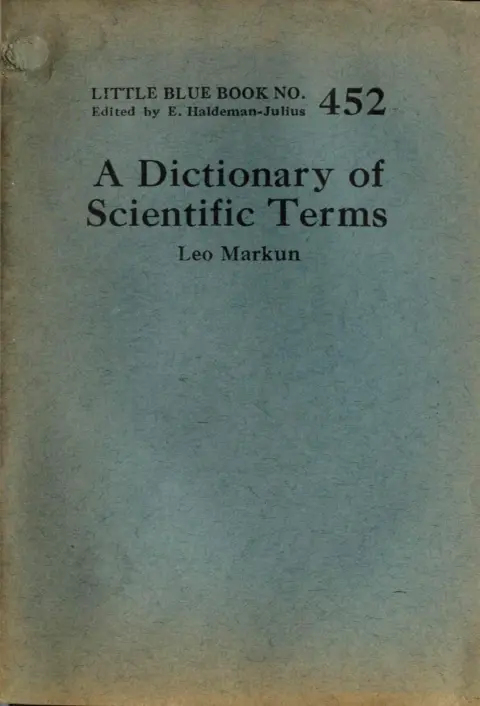
A dictionary of scientific terms by Leo Markun is a compact scientific reference compiled in the early 20th century. It is a dictionary designed for general readers and students, offering brief, accessible explanations of terminology across physics, chemistry, biology, and related disciplines; its likely topic is clarifying scientific vocabulary and method.
The preface sets a modest scope, stressing clarity for non-specialists, noting disagreements over meanings, and including boundary terms that test what counts as science (such as common sense, philosophy, theology, superstition). The main text is an alphabetical glossary from Abasia to Zymurgy, covering taxonomy, anatomy, geology and geological eras, elements and symbols, units and instruments, mathematical and physical concepts, and core ideas in evolution, genetics, psychology, and astronomy. Entries are concise and practical, often giving plural forms, variant spellings, prefixes and roots, and cross-disciplinary notes, with occasional viewpointed remarks on scientific method (hypothesis, theory, law), contested notions (instinct, ether, vitalism), and the value of metrics and standards. The result is a quick-reference guide aimed at orienting readers to essential meanings and usage across the scientific lexicon.
Introduction adapted from the source catalogue; source summaries may be automatically generated.
Free to read · English · 11,972 words · No account needed
MAKE TIME FOR A GOOD BOOK
On by default. Untick to stop anonymous reading totals. Each page counts after 10 seconds in view. How this works.
Anonymous counting is on unless you have switched it off.
Hydraulics. The science dealing with liquids in motion.
Hydrocarbon. A compound of carbon and hydrogen.
Hydrogen. A gaseous element. Symbol: H.
Hydrolysis. The decomposition of water in such a reaction as includes the formation of new compounds with the hydrogen and the oxygen of the water.
Hydrometer. An instrument used to determine the specific gravity of a
liquid.
Hydrostatics. The science which deals with the pressure of liquids.
Hydrous. Containing water, whether in combination or in a mixture.
Hydrozoan. A member of a class (Hydrozoa) of coelenterate animals, chiefly marine, including jellyfish.
Hygiene. The science of sanitation, preventive medicine. In the United States, textbooks of hygiene are chiefly concerned with proving that alcohol and tobacco are injurious. Here is an example of “science” created by legislative fiat.
Hygrometry. The measuring of atmospheric moisture.
Hypothesis. A supposition used as a basis for reasoning, a provisional explanation. If it appears to be unconfirmed by the facts, it is rejected. Otherwise it becomes a theory, then a law.
Igneous. Formed by great heat, as rocks.
Indehiscent. Not bursting open at maturity.
Indium. A metallic element. Symbol: In.
Indo-European or Indo-Germanic. Pertaining to a great family of languages including most of those spoken in Europe and by the white men in America as well as some used in India and other parts of Asia.
Inductance. The electrification of a conductor placed near a circuit or charged body, resulting from the proximity.
Inert. Not easily made to react.
Inertia. The property of matter by which it tends to remain at rest if it is at rest, or, if it is in motion, to remain in motion in a straight line. Our notion of inertia may possibly be changed by Einstein’s theory.
Inflorescence. Flowering, the arrangement of flowers on a plant.
Infra-. In compounds, below.
Infusoria. A class of protozoa which possess hairlike outgrowths.
Inorganic. Not derived from living organisms. Pertaining to the chemical compounds which do not contain carbon--but carbonates and a few other carbon compounds are considered to be inorganic.
Insect. A member of a class of small and invertebrate animals, all of which have bodies clearly divisible into head, thorax, and abdomen.
Instinct. An action pattern present from birth. (The varying theories of instinct, especially with regard to man, are often based upon varying definitions. This is true of many of the terms here defined.)
Intelligence quotient. The ratio between the “mental age” of an individual and the true age. The true age is often easier to determine than the mental age, that is, the age which a normal individual of a given intelligence possesses. How can intelligence be expressed numerically? Abbreviation: I. Q.
Your reading position is saved on this browser. Take it to another device with a library code. Reading pages adapt to text, rather than matching a printed edition.
BEHIND THE BOOK
This eBook is for the use of anyone anywhere in the United States and most other parts of the world at no cost and with almost no restrictions whatsoever. You may copy it, give it away or re-use it under the terms of the Project Gutenberg License included with this eBook or online at www.gutenberg.org. If you are not located in the United States, you will have to check the laws of the country where you are located before using this eBook. Read the source licence.
The original source file, including credits and licence, is retained by this library. Request an original-format copy at no charge. Please include the book title and Project Gutenberg identifier #77721.
KEEP YOUR CURIOSITY GOING

John Muir

Asa Gray
Asa Gray

Florence Nightingale
Elizabeth Robins Pennell
Denison Olmsted