THE CLASSIC COLLECTION✦The psychology of the criminalCLASSIC FREE BOOKS
The psychology of the criminal
Leo Markun
THE CLASSIC COLLECTION · 1927
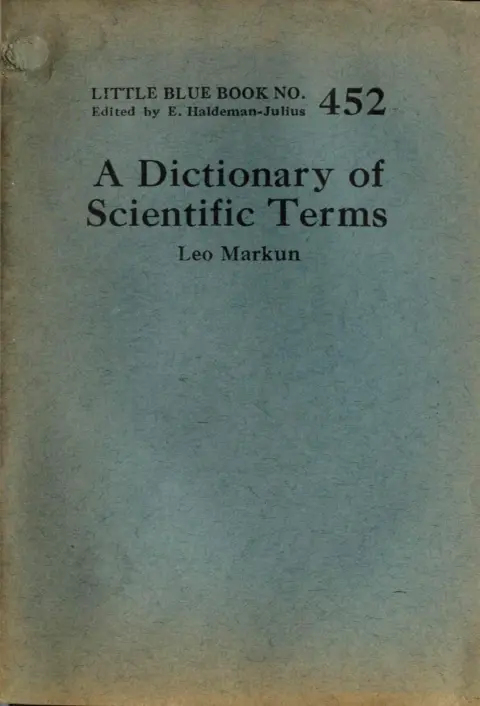
A dictionary of scientific terms by Leo Markun is a compact scientific reference compiled in the early 20th century. It is a dictionary designed for general readers and students, offering brief, accessible explanations of terminology across physics, chemistry, biology, and related disciplines; its likely topic is clarifying scientific vocabulary and method.
The preface sets a modest scope, stressing clarity for non-specialists, noting disagreements over meanings, and including boundary terms that test what counts as science (such as common sense, philosophy, theology, superstition). The main text is an alphabetical glossary from Abasia to Zymurgy, covering taxonomy, anatomy, geology and geological eras, elements and symbols, units and instruments, mathematical and physical concepts, and core ideas in evolution, genetics, psychology, and astronomy. Entries are concise and practical, often giving plural forms, variant spellings, prefixes and roots, and cross-disciplinary notes, with occasional viewpointed remarks on scientific method (hypothesis, theory, law), contested notions (instinct, ether, vitalism), and the value of metrics and standards. The result is a quick-reference guide aimed at orienting readers to essential meanings and usage across the scientific lexicon.
Introduction adapted from the source catalogue; source summaries may be automatically generated.
Free to read · English · 11,972 words · No account needed
MAKE TIME FOR A GOOD BOOK
On by default. Untick to stop anonymous reading totals. Each page counts after 10 seconds in view. How this works.
Anonymous counting is on unless you have switched it off.
Glass. A substance made by mixing silicates and including some alkali silicate. Not every sort of glass is transparent.
Glomerate. Gathered in a compact group.
Glottis. The opening at the upper end of the windpipe.
Glucinum or beryllium. A metallic element. Symbol: Gl or Be.
Glucose. One of a group of sugars, including grape sugar.
Gneiss. A sort of highly crystalline rock arranged in layers, as of
quartz and mica.
Gold. A metallic element. Symbol: Au.
Gram. The unit of weight in the metric system. About the weight of a cubic centimeter of water at its greatest density.
Graph. A symbolical diagram, as in mathematics of chemistry.
Gravity or gravitation. The attraction existing between bodies. If the earth draws a falling apple, it is said that the apple also draws the earth to it.
Gregarious. Living in or pertaining to flocks, groups, or
communities. Social.
Gymnosperm. A plant whose seeds are not enclosed in seed-vessels.
Habit. An action pattern; specifically, one that has been acquired. In biology, a mode of growth.
Hallucination. The perception of something which is not actually
present.
Hardness. The presence of certain salts in water.
Heat. Energy which can be transmitted by conduction or radiation, and which is expressed in molecular motion.
Helium. A gaseous element. Symbol: He.
Henry. The unit of inductance. The inductance in a circuit in which the induced electromotive force is one volt when the inducing current varies at the rate of one ampere per second.
Herb. A plant whose stem is not woody or persistent.
Hermaphrodite. An organism possessing male and female characteristics
or organs.
Herpetology. The study of reptiles.
Hexapoda. The order of insects.
Hilum. The point where the seed is attached to the seed-vessel.
Hinterland. The district behind a coast.
Histology. The study of organic tissues, usually with the aid of a
microscope.
History. The study of the past. It deals with human institutions rather than with the animal, vegetable, or mineral kingdom. History is concerned first of all with concrete data, specific cases, and then with explaining them in the light of general laws. There have been some ingenious, but not altogether successful, attempts to make history into a science.
Holmium. A metallic element. Symbol: Ho.
Homo-. In compounds: same, similar.
Homology. That relation between parts which results from their development from corresponding embryonic parts, either in different animals or in the same individual.
Hormone. A stimulating substance carried from one organ to another.
Horse-power. The unit of power in the English system. It is equal to 550 foot pounds per second.
Humidity. Moisture.
Hurricane. A wind of stormy violence.
Hybrid. The offspring of two plants or animals of different sorts.
Hydrate. A compound containing combined water.
Your reading position is saved on this browser. Take it to another device with a library code. Reading pages adapt to text, rather than matching a printed edition.
BEHIND THE BOOK
This eBook is for the use of anyone anywhere in the United States and most other parts of the world at no cost and with almost no restrictions whatsoever. You may copy it, give it away or re-use it under the terms of the Project Gutenberg License included with this eBook or online at www.gutenberg.org. If you are not located in the United States, you will have to check the laws of the country where you are located before using this eBook. Read the source licence.
The original source file, including credits and licence, is retained by this library. Request an original-format copy at no charge. Please include the book title and Project Gutenberg identifier #77721.
KEEP YOUR CURIOSITY GOING

John Muir

Asa Gray
Asa Gray

Florence Nightingale
Elizabeth Robins Pennell
Denison Olmsted