THE CLASSIC COLLECTION✦An outlaw’s diary: the CommuneCLASSIC FREE BOOKS
An outlaw’s diary: the Commune
Cécile Tormay
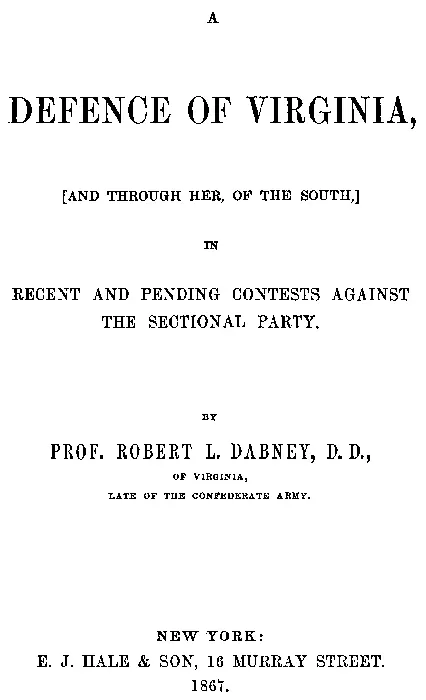
THE CLASSIC COLLECTION · 1867
"A Defence of Virginia" by Robert Lewis Dabney is a historical account written in the late 19th century. The book serves as a justification for the institution of slavery and the Southern cause during and after the American Civil War, arguing that the principles of slavery are both moral and historically valid. Dabney presents a defense of Virginia and through it, the Southern states, against what he perceives as a misrepresentation by abolitionists and their sympathizers. The opening of the text introduces the author's intent to defend Virginia, whom he views as slandered by the Northern anti-slavery sentiments that emerged during and after the Civil War. Dabney critiques the moral and social judgments placed upon Southern slavery, asserting that such judgments are rooted in a misunderstanding of history and human rights. He emphasizes that while other nations and regions continued the practice of slavery, the Southern states were unfairly targeted for disdain. Dabney sets the tone for a thorough examination of the ethical and scriptural justifications for slavery, asserting the need for a historical perspective that acknowledges Virginia's significance and the complexities surrounding the institution of slavery in America. This summary covers only the opening portion of the book.
Introduction adapted from the source catalogue; source summaries may be automatically generated.
Free to read · English · 98,110 words · No account needed
MAKE TIME FOR A GOOD BOOK
On by default. Untick to stop anonymous reading totals. Each page counts after 10 seconds in view. How this works.
Anonymous counting is on unless you have switched it off.
Such are the wretched quibblings by which abolitionism seeks to pervert the plain meaning of God's Word, as clearly apprehended by the great current of Christian expositors, both ancient and modern, Greek, Latin, and English. We almost feel that an apology is due to the enlightened reader, for detaining him with the formal exposure of these miserable follies; but our promise was to display the thorough emptiness of our opponents.
§ 8. St. Paul reprobates Abolitionists.
One passage of the New Testament remains to be noticed. It is that which commands the exclusion of Abolitionist teachers from church communion, 1 Tim. vi. 3-5. St. Paul had just enjoined on this young minister the giving of proper moral instruction to servants. The pulpit was to teach them the duty of subordination to masters, as to rightful authority; and if those masters were also Christians, then the obligation was only the stronger. See v. 1, 2. The apostle then proceeds, v. 3, "If any man teach otherwise, and consent not to wholesome words, even the words of our Lord Jesus Christ, and to the doctrine which is according to godliness," (the opposite teaching of abolitionism contradicts Christ's own word,) "he is proud, knowing nothing, but doting about questions and strifes of words, whereof cometh envy, strife, railings, evil surmisings, perverse disputings of men of corrupt minds, and destitute of the truth, supposing that gain is godliness: from such withdraw thyself."
The more carefully these words of the Holy Ghost are considered, the more exceedingly remarkable will they appear. Doubtless, every reader of previous ages has felt a slight trace of wonder, that the apostle should have left on record a rebuke of such particularity, sternness, and emphasis, when there appeared nothing in the opinions or abuses of the Christian world, of sufficient importance quite to justify it. We have no evidence that, either in the primitive or mediæval church, any marked disposition prevailed to assail the rights of masters over their slaves, to such extent as to threaten the disorganization of civil society or the dishonouring of Christianity thereby. This denunciation of the apostle seems to have been sufficient to give the quietus to the spirit of abolition, so long as any reverence for inspiration remained. Even while the policy of the Roman Church and clergy was steadily directed to the extinction of feudal slavery in Western Europe, it does not appear that the doctors of that church assailed the master's rights or preached insubordination to the slaves. Why then did St. Paul judge it necessary to leave on record so startling a denunciation? The question is answered by the events of our age: these words were written for us on whom these ends of the world have come. And we have here a striking proof that his pen was guided by omniscient foreknowledge. The God who told Paul what to write, foresaw that though the primitive church stood in comparatively slight need of such admonitions, the century would come, after the lapse of eighteen ages, when the church would be invaded and defiled by the deadly spirit of modern abolitionism, a spirit perverse, blind, divisive and disorganizing, which would become the giant scourge and opprobrium of Christianity. Therefore has this stern warning been recorded here, and left standing until events should make men understand both its wisdom and the lineaments of the monster which it foreshadowed. The learned Calvin, and the amiable Henry, in explaining the Epistle to Philemon, allude to the question: Why should this short letter, which directly touches no publick concernment of the churches, written on a personal topick from Paul to his friend, be preserved among the canonical Scriptures by God's Spirit and providence? They answer, that it was placed there because, although short and of private concernment, it teaches us many pleasing lessons of Paul's condescension and courtesy, and above all, of the adaptation of Christianity to visit, purify, and elevate the lowest and vilest of the ranks of men. This is true, so far as it goes; but another part of God's purpose is now developed. He left this little Epistle among his authoritative words, because he foresaw that the day would come when the Church would need just the instructions against insubordination, which are here presented in a concrete case.
Your reading position is saved on this browser. Take it to another device with a library code. Reading pages adapt to text, rather than matching a printed edition.
BEHIND THE BOOK
This eBook is for the use of anyone anywhere in the United States and most other parts of the world at no cost and with almost no restrictions whatsoever. You may copy it, give it away or re-use it under the terms of the Project Gutenberg License included with this eBook or online at www.gutenberg.org. If you are not located in the United States, you will have to check the laws of the country where you are located before using this eBook. Read the source licence.
The original source file, including credits and licence, is retained by this library. Request an original-format copy at no charge. Please include the book title and Project Gutenberg identifier #47422.
KEEP YOUR CURIOSITY GOING
Cécile Tormay

Moritz Busch
John L. Ransom
Frances Wright
Cécile Tormay

Mabel Potter Daggett