THE CLASSIC COLLECTION✦An outlaw’s diary: the CommuneCLASSIC FREE BOOKS
An outlaw’s diary: the Commune
Cécile Tormay
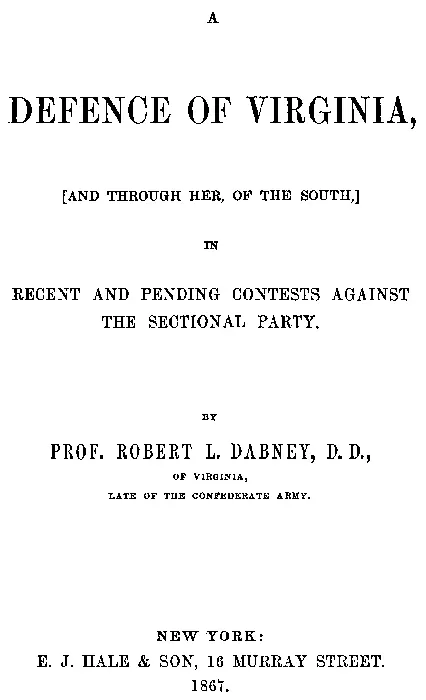
THE CLASSIC COLLECTION · 1867
"A Defence of Virginia" by Robert Lewis Dabney is a historical account written in the late 19th century. The book serves as a justification for the institution of slavery and the Southern cause during and after the American Civil War, arguing that the principles of slavery are both moral and historically valid. Dabney presents a defense of Virginia and through it, the Southern states, against what he perceives as a misrepresentation by abolitionists and their sympathizers. The opening of the text introduces the author's intent to defend Virginia, whom he views as slandered by the Northern anti-slavery sentiments that emerged during and after the Civil War. Dabney critiques the moral and social judgments placed upon Southern slavery, asserting that such judgments are rooted in a misunderstanding of history and human rights. He emphasizes that while other nations and regions continued the practice of slavery, the Southern states were unfairly targeted for disdain. Dabney sets the tone for a thorough examination of the ethical and scriptural justifications for slavery, asserting the need for a historical perspective that acknowledges Virginia's significance and the complexities surrounding the institution of slavery in America. This summary covers only the opening portion of the book.
Introduction adapted from the source catalogue; source summaries may be automatically generated.
Free to read · English · 98,110 words · No account needed
MAKE TIME FOR A GOOD BOOK
On by default. Untick to stop anonymous reading totals. Each page counts after 10 seconds in view. How this works.
Anonymous counting is on unless you have switched it off.
Now who can believe that the Apostle Paul would have spoken thus of slavery, if he had thought it an injurious and iniquitous relation, as hostile to religion, as degrading to the victim's immortal nature, and as converting him from a rational person into a chattel, a human brute? He treats the condition of bondage, in its religious aspects, precisely as he does accidents of birth, being born circumcised or uncircumcised, a citizen of the Empire or a subject foreigner, male or female. We have a practical evidence how incompatible such language is with the Abolitionist first principle, in their very different conduct. Do they ever say to the Christian slave: "Art thou called being a servant? care not for it." We trow not. They glory in teaching every slave they can to break away from his bondage, even at the cost of robbery and murder. And Mr. Albert Barnes informs his readers, that in his interviews with runaway slaves, he long ago ceased to instruct them that it was their duty to return to their masters. It is evident, therefore, that this abolitionist and St. Paul were not agreed.
§ 6. Slaveholders fully Admitted to Church-membership.
We now proceed, in the sixth place, to a fact of still greater force: that slaveholders were admitted by Christ to full communion and good standing in the Christian church. Let us first establish the fact. In Acts X. 5-17, we learn that the pious Cornelius had at least two household servants, (οικετων, one of the Septuagint words for domestic slave.) There is no hint of his liberating them; but the Apostle Peter tells his brethren, Acts xi. 15-17, that he was obliged to admit him by baptism to the church, by the act of God himself. Says he: "Forasmuch then as God gave them the like gift as he did unto us," (power of miracles,) "who believed on the Lord Jesus Christ, what was I, that I could withstand God?" So he baptized him and his servants together. Again we find the Epistle to the Ephesians addressed in the first verse, "to the saints which are at Ephesus, and to the faithful brethren in Christ Jesus," with a blessing in the second verse appropriate to none but God's children. When, therefore, in subsequent parts of the Epistle, we find any persons addressed in detail with apostolic precepts, we conclude of course that they are included in "the saints and faithful." But all expositors say these terms mean church members in good standing. If we find here any persons commanded to any duty, we know that they are church members. This thought confirms it, that St. Paul knew well that his office gave him no jurisdiction over the external world. He had himself said to the church authorities at Corinth, "What have I to do, to judge them that are without?" 1 Cor. v. 12. Now, in the sixth chapter and ninth verse of Ephesians, we find him, after commanding Christian husbands, Christian wives, Christian parents, Christian children, and Christian slaves, how to demean themselves, addressing Christian masters: "And ye, masters, do the same things unto them, forbearing threatening, knowing that your Master also is in heaven," &c. Here, therefore, must have been slaveholders in good standing in this favourite church, which was organized under St. Paul's own eye. The Epistle to the Colossians is also addressed "to the saints and faithful brethren in Christ which are at Colosse:" and in ch. iv. 1, Christian slaveholders are addressed: "Masters, give unto your servants that which is just and equal," &c. There were, therefore, slaveholders in full communion at Colosse. Again: Mr. Albert Barnes (whom we cite here for a particular reason which will appear in the sequel) says correctly, that Timothy received his first Epistle from St. Paul at Ephesus, three or four years after that church was planted, having been left in charge there. But in Ephes. vi. 2, St. Paul Writes: "And they" (i. e. these Christian slaves) "that have believing masters, let them not despise them because they are brethren, but rather do them service because they are faithful and beloved, partakers of the benefit," (i. e. of the blessings of redemption.) "These things teach and exhort." There were still slaveholders then, in this church, three or four years after its organization; and Timothy is commanded to have them treated as brethren faithful and beloved, partakers of the favour of God. The Epistle to the Ephesians, according to the same Mr. Barnes, was written from four to seven years after the founding of the church, and that to the Colossians from ten to thirteen. So that this membership of slaveholders had continued for these periods.
Your reading position is saved on this browser. Take it to another device with a library code. Reading pages adapt to text, rather than matching a printed edition.
BEHIND THE BOOK
This eBook is for the use of anyone anywhere in the United States and most other parts of the world at no cost and with almost no restrictions whatsoever. You may copy it, give it away or re-use it under the terms of the Project Gutenberg License included with this eBook or online at www.gutenberg.org. If you are not located in the United States, you will have to check the laws of the country where you are located before using this eBook. Read the source licence.
The original source file, including credits and licence, is retained by this library. Request an original-format copy at no charge. Please include the book title and Project Gutenberg identifier #47422.
KEEP YOUR CURIOSITY GOING
Cécile Tormay

Moritz Busch
John L. Ransom
Frances Wright
Cécile Tormay

Mabel Potter Daggett